Category: LDS

  • Bullsh*t Feminism

    Just for the record, I’m a big fan of bullshit.  In fact, I buy huge bags of it every spring to use in my garden.  Sure it’s stinky, but it gets the job done.

    Recently, the Feminist Hulk (a tongue-in-cheek twitterer) sent out a tweet about bullshit and it was widely “re-tweeted” (or copied, with attribution) by many users in The Exponent community.* It read:

    When I first saw this tweet I bristled a bit at the profanity.  These words carry more weight and are somewhat more offensive when in print than when heard in casual conversation.  However, that’s precisely why I liked the tweet.  I felt uncomfortable and it caught my attention.  And that discomfort made me think about how feminism is portrayed on The Exponent blog.   The look of our blog is organic and feminine: pastel colors, the leaf motif, subdued fonts.  The photos in the sidebar are artful–all of winsome smiling young women.  Not a scary old hairy feminist in the bunch.  I’d say that we sit squarely on the “softer side” of the feminist line when compared to mainstream feminist blogs like Feministing, Bust, or Pandagon.

    So when the bullshit post from above was re-tweeted on the official Exponent channel, several of the bloggers protested on the private permablogger listserv.  And when the week’s aggregate feed post went up, the bullshit tweet was removed because it was considered too vulgar for an Exponent post.

    I’m shaking my head here, as I ponder whether feminism is best served with a wink and a smile.  Our sisters who fought for the 19th amendment weren’t afraid of a little discomfort.  I’m not necessarily suggesting that profanity be used in every Exponent post–just the opposite.  When used judiciously, the discomfort that results from a smartly-used swear word can serve to illustrate an important point.  Because if the Hulk tweet had said simply “RESIST THE PRESSURE TO DOWNPLAY FEMINISM TO MAKE PEOPLE MORE COMFORTABLE.  DISCOMFORT CAN BE PRODUCTIVE,” I seriously doubt it would have had even half the intended impact. Discomfort can be productive.  But when we carefully sanitize our writing so we don’t push boundaries or let things get a bit ugly, are we missing out?

    In fact, not one reader even mentioned the Hulk tweet or the profanity in the twitter blogpost.  If someone had been offended, I’m sure they would have let us know–the fact that the profanity passed unnoticed by our readers makes me wonder if there was even any cause for concern in the first place. 

    When I use steer manure in my garden I have to be cautious to ensure that it’s been properly aged or it can burn young seedling plants.  Similarly I can see why profanity needs to be used with caution, because of the possibility of “burning” those blogreaders who are only just barely acquainted with feminism or who might be turned-off by a bit of bullshit.  But at the same time I can’t help but wonder if the discomfort is really our own, and not that of our imagined audience–and if it is, then what are we really afraid of?

    *Note: For new readers of my blog: I’m a founding member of The Exponent blog, which focuses on Mormon feminism and other topics that are relevant to progressive LDS women.

  • What Has to be Done, redux

    Many of you might remember my blogpost from two years ago, “What Has to Be Done.”  That post, and the talk I gave alongside famous blogger Heather Armstrong (of dooce.com) brought over 30,000 new readers to my blog.  What a hard time that was.  As I suffered through the pain of my surgery and the side-effects of the intensive antibiotic therapy, I wondered whether my plans to finish my PhD were evaporating.  I questioned whether my mobility might be forever impacted by the surgery and the persistence of the infection.  I marveled at the support of my family and my community even as I worried about John’s ability to hold together our lives while my health was so fragile.

    About a year ago, I faced another moment of “what had to be done” when local LDS leaders chose to summon my spouse to an ecclesiastical court.  I attended that event to testify on his behalf, and also to observe the events closely.  It was a time when my own relationship with the church was tenuous, and seeing how this event proceeded was a significant step in my realization that I could no longer be an active adherent of the Mormon faith.  Lately many of those feelings have been bubbling up again–I drive past the temple and the local LDS meetinghouse almost daily, which serves as a constant reminder of the church’s impact on my life.  Even now I remain cosmically disappointed in the Mormon church and its leaders (on all levels–local, regional, and global), despite supporting my friends who are members.   I feel a rather irrational amount of anger at the group of men who conducted John’s church court proceedings, especially because they were people in whom I’d once placed a great deal of trust.  Distancing myself from the church wasn’t because I was “offended” by these leaders, it was that I could no longer put my faith in an institution where leaders could wield so much power (such as the power to sever my sealing to my spouse) so irresponsibly.  Choosing to walk away from my LDS community was hugely difficult for me, given all that I had invested in the church through the years.

    On July 25th this year (in sharp contrast to July 25th two years ago when I was being re-admitted to the hospital for my leg infection), I was in Fairfax, Virginia meeting with a group of twelve digital humanists to embark on a radical tool-building experiment.  My colleague Effie, described our process on her blog today as “doing what needs to be done” (see the last paragraph).  I loved that she said that, because I hadn’t thought of our fast-paced development process in that way until now.  That phrase helped me to see the connective threads in my life from a point two years ago when I was purely in ‘survival’ mode, to the point that I’m at now with an abundance of opportunities ahead.  I feel as though the lessons I’ve learned since then continue to serve me in my scholarly and creative work, as well as in my spiritual life.  For now, “what needs to be done” is to focus on my dissertation while juggling an exciting array of side projects and the needs of my family (as well as squeezing in plenty of time out paddling on the ocean and time for quiet contemplation–sometimes simultaneously).  I feel so fortunate to have the health and confidence to move forward with my dreams.  These past two years have taught me much.

  • embodied


    self-po, originally uploaded by pilgrimgirl.
    In one of the more important Mormon temple rituals, your body is washed with water and anointed with oil. This washing and anointing is mostly symbolic–water and oil are only touched to a few points on your skin as sacred words are repeated by the officiants. However, what is most memorable about this ritual, is that the interaction happens after you remove all of your clothing.* The only item allowed to be worn is a wedding ring. For modesty’s sake, your body is draped in a white sheet throughout the washing and anointing process.

    When I received this ritual, it didn’t occur to me to remove my artificial limb. Most likely that was due to the fact that I wouldn’t have been ambulatory without it, and also because I was not sure exactly what the “rules” were about such things and no one clarified them for me (for the most part, these rituals are not explained beforehand, due to their sacred nature). Since then I’ve learned that women with breast prosthetics can choose to wear them during the ritual. I’ve never heard any definitive word on the wearing of artificial limbs, but I suspect that it is allowable.

    Because of the staging of this ritual, it was not evident to the recipients that I was wearing an artificial leg until it was nearly completed, when the officiant bent down in front of me to bless my legs (while I was seated on a throne-chair). After undergoing the washing and anointing a few times, I learned to catch the gaze of the officiant as she reached out to touch my not-real leg. There was often a pause. Usually a knowing glance was exchanged between us as she continued on with the script of the ritual (were she to speak words other than those prescribed, the ritual would be deemed ineffective and would have to be repeated according the prescribed pattern).

    In the moments after the ritual, as we waited for me to be escorted by an officiant to the next step in the process, there was often a moment for some whispered conversation. Usually the officiant would mention something about my leg, asking how did I lose it, or commenting that my prosthesis looked very lifelike (which was back in the day before I chose to let my robotic innards hang out).

    Those ritual moments, are, for me, emblematic of how I view my relationship to my prosthetic leg. It seems as much a part of me as my tongue, or my eyes, or my liver. That I take it off at night and lay it next to my bed, doesn’t make it any less “me.” That it is a thing of metal and plastic and vinyl, doesn’t make it any less familiar than my other leg and foot. That it sometimes makes an audible whirring adjustment sound when I walk through quiet spaces, is no different than the familiar creaks of my organic joints. That its parts are fabricated from components that come from all over the globe, and are assembled by workers in Germany and are fitted to my body by men in Orange County, doesn’t make it any less me. Perhaps what makes it feel the most ‘foreign’ is the attention that my leg garners as I move through public space. It is the reaction of others that reminds me that I am different.

    I suppose that being a cyborg comes “naturally” to me. I couldn’t live my life normally without the microprocessor in my knee, or the metal crutches that I use when I’m not wearing my prosthetic. These tools are so much a part of my life that they are my life. They are familiar in the same way that my hands are on my keyboard. I don’t think each time I type that I am sending letters from my fingertips to the screen and out to you. I just do it. Like that, I just walk. And stand. And move. The way that I do.

    *Note: recently there were some changes to this ritual that include less physical interaction between officiant and recipient, and also how much clothing is removed beforehand. I am discussing how it worked back in 1992, when I first participated.

  • yet another reason that I haven’t been blogging much lately

    I just launched a re-design of The Exponent blog, which included moving the site off of wordpress.com and onto a hosted server.   The blog is actually still just a wee bit buggy, but be patient with me–I’m learning a lot, making mistakes, and figuring things out as I go along.  :)

    As I wrote a few days ago, I’m continuing to enjoy my association with the fine Mormon-feminist women that I know from The Exponent & ExponentII.  I feel so fortunate to count them each as friends and sisters.

  • Why?

    Yesterday I attended a few sessions of the Sunstone West conference at Claremont Graduate University, an event that examines Mormon culture and thought.  Several people asked me why I attended the event, or why I continue to be involved in Mormon circles given that I’m not a practicing member of the LDS church.

    Those are good (hard) questions, ones that I’ve often asked myself these past few years.  I don’t know if I have any good answers.  But I continue to feel that these folks are my ‘tribe.’  These are not your everyday Mormons, these are women and men who’ve walked much of the same path that I have.  Our shared history and experience allows me a freedom that I don’t have in other spaces.  My Quaker Friends, as dear as they are, can’t fully sympathize with my struggles.  Nor can most of my local ward members.  Having a continued tie to the Sunstone and Exponent community is somewhat akin to having a shared history with extended family members.  There is so much joy in the reunion, even if it is a rare occurrence.

    It may be that at some point I will cease being involved in Mormon organizations altogether.  But for now, for me, it feels right to continue.  Much joy comes from being with this group, and that joy is what keeps me returning.  I need those hugs and hi-fives from my fellow travelers.  I especially relish the strength and support of my Exponent sisters–each of you give me the courage to continue on my journey. 

  • Dear LDS missionaries

    clementine oranges

    This letter is prompted by two recent visits from LDS missionaries. One was two nights ago, when I was knocked out on drugs and could barely register what was happening in the living room. Apparently the elders came by “just to visit” people on the ward list. John politely explained that he’s not a member of the church and said that our family has officially requested “no contact” with the church. He asked the elders to pass that information on to the powers-that-be in the ward, given that our earlier request was not honored. The letter below is from the previous of the two visits…

    Dear LDS missionaries who helped me carry my groceries in the rain:

    First of all, it was very nice of you to help me–particularly with that box of clementine oranges that I was grasping awkwardly with two fingers while having 3 or 4 bag handles draped over each arm. It was obvious I was about to lose some oranges, so the help was very considerate.

    I liked how genuinely surprised you seemed when I greeted you each as “Elder” and asked where you came from. That you were both from rural Utah didn’t surprise me very much–you both looked pretty intimidated by the heathen graduate students milling around our neighborhood. When you found out that I was nearly done with my PhD, one of you asked for suggestions for a good college major. My reply that a degree in engineering might be a good way to support a family was sincere–I worry about young LDS couples and their ability to survive in today’s economy. That you both looked at each other and admitted that neither of you can do math reminded me just how very young you missionaries are, and I realized how hard it must have been for your mothers to let you go for two years.

    It probably seemed like the reason that I didn’t invite you in after you helped with the groceries was because I was busy. But it really was because I didn’t want the conversation: the one where I would explain about apostasy, about not going to church for awhile. And about institutions and inequity and history. About needing a new place to call home. About wounds. About the kinds of life experiences that couldn’t be articulated to two nineteen year-old boys who don’t even know what to study in school.

    I wanted your memory of the afternoon to be one of rescuing a fellow Saint who was about to lose her oranges. Not of a lost soul for you to pity.

    And when I prayed, as you walked away in the rain, that you would avoid the doors of my neighbors who have been the most hurt by the Church’s influence…that was one of my most sincere prayers in quite some time.

    Love,
    Jana

  • stepping stones…


    Cape Cod, originally uploaded by pilgrimgirl.

    About a year ago I applied for membership in my local Quaker Meeting. Joining a Quaker Meeting is not like joining a religion like Mormonism–there’s not a proscribed set of rituals involved in the process and it’s largely a local matter.

    My reasons for joining were numerous, but they boiled down to something very simple…it just felt right. Every time I considered the choice, I felt full of joy and light. I tried to talk myself out of it several times. There was no compelling reason for me to join–there was no barrier to my participating fully in the community as an ‘attender’ rather than as a member. But I also wanted to be true to the leading that I’d felt to join, especially when doing so produced such a strong feeling of satisfaction.

    To join I wrote a simple letter to the clerk of our Meeting, explaining to her why I felt compelled to seek membership. Some important points in that letter included my desire to take on the identity of a Quaker, my family’s support in my doing so, and my acknowledgement that this choice might not sit well with my Mormon leaders. I expressed a desire to maintain a dual religious identity, knowing that both traditions are deeply important to me. Then the clerk, along with the Ministry & Oversight Committee, put together a group of women to serve on my membership committee. I met with them and discussed my feelings about seeking membership. It was a delightful experience and I felt such deep peace with this decision.

    As a public acknowledgment of my decision, the Orange County Friends held a ‘Welcoming Meeting’ for me yesterday, which was an outdoor inter-generational potluck of Friends & friends. The Meeting presented me with a copy of Mothers of Feminism: The Story of Quaker Women in America, which I can’t wait to read (and what a great match for my interest in American feminism!)! Frankly, I was rather embarrassed to be the center of attention at this event, but also felt such happiness at celebrating this occasion with so many people that cared for me and my spiritual journey.

    Officially becoming a Quaker changes very little about who I am, but it is one more important stepping stone on the path of my pilgrim-life. More than I can express with words, I appreciate all of you who are supporting me–either virtually or in “real-life”–as I make my way on this journey.

    John took some great pics of my party.

  • This post, brought to you by the letter "A" (or, John & I go to LDS court)

    My husband was excommunicated from the LDS church last Wednesday night by a council of 12 men led by the three members of our Stake Presidency. Other relevant officials, such as our bishop, were also involved in the proceedings.

    I will run through a brief summary of the events and then offer some of my observations about them. Note: to protect the privacy of the people involved, I’m going to discuss some of the actions more generally.

    1) We arrived at the appointed time and were asked to wait in a small foyer while the men convened. There was a bit of small talk. I knew most of the men involved with this event and greeted them by first name (I knew more of them than John because of my previous stake-level callings).

    2) We were ushered into an office to meet with the man who was officiating at the event. He stressed to us that the event was sacred and should not be discussed, adding that it would not proceed if we insisted on recording any part of it. We affirmed that we would not record it and then he explained to us how the evening would proceed. John was charged with being in apostasy, which our church leaders defined using the CHI definition: “to repeatedly act in clear, open, and deliberate public opposition to the Church or its leaders.” We were told that if John didn’t deny those charges, the procedure would be over rather quickly. John then requested that whether he accepted or denied the charges, he wanted me to have the opportunity to testify on his behalf. The leader agreed to this.

    3) We were led to a side room to meet briefly with our bishop. We exchanged pleasantries, having only met him once before.

    4) John was ushered into the Council room. He can speak best on what happened at that point. He did not deny the charges. This portion of the evening was the only time that I was left alone.

    5) I was then led into the Council room. To draw a picture for those who have never seen one before: it is a long, rectangular room with a gigantic T-shaped table in the middle. At the head of the “T” sat the Stake Presidency. The room’s long walls were lined with about ten men sitting on each side. At the far end of the table from the SP there were two folding chairs. That is where we were directed to sit. When I entered the room everyone was standing. Every man in the room except for John was wearing a dark suit, a white or pastel-colored shirt, and tie. Most of the men were 50+ years of age. There were numerous familiar faces. I will admit that the scene was daunting. I think I even visibly startled for a moment at the sea of suits.

    6) After a bit of small talk, I was then asked to offer my opinion on whether John was in apostasy, and was read the above definition. I sat in silence for a few moments, realizing that I could not answer that question.

    7) I then explained that I could not answer the question posed to me because I felt that the question was worded far too vaguely for me to answer definitively. I noted that words like “public” and “deliberate” were terms that were open to a variety of interpretations. I then stated that my purpose in testifying was to speak about John’s intentions and his character, and to offer my observations that his writings online were in line with his ongoing search for truth, and that I saw no inconsistency between his recent behavior and his decision 20 years ago to be baptized into the church even knowing that doing so was against his family’s will. I emphasized that John intended no malice with his writings, that his intentions were to speak truth rather than to destroy faith. And so forth. I believe I spoke for about 5 minutes.

    8) I was then asked if I loved John. And he was asked if he loved me. We were led into a small room to meet with our bishop. At this point, I believe the council members were praying to know the Lord’s will about the court verdict.

    9) My favorite part of the evening was my chat with the Bishop. I suspect that I might have freaked him out a bit with my non-stop description of our family’s faith journey. In any case, I got some things off my chest & found a listening ear.

    10) John was invited back to the Council room. He can fill in what happened there.

    11) John retrieved me from the small room where I was waiting and the various men milling around in the hall made it clear that the meeting was adjourned. I followed John out the door into the night air, the bishop walking alongside. But no one had yet told me the verdict, and there was some awkwardness to the final exchanges between us and the Councilmen. As we neared the car I turned to John & Bishop and asked. They had supposed that I knew John was ex’d. It was a strange end to an odd night. I had thought that there would be a final meeting with a church official to explain the consequences of the ex’ing, specifically how it would affect my temple ordinances, and I felt a bit lost by not having had that. As we drove away John said that the consequences of the ex’ing were never explained to him, either, and that the verdict was given that he was in apostasy and something about excommunication was mumbled afterwards. (I should note that the room where the council was held was gigantic and the man conducting the meeting is so soft-spoken that it was nearly impossible to hear anything he was saying from where we sat.)

    Here are some of my initial thoughts about this experience:

    –We were told at the beginning of the proceedings that there was little doubt that John would be found in apostasy due to the clarity of his web writings. I found this declaration off-putting given that John’s request to know specifically which of his writings were ‘apostate’ was not considered relevant. The only detail that was offered was a confirmation that he was not being called to court for his stand on Prop. 8.

    –Holding a court for ‘apostasy’ is confusing to me, perhaps because the reasoning behind such activities is never explained. If I had not heard of the September Six, I doubt I would have even known that there was such a thing as a court for apostasy–this is not mainstream Mormon stuff. There is never a point in LDS ritual where members make a covenant to not criticize their leaders or the church (note: there is a moment in the temple where one promises to avoid all lightmindedness, loud laughter, evil speaking of the Lord’s anointed, the taking of the name of God in vain, and every other unholy and impure practice. I had always assumed the “evil speaking” bit to mean saying lewd or rude things about church leaders, not critique of church policies–and the meaning of these archaic phrases is never explained in the temple. Also, given that I’ve never heard of anyone being ex’d for swearing or laughing, it seems a highly selective and arbitrary criteria for cutting someone off from the church). Yes, there are prophetic warnings about avoiding personal apostasy, but I know of nowhere that members are given the handbook definition of apostasy as a behavioral guideline. We did not even know how this term was defined until we asked for clarification prior to the court. I would add that even with the definition given to us I had no idea how it applied to the fuzzy space of internet writing.

    –The actual physical dynamic of this event was very strange. We were constantly being ushered in and out of the various rooms. At one point I requested to sit in the foyer outside the council room rather than having to walk back to the holding room down the hall. My request was denied, which seemed very strange. I suppose there is a very rigid protocol that’s being followed, but the rules weren’t all explained to us and it just felt weird to be led back and forth and all around every few minutes. As I’ve reflected on why we were carefully corralled and escorted during these proceedings I wondered if there was a concern that we would initiate a protest or invite protesters to ‘storm the building.’ I have no idea, but it was very strange, indeed.

    –John has said that he’s satisfied with all that happened. He went expecting to lose his membership and he encountered no surprises there. I couldn’t help but find it oddly harsh to have the council only interested in the answer to a single question as a litmus test for a 20-year investment in the church. They didn’t care about John’s intent, about any of his devotional practices, about his adherence to the commandments, etc. They didn’t ask about any unorthodoxies in the realm of sexual behavior or Word of Wisdom (note: typically excommunication in the LDS church happens because of sexual indiscretion). It hurts to know that the church had felt it appropriate and necessary to excommunicate John, when someone like my high school boyfriend who was baptized & active for all of one month is still considered a member in good standing.

    –I got the feeling from some of our interactions with church leaders that they expected us to be belligerent or to make a scene at this occasion. Though these were all subtle impressions, it reinforced my sense that all ‘apostates’ are painted with the same broad brush. John and I have repeatedly affirmed that we would not disrupt meetings or violate the sanctity of church spaces–doing so would be inconsistent with our values. However, overall, it may be that the stigma of the letter “A” will now speak more loudly than anything else John says or does from now on within the Mormon community.

    –I don’t yet know how this excommunication will affect me or our children. From what I gather, the sealing ordinance that occurred when we married in the Los Angeles Temple is now dissolved (this is the ordinance that binds me and John and our children together in the hereafter). Most Mormons are asked on an annual (or biannual) basis whether they affiliate with or are sympathetic to apostates (or apostate groups). This is part of the list of questions that they must answer to qualify for a temple recommend. Because of this question, I suspect that many active LDS will be wary of being friendly with me or John. When I was more embedded in the church myself, I remember feeling some concern about developing close friendships with excommunicants–I was concerned that doing so was a step forward onto the slippery slope of my own apostasy.

    –In this write-up of the events, I’ve attempted to be fairly objective in my understanding of what happened that night. For those who might not know me (or my blog), I want to make it clear that I do not support the holding of LDS church courts for apostasy. Such events reinforce a hierarchical/patriarchal approach to spirituality that is repulsive to me. While I respect many of the men who participated in this event, I do not respect the reasoning behind it. In my mind, it is an act of violence to cut someone off from the body of the church, essentially ‘damning’ them from affiliation with church members and from the celestial kingdom (or Mormon heaven) in the afterlife. I see nothing of God or of the divine in such actions.


  • This post, brought to you by the letter “A” (or, John & I go to LDS court)

    My husband was excommunicated from the LDS church last Wednesday night by a council of 12 men led by the three members of our Stake Presidency. Other relevant officials, such as our bishop, were also involved in the proceedings.

    I will run through a brief summary of the events and then offer some of my observations about them. Note: to protect the privacy of the people involved, I’m going to discuss some of the actions more generally.

    1) We arrived at the appointed time and were asked to wait in a small foyer while the men convened. There was a bit of small talk. I knew most of the men involved with this event and greeted them by first name (I knew more of them than John because of my previous stake-level callings).

    2) We were ushered into an office to meet with the man who was officiating at the event. He stressed to us that the event was sacred and should not be discussed, adding that it would not proceed if we insisted on recording any part of it. We affirmed that we would not record it and then he explained to us how the evening would proceed. John was charged with being in apostasy, which our church leaders defined using the CHI definition: “to repeatedly act in clear, open, and deliberate public opposition to the Church or its leaders.” We were told that if John didn’t deny those charges, the procedure would be over rather quickly. John then requested that whether he accepted or denied the charges, he wanted me to have the opportunity to testify on his behalf. The leader agreed to this.

    3) We were led to a side room to meet briefly with our bishop. We exchanged pleasantries, having only met him once before.

    4) John was ushered into the Council room. He can speak best on what happened at that point. He did not deny the charges. This portion of the evening was the only time that I was left alone.

    5) I was then led into the Council room. To draw a picture for those who have never seen one before: it is a long, rectangular room with a gigantic T-shaped table in the middle. At the head of the “T” sat the Stake Presidency. The room’s long walls were lined with about ten men sitting on each side. At the far end of the table from the SP there were two folding chairs. That is where we were directed to sit. When I entered the room everyone was standing. Every man in the room except for John was wearing a dark suit, a white or pastel-colored shirt, and tie. Most of the men were 50+ years of age. There were numerous familiar faces. I will admit that the scene was daunting. I think I even visibly startled for a moment at the sea of suits.

    6) After a bit of small talk, I was then asked to offer my opinion on whether John was in apostasy, and was read the above definition. I sat in silence for a few moments, realizing that I could not answer that question.

    7) I then explained that I could not answer the question posed to me because I felt that the question was worded far too vaguely for me to answer definitively. I noted that words like “public” and “deliberate” were terms that were open to a variety of interpretations. I then stated that my purpose in testifying was to speak about John’s intentions and his character, and to offer my observations that his writings online were in line with his ongoing search for truth, and that I saw no inconsistency between his recent behavior and his decision 20 years ago to be baptized into the church even knowing that doing so was against his family’s will. I emphasized that John intended no malice with his writings, that his intentions were to speak truth rather than to destroy faith. And so forth. I believe I spoke for about 5 minutes.

    8) I was then asked if I loved John. And he was asked if he loved me. We were led into a small room to meet with our bishop. At this point, I believe the council members were praying to know the Lord’s will about the court verdict.

    9) My favorite part of the evening was my chat with the Bishop. I suspect that I might have freaked him out a bit with my non-stop description of our family’s faith journey. In any case, I got some things off my chest & found a listening ear.

    10) John was invited back to the Council room. He can fill in what happened there.

    11) John retrieved me from the small room where I was waiting and the various men milling around in the hall made it clear that the meeting was adjourned. I followed John out the door into the night air, the bishop walking alongside. But no one had yet told me the verdict, and there was some awkwardness to the final exchanges between us and the Councilmen. As we neared the car I turned to John & Bishop and asked. They had supposed that I knew John was ex’d. It was a strange end to an odd night. I had thought that there would be a final meeting with a church official to explain the consequences of the ex’ing, specifically how it would affect my temple ordinances, and I felt a bit lost by not having had that. As we drove away John said that the consequences of the ex’ing were never explained to him, either, and that the verdict was given that he was in apostasy and something about excommunication was mumbled afterwards. (I should note that the room where the council was held was gigantic and the man conducting the meeting is so soft-spoken that it was nearly impossible to hear anything he was saying from where we sat.)

    Here are some of my initial thoughts about this experience:

    –We were told at the beginning of the proceedings that there was little doubt that John would be found in apostasy due to the clarity of his web writings. I found this declaration off-putting given that John’s request to know specifically which of his writings were ‘apostate’ was not considered relevant. The only detail that was offered was a confirmation that he was not being called to court for his stand on Prop. 8.

    –Holding a court for ‘apostasy’ is confusing to me, perhaps because the reasoning behind such activities is never explained. If I had not heard of the September Six, I doubt I would have even known that there was such a thing as a court for apostasy–this is not mainstream Mormon stuff. There is never a point in LDS ritual where members make a covenant to not criticize their leaders or the church (note: there is a moment in the temple where one promises to avoid all lightmindedness, loud laughter, evil speaking of the Lord’s anointed, the taking of the name of God in vain, and every other unholy and impure practice. I had always assumed the “evil speaking” bit to mean saying lewd or rude things about church leaders, not critique of church policies–and the meaning of these archaic phrases is never explained in the temple. Also, given that I’ve never heard of anyone being ex’d for swearing or laughing, it seems a highly selective and arbitrary criteria for cutting someone off from the church). Yes, there are prophetic warnings about avoiding personal apostasy, but I know of nowhere that members are given the handbook definition of apostasy as a behavioral guideline. We did not even know how this term was defined until we asked for clarification prior to the court. I would add that even with the definition given to us I had no idea how it applied to the fuzzy space of internet writing.

    –The actual physical dynamic of this event was very strange. We were constantly being ushered in and out of the various rooms. At one point I requested to sit in the foyer outside the council room rather than having to walk back to the holding room down the hall. My request was denied, which seemed very strange. I suppose there is a very rigid protocol that’s being followed, but the rules weren’t all explained to us and it just felt weird to be led back and forth and all around every few minutes. As I’ve reflected on why we were carefully corralled and escorted during these proceedings I wondered if there was a concern that we would initiate a protest or invite protesters to ‘storm the building.’ I have no idea, but it was very strange, indeed.

    –John has said that he’s satisfied with all that happened. He went expecting to lose his membership and he encountered no surprises there. I couldn’t help but find it oddly harsh to have the council only interested in the answer to a single question as a litmus test for a 20-year investment in the church. They didn’t care about John’s intent, about any of his devotional practices, about his adherence to the commandments, etc. They didn’t ask about any unorthodoxies in the realm of sexual behavior or Word of Wisdom (note: typically excommunication in the LDS church happens because of sexual indiscretion). It hurts to know that the church had felt it appropriate and necessary to excommunicate John, when someone like my high school boyfriend who was baptized & active for all of one month is still considered a member in good standing.

    –I got the feeling from some of our interactions with church leaders that they expected us to be belligerent or to make a scene at this occasion. Though these were all subtle impressions, it reinforced my sense that all ‘apostates’ are painted with the same broad brush. John and I have repeatedly affirmed that we would not disrupt meetings or violate the sanctity of church spaces–doing so would be inconsistent with our values. However, overall, it may be that the stigma of the letter “A” will now speak more loudly than anything else John says or does from now on within the Mormon community.

    –I don’t yet know how this excommunication will affect me or our children. From what I gather, the sealing ordinance that occurred when we married in the Los Angeles Temple is now dissolved (this is the ordinance that binds me and John and our children together in the hereafter). Most Mormons are asked on an annual (or biannual) basis whether they affiliate with or are sympathetic to apostates (or apostate groups). This is part of the list of questions that they must answer to qualify for a temple recommend. Because of this question, I suspect that many active LDS will be wary of being friendly with me or John. When I was more embedded in the church myself, I remember feeling some concern about developing close friendships with excommunicants–I was concerned that doing so was a step forward onto the slippery slope of my own apostasy.

    –In this write-up of the events, I’ve attempted to be fairly objective in my understanding of what happened that night. For those who might not know me (or my blog), I want to make it clear that I do not support the holding of LDS church courts for apostasy. Such events reinforce a hierarchical/patriarchal approach to spirituality that is repulsive to me. While I respect many of the men who participated in this event, I do not respect the reasoning behind it. In my mind, it is an act of violence to cut someone off from the body of the church, essentially ‘damning’ them from affiliation with church members and from the celestial kingdom (or Mormon heaven) in the afterlife. I see nothing of God or of the divine in such actions.

  • if there be…


    bright, originally uploaded by pilgrimgirl.

    Question with boldness even the existence of a God; because, if there be one, he must more approve of the homage of reason, than that of blind-folded fear.
    ~Thomas Jefferson

    I’m not going into this event with any fear about eternal consequences. I don’t feel any fear about divine reprisal. And I certainly don’t fear the disapproval of 15 aged men.

    My fear is simply that I will find it difficult to speak my truth. I’ve been socialized to bow to authority, especially when that authority is cloaked in the trappings of the LDS priesthood. Every time I sat on the opposite side of the desk from one of these leaders in an interview, I ‘performed’ appropriately. I have not, as of yet, been face-to-face with an LDS church leader and discussed how I really view the world and my place in it.

    I suspect that my opportunities to speak in tonite’s events will be limited. After all, it’s John’s court and not mine. But when I do speak, I am hoping to do so from my soul and from my heart. I will be afraid, but if I’ve learned anything this past few years, it’s that fear is normal at times of stress and change. And I will not let fear stop me from living my life authentically.

    I find that the ocean has taught me much about facing fear–everytime our canoe dives into the belly of a wave I feel it. It’s exhilarating to live through uncertainty and to come out the other side even stronger for it.

    “I gain strength, courage, and confidence by every experience in which I must stop and look fear in the face…I say to myself, I’ve lived through this and can take the next thing that comes along…We must do things we think we cannot do.”
    ~Eleanor Roosevelt

    Some other posts about facing fear:
    –Casting Faith
    –When I was Found Naked
    –After dark
    –Inside-Out
    –What has to be Done

  • my thoughts on open-ness


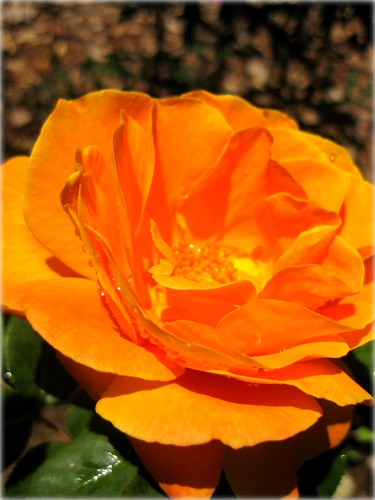
    orange rose, originally uploaded by pilgrimgirl.

    This morning I found several new bright yellow roses had opened in my garden. It was my intention to share them with you via a few pictures, but when I turned on my camera I learned that my battery pack was dead. Oops! So here’s a photo of an orange rose from a few weeks ago for you to enjoy.

    Today I’m thinking about open-ness. It’s a topic that I’ve discussed fairly often on my blog. For example, one of my primary aims in blogging was to discuss my disability in an open and honest way. There’s a strong taboo in our culture about addressing physical differences, and it seemed that a blog was a great way to initiate the discourse.

    Of course there are risks to being open. When I talk about my experience as an amputee, I’m vulnerable to cyber-stalking by folks who have acrotomophilia (a sexual fetish for amputee women). So at some point I had to decide that the benefits of blogging about my disability outweigh the risks of attracting the wrong crowd of visitors to my blog.

    Similarly, my discussions about my spiritual journey have often touched on the taboo. I’ve been open about my frustrations with the LDS church and my experiences as a marginal member. My attraction to Quakerism has also been an significant thread in this journey and it’s been important for me to share that with you, even though my Mormon readers might find it disconcerting. I know that some of my extended family members follow my blog and are saddened to hear that I’m not currently active in the LDS church. But the reality of that is that many of our family members have left activity–it’s not just me. And I appreciate open dialogue with family members from both extremes of the faith spectrum. I love hearing about how your spiritual experiences have impacted your life choices. Truly. Now I am not going to tell anyone how to live their lives, but I would encourage those who have something to say to me about the church or any other aspect of my life to feel free to initiate that dialog. I will listen to and respect your thoughts, even if my beliefs are different than yours.

    In this process of navigating my journey it’s been my aim to be as sincere and honest as possible. I learned long ago that speaking my truth makes me vulnerable to hurt*, but it also helps me to live authentically. I am not one person in a church setting and another person at home. I am not different online than I am in person. I am not ashamed of anything I believe nor of any of my actions.

    *and yes, it does pain me sometimes when anonymous folks leave rude comments. I am not made of steel (although approximately 1/4 of my body is a carbon-fiber composite that’s pretty rugged stuff).

  • precedent?

    From what I can gather, John’s impending church council for apostasy would be either the first or second incidence of a church member receiving discipline for blogging. Right now I am pondering the possible significance of this. For those of you who are LDS, does it concern you that this could set a precedent for future ecclesiastical discipline against blogging? If so, how do you think this might affect online conversations, which up to now have been uncensored by church authorities?