Category: outrigger

  • Hard Things

    Hard Things

    Two years ago, after my canoe trek in the wilds of British Columbia, I realized something about myself that has become something of a mantra to me in the meantime:

    I like to do hard things

    And this is what I was repeating in my mind last night as I sat alone at home listening to porting rain and thunder and wondering if it was worth keeping the commitment I’d made to race in my one-person canoe this morning. Because, for all the many hours that I’ve spent out on the water on my canoe, I’ve never actually raced on it. And so I when I registered for the “Off Da Couch” race a few weeks ago, I was actually on half-sure that I would follow through. Not only is racing hard work, but it’s so different than setting out for a solo Lido loop where I can go at my own pace and avoid everyone else.  Racing puts you into a pack of boats and you need to be aggressive (i.e. hold your line even when others are around you) rather than go the long way around anyone else. I’m not particularly good at being aggressive and I loathe when others cut in front of me and put me at risk of capsizing. And of course deep down I was wondering if I had the courage to deal with the fact that I could possibly be DFL if I were to race…

    But I did it.

    I wasn’t last place and I did cut someone else off around a turn but it wasn’t intentional (I apologized even as he cursed me). I came in 3rd in my division (Masters) and smack-dab in the middle of the pack of racers. Perhaps my brightest moment during the race was in the last third where everyone else was obviously tired out, but I got my second wind.  I was right between two other women on canoes and I realized that being the middle I was going to get sandwiched and I considered putting my paddle into the water to stop my boat from being squeezed and let them go ahead.  But instead I turned on my power, paddled super-hard for about 45 seconds and zoomed between and past both of them. That felt pretty good.

    But besides the logistics of the race itself, there’s one more part of this story I need to tell.  Eight years ago I bought my one-man canoe with a little bit of money that I inherited from my grandmother.  The canoe was used, but sturdy and lightweight, and I knew when I saw her that she was just perfect for me. However, it was an OC-1 canoe, which was steered with foot pedals. I knew I couldn’t steer it with the pegleg I wear on my right side in the water, so I brought my boat to Sam Couch who had a repair shop at the Newport Aquatic Center (NAC), and asked him for some help in modifying it to meet my needs.  We talked through a few strategies for re-routing the steering and he made a few other fixes (including a rudder upgrade) to the boat so it would suit me well. In the years since it’s been perfect for me and all my miles of solo paddling, and of course I’ve never forgotten Sam’s helpfulness and creativity in making my boat work just right for me. So it was a privilege to paddle in today’s race, which was named in his honor for all of his contributions to the NAC and the outrigger community over the years. Paddling has been my primary physical outlet through so many hard times and I am so very fortunate to have a vibrant community (NAC, ImuaOCC, OffshoreOCC, SCORA, etc) to support me.*

    *hats off to my Offshore teammates Mark and Bob who helped with transporting my boat to the race, too!


  • Getting healthy, one day at a time

    Getting healthy, one day at a time

    A few years ago I realized that being healthy and strong was critical to my overall well-being.  In fact I began to see that when I was healthy, everything else in my life flowed better.  As a result, each time I sit down to set goals, healthiness is at the top of my list: to walk as well as I can, to do strength training, and to maintain my joint health.

    For me being healthy is also one of my biggest challenges.  Because I’m an amputee I can’t just take up jogging five miles a day, so I find that I have to be a lot more creative in the ways that I exercise.  I also have learned that I can’t do this alone, so I have coaches and friends who keep me motivated to keep at my health routines.

    As of right now, this is my weekly exercise schedule:

    Monday:
    Early Morning, strength training with Coach Sarah
    Evening, gyrotonics with Victoria (at Beau Corps studio)

    Tuesday:
    Rest Day

    Wednesday:
    Early Morning, strength training with Sarah
    Evening, Iyengar yoga with Denise’s Intermediate Class

    Thursday:
    Rest Day

    Friday:
    Early Morning, strength training with Sarah

    Saturday:
    Early Morning, Outrigger Canoeing Team Practice

    Sunday:
    Either a 2-hour yoga workshop or a solo paddle on my canoe

    What I like about this schedule is that it is a good mix of activities that I genuinely enjoy.  And I also like that it is a mix of solo exercise and group/team exercise.  What I don’t like: is that I don’t get ample cardio exercise.  I also feel like I ought to incorporate more stretching into my regular routines, such as a deep stretching/yoga workout on Tues/Thurs mornings.  And I must confess that the first thing to go in this schedule is my Wednesday yoga class–it is so hard to keep that commitment between teaching into the evenings on Tuesday and Thursday (and also one Wednesday per month I am at our South County campus too late in the evening to get to my yoga class).

    I also just feel like overall it’s not enough.  I’m not as tone as I used to be and I definitely get creaky and injured far more easily than I did even five years ago (not to mention having put on 10 pounds that is definitely not muscle).  But I can barely keep up with this routine on top of my work and teaching, so I can’t really imagine adding more (like swimming, I really want to add swimming–but when?).

    I guess I’m curious if any of you can suggest ways that I could squeeze in a bit more exercise here and there, or if you want to share your fitness plans with me, as something I might emulate?

    (Note: photo taken 6 years ago, when my friend Crystal was doodling on my shoulders–that’s not permanent ink…)

  • as powerful and as strong…

    Last week we did a fairly strenuous canoe paddle, more than 60km, in a remote northern area of British Columbia.  The paddling wasn’t so daunting (3-4 hours per day of solid work), but it was the portages from lake to lake, the lightning storms, and the persistent pelting rain that quickly dampened my sleeping bag and all of my clothing that took their toll.

    Now that it’s over, however, so much of that difficulty is forgotten.  And instead what remains are the gorgeous images imprinted into my memory and onto the roll of film that we shot as we traveled.  Such as this one, taken on the home stretch to Bowron Lake:

    glassy waters(Note: the horizon is slightly crooked due to the boat leaning a bit to the right side that morning)

    As I was writing in my journal when the journey was completed, the first thing I put on my list of lessons learned was:

    I like to do hard things

    And it’s true.  The stretch of an ambitious endeavor makes me happy.  Doing the mundane, the repetitive, the easily achieved task…boring.  I thrive when presented with a challenge, which is why the trip to British Columbia was so much more appealing than a resort stay or some other leisure activity.

    While on this trip, these two books, Tracks and Paddling My Own Canoe accompanied me everywhere:

    two books for my travels later this month…journey narratives ftw #JSLFL #booklover

    A photo posted by @janaremy on


    I just finished reading Tracks today, which is a book about a woman who walked across the Australian desert with four camels in the 1970s.  At the close of the text, this quotation jumped out at me, as a better expression of my thoughts about hard things, than I expressed myself in my journal (emphasis my own):

    As I look back on the trip now, as I try to sort out fact from fiction, try to remember how I felt at that particular time, or during that particular incident, try to relive those memories that have been buried so deep, and distorted so ruthlessly, there is one clear fact that emerges from the quagmire.  The trip was easy.  It was no more dangerous than crossing the street, or driving to the beach, or eating peanuts.  The two important things that I did learn were that you as powerful and as strong as you allow yourself to be, and that the most difficult part of any endeavor is taking the first step, making the first decision. 

  • committed

    This is another post in the series about MyYearinIT.

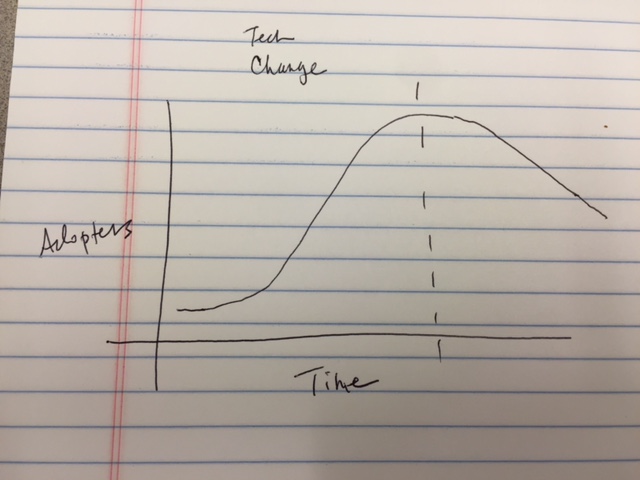
    Not too long ago I found myself in a “Strategic IT” meeting we were discussing where we each sit on the curve of change.  The discussion leader drew something a bit like this on his whiteboard and asked us each to come up and put a mark where we would be in the curve of adopting to technological changes.

    He then asked: Were we on the leading edge?  Or did we follow the crowd?

    graph of change

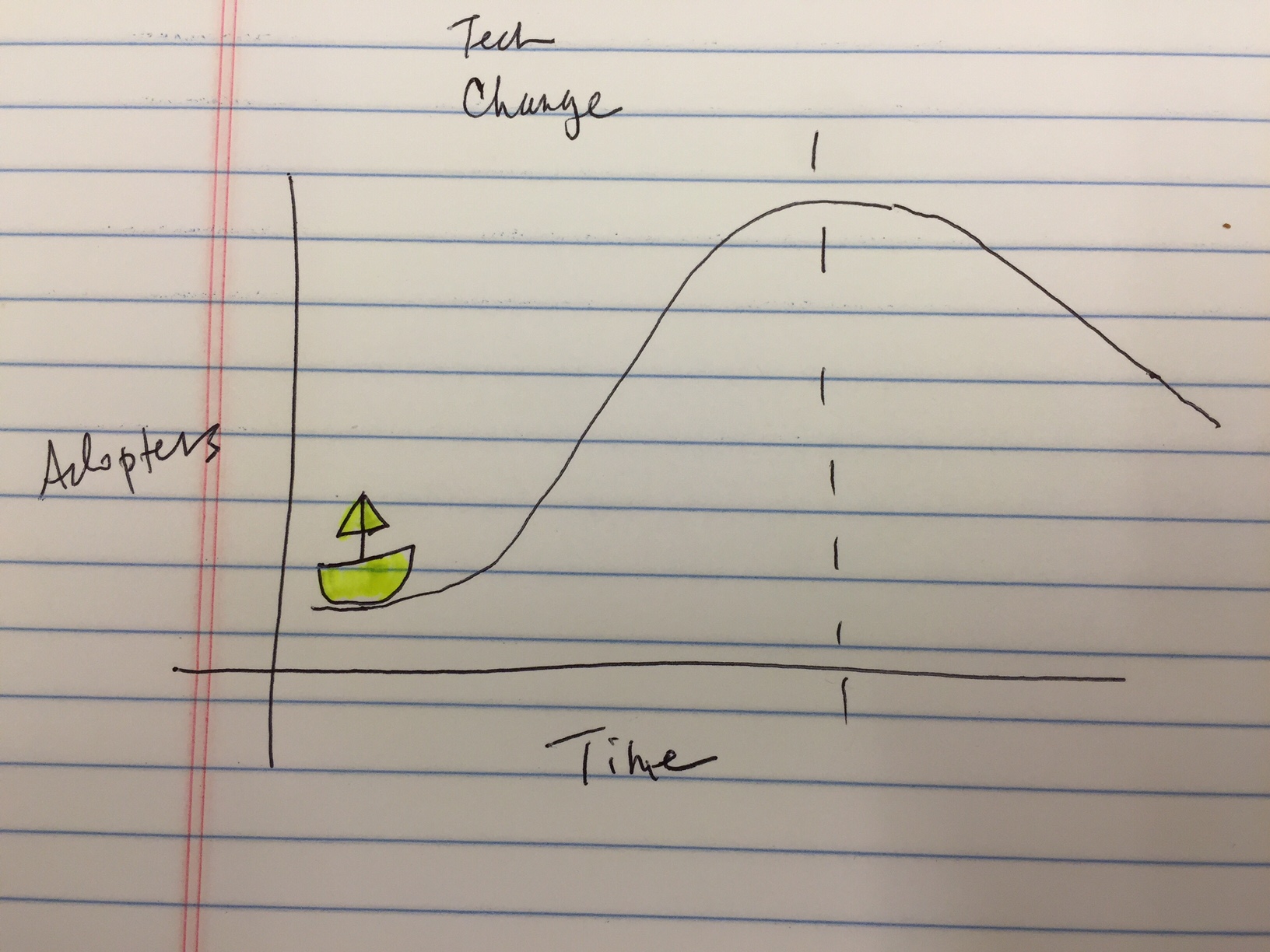
    Various colleagues got up and put a mark somewhere on the curve, most of them right around the big bump (those who tended to jump on the bandwagon with everyone else) and a few afterwards (those folks said that they usually waited to whether a technology was likely to last before they adopted it).  I was one of the last people to go up to the sign and leave my mark.

    This is where I put myself (note: I was the only person to draw a picture, but I’m dorky like that):

    my boat, in front of the wave of changeI then told the group a story that’s become a touchstone for me…

    When I first began canoeing on the ocean, it was pretty scary to be surrounded by wide open water.  The swell could be a low rolling bump that gave a gentle nudge to the boat or the entire ocean could be flat as a pancake, where you had to dig in your paddle to do all the work.  But of course there was also the possibility of really big swell.  And the first time I encountered that, it was unforgettable. (more…)

  • off-season

    Some of the off-season crew on a Saturday morning paddle.
    Steering some of the off-season crew on a Saturday morning paddle.

    Winter is “off-season” for outrigger canoeing, so my team doesn’t practice regularly.  It is a  much less-desirable time of year for being on the water–it’s cold, stormy, and the days are short.

    But it’s precisely all of those undesirable reasons that make off-season paddling so fun to me.  There’s a small hardy band of half-a-dozen paddlers that comes together every Wednesday for a nighttime jaunt–an easy 8 miles or so of canoeing from the Back Bay to the Harbor mouth (and when we’re lucky, all the way out to the bell buoy).  There’s an irreverence to the off-season that is potty humor and in-jokes, plenty of near-misses with docks and channel markers and whatever mysterious dark detritus floating alongside our boat (a dead sea lion? a dead bird? a bag of beach trash?).  But it is also the beauty of bioluminescent plankton and a sky full of stars.  It is a Jerry moonlight serenade after we cross the PCH bridge and it is Lynn’s unmistakable and infectious laugh. It is pirates at Halloween and twinkling lights for the holiday parade.  It is cold toes and noses and ears and fingers, and that occasional balmy Santa Ana breeze that greets us as we round the bend of the Back Bay. It is paddling for the for the sheer joy of being on the water and in the water, with friends.

    But tonight regular Team Imua season practice begins.  It is time to prepare for races, to polish our form and build our strength.  Of course that’s all good (especially the strengthening part), but I’ll still be missing the off-season, more than a bit.

  • between Scylla & Charybdis

    between Scylla & Charybdis

    Last year I set a HUGE goal for myself: to train for the qualifying race to win a spot on the U.S. paracanoe team heading to the 2013 World Sprints. It’s a particularly ambitious goal because I’m switching from the 6-man long distance ocean canoeing that I’ve been doing for several years to paddling a rudderless canoe in short flatwater sprints. But, I decided that there was no time like the present to set my sights on something ambitious. So, to cement my plan I bought a plane ticket to the race and began training in earnest.

    Then a few months ago, I started realizing that something funny was going on with my left (read: my only) foot. My ankle was swelling and my toes felt numb. Because the numbness often occurred when I was sitting in my canoe, I assumed that there was something wrong with the design of my seat and that my nerves were being pinched. Until I went in for a routine physical.

    30089_898609991271_7884299_nMy doctor found a mass in my pelvis during my exam. And then a follow-up ultrasound showed that there were two masses (for the record, I’ve now christened those two lumps “Scylla” and “Charybdis”). More tests came back and I learned that I have three different medical issues that each warrant some surgical intervention.

    For someone who’s had cancer before, this news was not easy. Tears. Fears. Why me. And most of all, why now–when my body is stronger than it’s ever been?

    There’re still a lot of medical questions and I’m in the process of getting answers.   In the meantime I’m in some pain–both emotional and physical. I have good days and some not-so-good ones.  I’m not out in my canoe as often right now, although I’m swimming regularly to maintain conditioning.  I started yoga again–my body craving the stretching and breathing at this time when things are out of sorts.

    But above all, I’ve been questioning whether my goal was a ridiculous one. I’ve been asking myself, “Who am I, for crying out loud, to think that I could be an athlete?” I’ve wondered whether I pushed too hard, and at what cost.

    So it was bittersweet news a few days ago to open an award letter from the Challenged Athletes Foundation, to learn that I’d earned the funds I needed to finance my racing goal–a grant that I had applied for many months ago. I cried and cheered and then sat in the sun on the back porch and pondered what it really meant for me, right now.

    And this is what it means. I will probably not be in that qualifying race in New York in July that I’d originally aimed for because I need time for recovery and to build my strength again after surgery. But that doesn’t mean that the HUGE goal is gone. There will be other outrigger races and I will get stronger. Again and again.

    I’m remembering a meeting I had with a university athletics coach recently. I told him a bit about my background and my racing goal and as I did so he sort of shook his head a bit. And then he repeated it back to me: “You had cancer when you were 12 and you lost your leg. Then ten years ago went back to school and started a PhD program and then finished it, as a single Mom of two teens. And then you started a new sport five years ago after never being particularly athletic and now you want to compete internationally.” He paused for a bit and I expected him to laugh at me–this crazy one-legged woman that he’d just met and who had described such a circuitous life story.  Instead, he replied: “Then my money is on you to win that race.”

    So come Scylla, come Charybdis, or whatever else life might throw my way…I’m going for this one like I have with so many other things.  One step at a time, one day at a time.   And with the knowledge that working towards a huge goal is more of a reward than anything that happens at the finish line.

    Photo above of one of my all-time favorite IMUA races–our canoe had started the race DFL and worked hard enough to finish just behind the boats that medaled.  What an amazing feeling to have worked so hard together and to have accomplished so much…

  • why I stopped taking PPIs for gastric reflux

    why I stopped taking PPIs for gastric reflux

    This post feels a bit like a PSA rather than a typical pilgrimsteps post.  But I wanted to share my experience with PPIs just in case it might be of help to some of you….

    Last year I struggled to paddle because of severe back pain that was due to some problems with my prosthesis.  But it wasn’t just back pain, it was horrible painful muscle spasms that I had in my back, but also happened just about anywhere whenever I exercised vigorously.  My muscles just simply didn’t seem to be responding well to exercise–I was continuously fatigued and got cramps easily no matter what type of supplement I tried.

    As a result, I quit paddling about halfway through last season.*

    It wasn’t until a few months later that a lightbulb went on in my head as I talked with a friend about my chronic gastric reflux problems.  She told me that long-term use of over-the-counter PPIs did have long-term side effects (despite my thinking that they were nearly-benign meds) and that one of those was mineral loss.  I realized that the muscle cramping symptoms that I was experiencing were quite similar to the problems I’d had more than a decade previous when I was calcium deficient.  Given that I already have the double-whammy of bone density loss from being female and from having had high-dose chemotherapy, I started to become nervous about my dependence on PPIs to get me through dinnertime (it was almost always dinner that gave me problems–causing acid reflux for hours afterwards).

    So…I stopped taking the PPIs cold-turkey and modified my diet as much as I could to compensate (such as no citrus or tomatoes and more yogurt).  Within a few weeks my acid reflux symptoms mostly disappeared–with only an occasional flare-up during stress.  And I found that I regained my muscle endurance fairly quickly after that.

    I know that PPIs are necessary for many people and I’m not suggesting, necessarily, that you do what I did and stop taking them.  But I think it’s worth reading this recent article that warns of their side-effects, and to consider whether they are drugs that you really do need to be taking regularly.  In my case, I think the PPIs caused me to exercise less which exacerbated my reflux and led to weight gain (weight gain being one of the major contributors to reflux issues).  And I needed to get off the PPIs to I could become more active and healthy again.   My hope now is that the year I spent taking them won’t result in any long-term effect on my bone density.

    *Additional motivation for quitting mid-season was due to some problems with my coach and the need to focus on my studies.  But the major reason was that I was in terrible pain each time I tried to paddle, I and I simply couldn’t figure out why my body was hurting so badly.

  • a short story

    a short story

    The photo above was snapped about 10 miles into the race, when my sunscreen melted into my eyes and I couldn’t see a thing, and didn’t want to stop paddling to clear my vision.

    And this was as I was yelling to the team to get our second wind, because we had some boats to pass before we reached the finish line:

    I don’t have photos of me getting out of the boat after the race or of that sublime bubble-bath about three hours later…I’ll let you just imagine that part.

  • the Outrigger Kama Sutra

    the Outrigger Kama Sutra

    I’ve noticed that my friends don’t like to talk much about my “paddling” habit.  I think it’s because you can’t really talk about outrigger canoeing without saying something that sounds more than a little bit dirty (note:  I don’t row or kayak.  I paddle.  There is a difference…).

    Adopting this new sport has meant learning a whole new language for me.  There’re the Hawaiian-isms that we use as part of the heritage of outrigger canoeing, vocabulary that’s specific to the type of stroke that we learn, and phrases that are particular to our team.

    So last night as we were doing double-hull drills in the dark around Lido Island and I was trying to keep warm…I started composing this Outrigger Kama Sutra list in my head.  Being somewhat new to the sport, I’m sure my list is woefully incomplete.  Please help me out by adding your favorite Outrigger Kama Sutra positions in the comments below…

    Out of the hole
    The double-bend paddle
    The short-course
    The long-course
    The iron-man
    Flying the ama
    Taking out your one-man
    Going out on a two-man
    The double-hull
    The triple-hull
    Paddling with the Open Women
    The Steersman
    The Steersman’s Blade
    Getting a rolling start
    The Engine Room
    The Stroker
    The Novice
    Dry seat changes
    Wet seat changes
    Drag drills
    The Coed team
    Surf entry
    Rigging the boat
    The huli
    Riding the swell
    The Triangle
    Keepin’ it Hot

    My previous posts about outrigger canoeing

    bringing it home

  • Upcoming events

    Two upcoming events that might be of interest to my followers in SoCal:

    1) The Past Tense seminar at the Huntington Library with Peter Stallybrass.  Always a delight to listen to (such as in this podcast of his plenary at the Past’s Digital Presence conference), Stallybrass will be speaking on “What is a Book?  And how do we write about it?”  At noon in the Munger Building on January 20th.  RSVP to reserve a box lunch and to receive a copy of the pre-reading for the event.

    2) Novice Open House for the IMUA outrigger paddling team.  Everyone is welcome to join us and try their hand at this sport. January 29th, 9-11am at NorthStar Beach (next to Newport Aquatic Center), Newport Beach.
    SD Mission Bay race

  • vistas

    IMG_3469
    This has been a week of hard work and travel. It’s the end of the semester crunch, I’ve been in the last stages of training for the opening of my outrigger season, and have layered on to that some significant obligations to friends and family. Oh, and also…I’ve found a house for the kids and I to move into later this summer (a house with roses, no less. Roses. And did I mention roses?)…

    As I look out at the months to come, I feel a lot like those wide open vistas that I encountered coming down highway 89 in Arizona last weekend. There’s so much ahead. Some of it is mysterious and indistinct. Some of it I can see clearly, but it’s going to be a bit of a climb. And some of it still lies around the bend in the road and I have no idea what will emerge as I move forward.

    Whew.

    It’s a lot, even for a pilgrim soul like mine.

    But it’s all good.

  • sublime

    Sakura in the Japanese garden

    For my friends who are under snow this weekend, here’s a view of cherry blossoms at the Huntington’s Japanese garden last Saturday.

    The weather has been so sublime here this weekend, that I’ve spent a good deal of my time out on the water. How about you, what are you up to this weekend?