Author: Jana

  • barelegged and barefooted


    wee blossom, originally uploaded by pilgrimgirl.

    Picture: a pink blossom surrounded by small pink buds w/greenery in the background.

    This weekend I took the skin off of my leg. It’s been summery warm here and I prefer the skinless look when I’m wearing shorts and short-er skirts. It’s been interesting to see the reactions of those around me who aren’t used to seeing my hardware (that metal bits that lurk underneath the cosmesis). But there’s also something completely satisfying about being ‘up front’ with my bionic-ness. As if to show that I’m secure with who I am and my body’s difference.

    One of the benefits of skinlessness is that I can go barefoot without shredding the stockings that cover my foam legcovering. So this weekend I planted and worked on my front and back porch barefoot. What a lovely feeling, even when there was a bit of mud squishing underfoot. And tonite I got back late from yoga and I wanted to run a quick load of laundry (because tomorrow is the first day of classes and I do want to be wearing some clean pants when I’m facing 150 undergrads in the morning). So I set out for the laundry room (in the building next door) barefoot. Feeling the cool, but not cold, pavement of the sidewalk and relishing the light of the full moon that made it easy to see my way. I walked even slower on the way home, ignoring the people who I passed who probably thought this legless shoeless woman wandering around in the dark and muttering at the moon was just plain crazy. Because going barefoot just does that to me, especially after a nearly-perfect yoga session and as I contemplate the excitement of a new school term. Yes, barefootedness is just lovely that way.

  • some pretty flowers


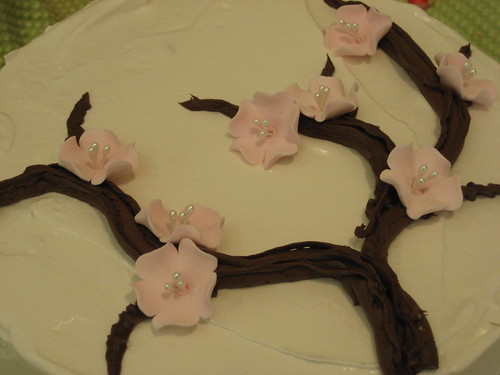
    wedding cake, originally uploaded by pilgrimgirl.

    Picture: a closeup of a round wedding cake decorated with frosting branches and sugary pink blossoms.

    This was the cake at a Quaker Wedding that we attended on Saturday. Friends marry somewhat differently than other denominations. There is no preacher or other authority figure to lead the service. Rather, the wedding party and guests gather in silence, then the couple rise and speak their vows to each other. There is a suggested form for these vows that fairly similar to that of other denominations. However, from what I understand, the couple is welcome to modify these words to suit their desires.

    After the vows, the silence continues but it is punctuated by those in the congregation who feel moved by the Spirit to speak. Yesterday some Friends gave marriage advice, some expressed their love for the bride & groom, and one Friend sang the refrain from “You Light Up My Life.” When the Meeting ended, the couple signed their marriage certificate to seal their vows. Then everyone in attendance signed the certificate as the witnesses to the marriage (it’s a fairly large piece of paper–more like a poster–to accommodate everyone’s signature).

    For those who are interested…attire at this event ranged from very casual to somewhat formal. Some women wore sundresses and some men wore slacks with dress shirts, though the bulk of the group was dressed more casually. The bride wore a simple ivory-colored lacy sleeveless dress and a long strand of pearls. The groom wore a suit.

    Photo by CatGirl

  • granny goes to war

    Are you all following Jane Stillwater’s blog? Ragin’ granny who eats peanut butter sandwiches for a year so she can afford a plane ticket to Baghdad. And she arrived a few days ago and she’s embedded with some troops and now is eating like a queen. She’s also making friends with many of the soldiers, listening to their stories. From yesterday’s post:

    These men are my boys. Hurt them and you have to go through me. Hear that, George Bush? These men aren’t just action figure toys for you to play with. These are real, living human beings. Sincere. Serious about doing their jobs — and doing them well. They deserve better than the blunders of GWB. They deserve respect. They’ve got mine.

    It reminds me of the conversation I had with a friend at Meeting today. I think this might be the Friend who used to be the head of the CDC. If not, at least he’s someone who has some connections. He asked me about my prosthetic leg, he told me about overseeing Walter Reed Medical Center in the post WWII years and how crappily veterans are being treated in this current war. We commiserated at the pointlessness of it all. The bodies being maimed in a war we shouldn’t be fighting, at the instigation of a president who shouldn’t have been elected. The horror….

  • I won’t be broken again….

    This is one of those days I probably should stay away from my computer. When I feel so raw and tired of being open. And I’m. just. tired. Tired, I say.

    This song, especially the refrain that I’ve put in bold type, was going through my head at Meeting this morning:

    Going Under, by Evanescence
    Now I will tell you what I’ve done for you
    50 thousand tears I’ve cried
    Screaming, deceiving, and bleeding for you
    And you still won’t hear me
    Don’t want your hand this time, I’ll save myself
    Maybe I’ll wake up for once
    Not tormented…Daily defeated by you
    Just when I thought I’d reached the bottom

    I’m dying again…

    I’m going under
    Drowning in you
    I’m falling forever
    I’ve got to break through
    I’m going under

    Blurring and stirring the truth and the lies
    So I don’t know what’s real and what’s not
    Always confusing the thoughts in my head
    So I can’t trust myself anymore

    I’m dying again

    So go on and scream
    Scream at me
    I’m so far away
    I won’t be broken again
    I’ve got to breathe
    I can’t keep going under

    The video for this song is a bit creepy, but if you’re not familiar with the tune, you might enjoy watching it (then again, maybe not, as it is pretty dark like a Buffy episode). I like the parts where she’s singing underwater–as someone who often feels more “right” in the water than on land, it works for me. The water part starts at 1:57 for those who want to skip straight to it,

    The other song going through my head today has a video that’s definitely worth watching.

    Are there times in your life when you’re just not “ready to make nice” to please someone else? What do you do? Sometimes I hide in the dark house with the drapes closed or go to my garden. Sometimes I scream. Or clean house. Or just roll into a ball and cry.

  • wormz


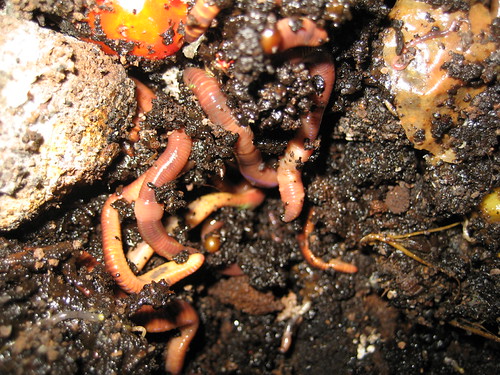
    wormz, originally uploaded by pilgrimgirl.

    Picture: a closeup of some worms in my compost bin.

    This photo is for the the three crazy people that I live with. They are at the table adjacent to where I’m typing right now, playing some kind of wormy computer game.

    Me, these are the only kinds of worms that capture my attention. These critters live in one of the three compost bins on my back porch. They make the rich fertilizer that makes my plants grow so pretty and strong. :)

  • on the streets of paris


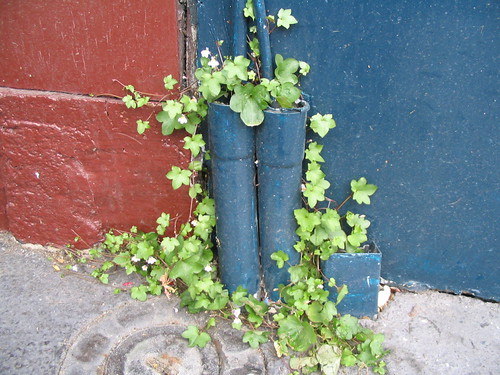
    on the streets of paris, originally uploaded by pilgrimgirl.

    Catgirl took this picture. She is an extraordinary artist who’s taught me many things about ‘seeing small’ and using the macro setting on the digital camera. I am so lucky to have her in my life!

    FYI, today is the last day to TAKE THE SURVEY. Don’t delay, because prizes await a few lucky respondents (I’ve decided to increase the number of prizes to three, because I’ve been so thrilled by your replies. You people are so cool! :)

  • Make me smile…

    –a new set of chairs for my dining room/library table from a freecycle friend. With lower backs and a smaller footprint. They make the room look so much bigger!

    –an email from this old friend today. Speaking of his surprise in having stopped by my blog and discovering my Quaker affiliation. He & his wife are Quakers now and he’s the clerk of the Saylesville Meeting–they meet in this simple 300+ year-old Meetinghouse in Rhode Island. What a *thrill* it is to know that David and I are not only friends, but Friends!

    –John’s off of work today because of Spring Break. Sitting across the table from each other this morning. Each working on our laptops. Then a nummy sushi lunch together. Playing footsie under the table and nibbling off of each other’s plates.

    –Discovering this article about a Chilean dancer in the “New Era” magazine. Mavi was a foreign exchange student in our previous ward. I was her YW leader and she spent many hours hanging out with our family, teaching us how to make empanadas, telling us of her dreams for dancing, and attending the Nauvoo Temple Dedication at our Stake Center together (her first dedication experience). How exciting to know that she’s achieving her dreams!
    :)

  • favorites


    merry-gold, originally uploaded by pilgrimgirl.

    Picture: a close-up of a marigold flower with drops of water on its petals.

    One of my favorite parts of each day is my morning walk to my garden. I water my plants and get reacquainted with everything. I revel in the warm sun and enjoy the ways that the plants change incrementally each day. I have a few routines that include searching for strawberries, calculating how many new blossoms are on the peach tree, dead-heading the marigolds, trying to guess how many more days until my roses’ first blooms, and sitting in the chair near the lavender and inhaling deeply.

    This year I’ve planted more oranges, golds, and yellow flowers than every before. I love how the bright flower faces greet me and make me smile. :)

    What are your morning routines? What do you wish you could do each morning to get the day started off on the ‘right foot’?(note: all of my days start on the left foot, but that’s okay, too. It may explain quite a bit, really….)

  • on accomodation and incorporation

    I’ve rarely been refused service because of my disability. I’ve rarely found myself unable to use a restroom or other public facilities. The few times I can remember having difficulties with accommodation were in the pre-ADA years.

    I was undergraduate when the ADA passed. Shortly afterwards I was included in a team of people–both disabled and able-bodied–to inspect the campus for ADA violations. We surveyed with tape measures and checklists. We went through every bathroom, elevator and classroom. What an enlightening experience that was. I was pleased when I learned that the school took our survey seriously and modified the most egregious violations quickly.

    With that experience in the back of my mind, I’ve been reading Kay’s discussion of the Molski case with interest. Yes, like many of you may be, I am uncomfortable with serial litigants. It makes me uncomfortable to know that individuals make a profit out of suing noncompliant businesses. But this isn’t someone who’s intentionally spilling hot coffee on themselves in order to make a quick buck. This is someone who’s suing businesses for violations of laws that’ve been in place since 1990. If someone like Molski doesn’t sue, then what incentive do businesses have to comply? Will they voluntarily go out of their way to spend the money for the accommodations? With all sympathy for the plight of small business owners, I’m glad that someone is forcing compliance. Because the ADA is the law, and as such it should be followed despite any difficulties/costs in doing so.

    Another interesting post from Kay led to my finding the following clip on youtube: a snippet of a dance performance by leg and finger amputee Lisa Bufano. I find this particular segment of her dance to be hauntingly beautiful. A more energetic performance of her dancing on stilts is also worth watching. I like these clips not because they portray her as a ‘supercrip’ but because they show how Lisa has incorporated the difference of her body into her art.


    Update: I’ve added one more image of Bufano to this post–I love this picture of her using prostehtic limbs that resemble table legs. Beautiful.

    John asked me how Bufano’s work is different from that of the spectacle found at the carnival. Certainly there are ways that it’s similar in that she’s dancing for an audience and there is a kind of crip curiosity driving the performance. But, for me, it’s different in that she’s appropriating the gaze, the stereotypes, and making them her own. Her legs are caricatures, she’s exploding the myth of normative ambulation. She’s reclaiming her body as her own kind of public space (and for those of us with mobility impairments, our body is a public space–every venture into a crowd becomes an act of theater).
    A quicktime movie of her performance on these table-leg stilts.

  • green & yellow


    tomati-yellow, originally uploaded by pilgrimgirl.

    Got many of my vegetable plants in this past weekend. This is my first year growing my own tomatillos. Can you tell that I’m thrilled? :)

  • green & yellow


    tomati-yellow, originally uploaded by pilgrimgirl.

    Got many of my vegetable plants in this past weekend. This is my first year growing my own tomatillos. Can you tell that I’m thrilled? :)

  • In any honest cause


    The best line from this article about Quakers’ role in the abolition of slavery: “In any honest cause there is no agitator like a Quaker.”

    Full article with pictures.

    Keeping it Under their Hats
    By Stephen Tomkins

    Quakers started the British campaign against the slave trade and invented modern campaigning, championing the petition and the consumer boycott, and mastering the use of images and logos. Not that they like to shout about it.

    It is perhaps the defining image of the battle to end the slave trade. Not a picture of a shackled slave, or some gruesome punishment, but a cross-section of a ship. It is a ship packed so full that the mind boggles at the sheer logistics of inhumanity.

    The use of the engraving of the Liverpool slave ship, the Brookes, is the perfect example of how Quaker mastery of PR kick-started the movement that toppled the slave trade.

    “In any honest cause there is no agitator like a Quaker,” said the abolitionist George Stephen. But today their contribution has largely been forgotten.

    Anyone in full possession of the facts would agree, it is time for that to be put right; few, if any, deserve greater credit for the defeat of slavery and the slave trade than them.

    The campaign to abolish the slave trade was an overwhelmingly religious affair. The importance of evangelical Anglicans, like William Wilberforce and John Newton, is well known.

    But Quakers were the pioneers of the movement, its brains, and much of the soul too. The more you delve into the story, the more you find Quakers under every shadow.

    The Quaker Anthony Benezet published a formative attack on the slave trade in 1772, 17 years before Wilberforce’s first abolition motion. Long before Wilberforce first spoke on the issue, the Quakers had formed a campaigning group, petitioned Parliament and distributed tens of thousands of free tracts.

    When the first Anglicans got involved – the philanthropist Granville Sharp, the rector James Ramsay and the passionate young ordinand Thomas Clarkson – it was the Quakers who published their literature and brought them together.

    Thus the Abolition Committee was formed, the engine of the movement. It consisted of 12 men, nine of them Quakers. The evidence and testimonies that Clarkson dug up for them all round the country were essential to the cause, but equally essential was the PR genius of the Quakers.

    They had a century of experience campaigning for their own rights, and channelled this expertise into defending the rights of slaves. As Adam Hochschild has argued in Bury the Chains, the movement forged most of the tools used by campaigners today. They pioneered the mass petition and the consumer boycott, targeting Caribbean sugar.

    The committee invented the campaign slogan and logo, commissioning Wedgwood to produce a design of a slave in chains with the words “Am I not a man and a brother?”. They got the poet William Cowper to write them a civil rights ballad. And in the greatest PR coup of the movement, the committee’s publication of the Brookes diagram, which showed 482 slaves lying shoulder to shoulder, made “an instantaneous impression of horror on all who saw it” according to Clarkson.

    The national network of Quaker meeting houses proved vital to mobilising the public and spreading information. Some of the most radical anti-slavery voices were Quakers – such as Elizabeth Heyrick, who argued, exceptionally, that when the slaves were freed it was they and not their owners who should be compensated.

    The Quakers were natural enemies of slavery, with their fundamental belief in equality in a hierarchical society where that was still highly controversial. They believed above all else that every person is made in the image of God and carries the divine light, so it is blasphemous to elevate one above another.

    They refused to raise their hats to their social betters or to call them “my lord”, “my lady” or even “you”, insisting on the familiar “thou”. Their egalitarianism was still quite scandalous in the 18th Century, but it made slavery uniquely abhorrent to the Quakers.

    The problem was that they were a dangerous sect of fanatics, according to the received wisdom, so no-one listened to a word they said. They were excluded from public office.

    This is why they needed to work with Anglicans like Wilberforce, who brought both respectability and political power to the movement. It is also why their involvement was not especially celebrated at the time, and why it was easily forgotten afterwards.

    The modern Quakers do not plan any major national commemoration of their role in ending the trade, preferring for the most part low-key local services. Their efforts will instead be focused on current campaigns, including their efforts to end the use of child soldiers.

    They are not the only unsung heroes of abolition. James Ramsay, for example, had a huge impact, being the first Anglican clergyman to publish revelations of plantation life, and became a martyr to the movement when constant attacks from colonists destroyed his health.

    But there can be few people who have done so much in such a good cause as the Quakers, and been so little recognised.