Tag: thatcamp

  • What I got out of THATCampSoCal 2012

    What I got out of THATCampSoCal 2012

    I’ve attended more THATCamps than I can keep track of now.  THATCamp Prime and THATCampBayArea and THATCampSoCal are standard annual events for me, with a few others working out in conjunction with other conferences that I attend along the way.  I’m used to the drill of TC and as a result I’ve even begun to wonder whether the familiarity of the unconference experience meant a loss of use-value for me.  You see, I easily become weary of the conversations about the abysmal academic market or the lack of funding for graduate student projects or the lack of women in tech-fields.  Not to say that these aren’t important conversations, I just don’t enjoy the repetition very much–I want to start the revolution, not just talk about what needs changing.

    And while there was some repetition of some of those typical conversations at this THATCamp, I found it to to still be quite useful for me, and this is why:

    • in the session about local DH collaboration, most of us who attended had been at the very first THATCampSoCal three years ago and had been involved in various local initiatives since then, including the now mostly-defunct DHSoCal website.  We committed to updating the DHSoCal presence that we created so many years ago by migrating our activities to newer platforms like Google Hangouts and Twitter.  This session had a very proactive feel to it and revved my enthusiasm for cross-campus collaborations.
    • those of us who met to discuss the role of Academic Technology at our campuses share many of the same problems with encouraging technology use.  The wide variety of suggestions for doing more (and doing better) made me feel good about what I have tried, as well as hopeful about future possibilities.  The take-away message for me personally was the reminder that I need to listen to the various constituents on campus more, and consider their needs before I push the latest shiny-new tech-tools.  Though this might not be true at every institution, at mine I believe that helping faculty to use a few tools very successfully is better than offering them with so many possibilities that they feel frustrated.
    • And finally, what will probably be the very-most-important thing that emerged from my experience at THATCamp was the faculty-friend who sat me down and asked about the state of my career and then nudged me to do more publishing (knowing that I desperately need this for my cv).  Actually, she didn’t just nudge me, she sent me her recent book proposal as a model and helped me to frame some rough ideas for how I could draft my own and then encouraged me to do so.

    All of these bullet points have one thing in common, and that’s the value of attending a conference where others are invested in the DH community and are excited about sharing with they know with others.  There’s a generosity at THATCamp conferences that is above and beyond what I’ve experienced at other academic venues.  Attending this event today reminded me just how much I need the mentoring and examples of other scholars in this field, and also affirmed my hope that I can offer the same to others, too.
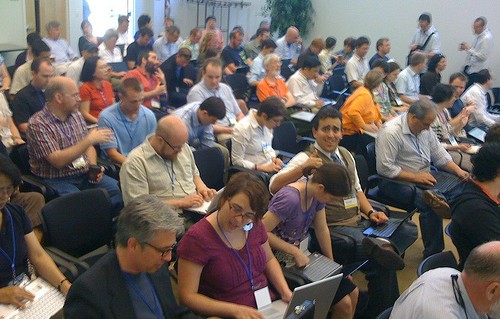
     

  • the “Versatile” PhD (warning: a bit of a rant ahead)

    the “Versatile” PhD (warning: a bit of a rant ahead)

    This morning I received a message from my university’s career center informing me that they now subscribe to a pay-for service called “The Versatile PhD” which has:

    * Examples of successful resumes and cover letters that real PhDs and ABDs used to get their first post-academic positions

    * A collection of first-person narratives written by successful non-academic PhDs and ABDs, describing how their careers have developed after grad school until now

    * Archived panel discussions where PhDs and ABDs working in specific non-academic fields describe their jobs and answer questions.  Past topics include Federal Government, Policy Analysis, Freelance Writing and Editing, Higher Education Consulting, Management Consulting, and University Administration.

    In an effort to understand this service (after I determined that my university login was not working to get me access to the site), I went to their website and learned that it’s geared especially towards the Humanities and Social Sciences, “to help humanities and social science PhDs identify and prepare for possible non-academic careers. We want them to be informed about employment realities, educated about nonacademic career options, and supported in preparing for a range of possible careers, so that in the end, they have choices.”  It’s a laudable goal, and I commend the Versatile PhD service and my uni’s Career Center for providing options for all of us unemployable PhD-types.  But it seems to me, that such stories are available in many places online, such as in Bethany Nowviskie’s open-source (i.e. free) book “#alt-ac: Alternate Academic Careers for Humanities Scholars.”

    Call me cynical, but it seems to me that the Career Center could better serve its Humanities constituents by giving them the skills to search the web and become digitally literate in open-source offerings rather than offering canned content about possible careers from a proprietary service.

    Do you agree?

    Photo taken at THATCamp–a crowd-sourced open-access alt-ac unconference for the Humanities.

  • Camp-ing

    Those of you who know me well, know that I enjoy camping.  But lately I haven’t done much of the sleeping-in-a-tent-and-sleeping-bag variety of camping.  Instead, I’ve been attending a variety of “camp” style conferences.  There was THATCamp SoCal, then WhereCampSF, and just this weekend I attended OC WordCamp (oh, and in two weeks I’ll be camping yet again–this time at the mothership THATCamp in Fairfax, Virginia).  What I remember nearly every time I attend one of these events, is just how sWordCamp logotimulating it is to be an environment with similarly-geeky tech-curious people.  The energy and the ideas associated with the camp movement are far more enlivening than traditional-style conferences (although, I love those too!).

    Being a tech-minded historian can be lonely business.  It’s also hard work to stay abreast of the latest trends in the field and to teach myself new skills.  Meeting up with campers a few times a year inspires me to stretch myself in new directions and to keep focused on my digital endeavors.  Learning about others’ development projects makes me a better administrator, blogger, podcaster, organizer, and researcher, as I apply their work to my own (WP plugins galore!).   I came away from this past weekend with loads of ideas to apply at Chapman University and to the Past Tense lecture series and to my efforts with the Making History Podcast.

    There are so many problems with the ossified structures of traditional academic conferences, and it seems to me that planning committees could do well to look to the Camp movement for keeping their events relevant in a post-web 2.0 world (pssst….I even learned of a groovy event-planning WP plugin that they could use).