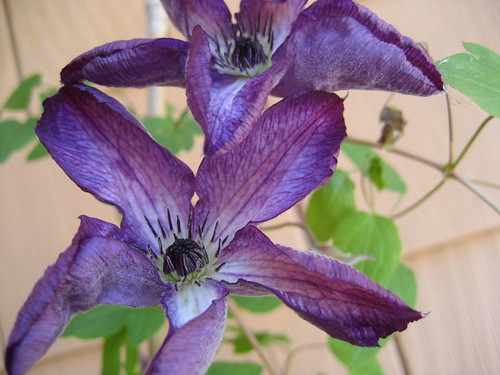
Picutre: closeup of two purple clematis flowers on a vine.
Doesn’t the inside of the lower flower look rather threatening?? :)
Picutre: closeup of two purple clematis flowers on a vine.
Doesn’t the inside of the lower flower look rather threatening?? :)
This sunshine-y flower greeted me this morning in the garden. Just lovely!
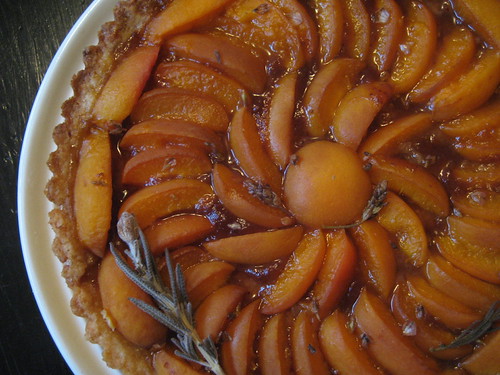
Picture: apricot tart garnished with sprigs of lavender
John and CatGirl made some gorgeous tarts this weekend. This is the apricot tart that we shared with Friends on Saturday evening. Luscious!
On Sunday the two of them served a ginger/peach tart for brunch. We ate it with steaming cups of ginger peach tea. Wow. Good stuff.
For dinner John made an apriocot-lavender compote that he served with a small scoop of vanilla bean ice cream. Such extravagance!
Swung by a colleague’s house in a nearby city in the morning to drop off a batch of exams. She lives in a craftsman-style two-story home with a plaque on the front stoop noting that the house is listed in the local historical registry. Between the front gate and the massive front porch was a zen-style rock garden. The porch was not only larger than my living room, but had a cozy couch, overstuffed chair, and a suspended bench swing. I won’t even start to discuss the huge row of rosebushes across the front. Wow. It was so hard to not to just move in on that veranda. CatGirl accompanied me up to the porch just so she could try out the furniture. I was too shy to try out the swing, but it was mighty, might tempting. Intense houselust. Just intense.
While we were in the neighborhood we stopped by the Goodwill to pick up some more glassware. At less than $1/glass it’s the best deal around. IMO even water tastes better in a goblet. I love all of the different shapes, cuts, and colors of stemware. I also pick up a few other good deals (including a darling deep green jacket for me and a bright green hoodie for CatGirl).
From there we had to drop CG off at a friend’s house to work on a school project. We had an address and a vague notion of where said friend lived. As we neared it we realized that it was the gated community that we’ve entered only occasionally before when GameBoy’s had school projects/events. It’s hard to explain how exclusive, upscale and remote this place is. Hidden in a nearby canyon, the surrounding hillsides are craggy and carefully landscaped to resemble a mediterranean village. Each of the expansive homes clings rather precipitously to the hills, each built of old-world stonework and landscaped with lavender, grape arbors, and such. From the website I learned that all of the rockwork is in the “Provence” style, there are “Approximately 400 luxury homes and homesites are dispersed within a total of 1,070 acres of some of the OC’s most pristine real estate. And the luxury custom homesites average 27,000 square feet.” Yah. wow. (this is in a city where a one bedroom condo costs more than $350K)
So this friend of CG’s doesn’t live in just any of these homes. She lives in the furtherstmost tippyity-top home. We went through two different sentry gates to reach her street and then found ourselves at yet another series of gates to actually enter the housesite. We opted to park on the street and I walked CG to the pedestrian gate. We buzzed and her friend soon appeared with her mother. We chatted a few moments about when I would pick up CG later and then I left. Her Mom was dressed super-casually like me : t-shirt, no makeup, sweatpants. But I couldn’t help but marvel and the differences between our two lives. The vista from her front yard–looking out over rolling hills and an open space preserve–it’s a multi-million dollar view. I wondered if her porch had a swing (I wasn’t allowed through the inner gate to actually see the front entrance) and if all of the iron bars make it hard to see the sunset?
So now I am at home curled up barefoot on my groovy purple couch. I just finished a little project on the back porch to hang some candle lanterns from some hooks that I bought 1/2-price at Goodwill. John is cooking up a huge feast for dinner: ratatouille(!), our new favorite leek soup, green bean salad, and an apricot compote. The “new” glasses are lined up on the table for me to scrape off the pricetags and wash before dinner. Some F/friends will probably drop by later and I’m sure a good time will be had by all.
I know that all three of these homes house good people who love each other and have purposefully chosen their particular lifestyle. I’m awed by the size and scale of the two homes that I mentioned earlier when compared to ours. I mean, I would love to live in a historical home–especially one with a grand porch (yes, especially that), but I really can’t imagine myself in such a large space. And the villa lifestyle, whoa. What would it be like to have a yard that’s even larger than my entire community garden? Unfathomable (though you can imagine that I would be growing a heckuva lot of organic food!)….
UPDATE: The price tag of the house adjacent to CG’s friend is 15 million. Gasp.
One of my students used the following word on one of their Final Exams, perhaps ya’ll can help me come up with a good definition for it:
HYPOCRIPSY
Why, oh why, did Disney/Pixar have to go and make a new movie about French cooking and Paris and a protagonist named Remy (one of my very favorite names in this whole world, btw) and make said main character a RAT??? What were they THINKING???
Note to Pixar/Disney:
Paris + Gourmet Food + Cat, Dog, and/or Platypus = good film
Paris + Gourmet Food + Rat = Wrong, Wrong, Wrongity, Wrong
–GameBoy atttending an all-nite school party to reward students who’d read 50+ books extra-curricularly this past year. Games, movies, pizza, oh my!
–The superb garden-fresh ciabatta lunches that John‘s prepared for me daily for the past 2 weeks.
–End-of-the-year concerts for both kiddoes. Some marvelous flute and cello music. Beaming parents all ’round.
–TobyKitty curled up in a couch-cushion tunnel next to me as I write and grade papers all day.
–Getting the giggles as I administered a Final Exam yesterday morning (trying to cover it with some dry coughing). Having to leave the classroom momentarily to regain my composure.
–Giving my piano to Dora-chan for safekeeping. The pleasure of knowing that she will give it much love and attention while I am distracted with my dissertation for the next couple of years.
–Making Bonny’s Blackberry Crumble with berries just picked in our garden.
Blackberry Crumble (recipe from this website)
* 2 cups washed blackberries
* 2/3 cup sugar (Note: I used half the sugar and it still tasted great)
* 2 tablespoons lemon juice, or juice of 1 lemon
* 3 tablespoons butter
* 2/3 cup all-purpose flour
* 1/8 teaspoon saltPut blackberries in a 1-quart baking dish with half of the sugar. Sprinkle with lemon juice. Cream butter, remaining sugar, flour, and salt together; sprinkle over berries. Bake blackberry crumble at 350° for 40 minutes.
Serve warm or cold with cream, ice cream, or dessert sauce. Blackberry crumble dessert recipe serves 4.
For the past few weeks I’ve been doing a lot of research on eating locally, supporting family farms that grow produce and raise livestock on a small scale. In the process I’ve found a few helpful websites:
—Local Harvest: You can search for Community Supported Agriculture programs for your region
–Find a Community Garden near you and grow your own organic food!
–website of the 100 mile Diet, moderated by the authors of Plenty
–Barbara Kingsolver’s new book about eating locally: Animal, Vegetable, Miracle
–For those who are interested in taking on the challenge to eat locally, I highly recommend subscribing to the “Eat Local Challenge” blog.
–For you who live near me (in SoCal), here are some links for some fabulous local foods: Winchester cheese (their super-aged Gouda is to-die-for), Temecula olive oil, and South Coast Farms (which is the best local CSA source, IMO)
My biggest problem in trying to source all of our family’s food locally is wheat. I know that wheat is grown within 100 miles of our home, but I can’t find any place to purchase the wheat. Does anyone have any ideas for me on how to do this??
UPDATE: The National Center for Home Food Preservation (for canning, pickling, etc all of that locally grown good-ness)
Also, see JohnH’s writeup of our local eating adventure last Sunday.
UPDATE #2: A list of OC Certified Farmers Markets with tons of seasonal recipes(!) included
Allright, so the second book with a chapter by moi is in print now. Never mind that its Sales Rank is #2,116,676. My previous book
One of these days I need to get something else published. :)
For those of you who haven’t yet read this particular interview, here’s an excerpt that you might enjoy…
Jana: Some theorists have suggested that the body is perhaps a better source of language and understanding than the mind. What do you think about these ideas and how do you think an LDS writer could use them to overcome something like the use of religious cliches or institutional thinking?
Terry: The body does not lie. Therefore, if we write out of the body, we are writing out of the truth of our lives. This creates a language that is organic and whole. Original. We listen to what is coursing through our veins, what is held within our hearts, what is registered in our bones. Call it cellular knowledge. Something akin to instinct. It is here, perhaps, were we write muscular prose that lifts our ideas to both a higher and deeper place where the full range of our intelligence can be found.
If we are simply writing out of our heads, there is no weight to our words. They become abstractions that dissipate into the air. This is the realm of rhetoric. The body is the realm of the story. And it is in story that we bypass rhetoric and pierce the heart. We feel it first and understand it later. Memory resides in the body. Memorization resides in the mind.
I think we fall into religious cliches when we become afraid of the deep reflective work that organic writing requires. Cliches follow answers and almost always leads us to sentimentality. Nothing surprises or delights. Original prose that breathes and bleeds follows the questions, the mysteries, the place where we dare to say I don’t know where I am going on the page. It is the place of discovery and revelation. This is where we can begin to trust the body. The body carries the physical reality of our spirits like a river. Institutional thinking is fearful of rivers because rivers inevitably follow their own path and that channel may change from day to day, even though the muscle of the river, the property of water remains consistent, life sustaining, fierce and compassionate, at once.
To write out of the body is to write ourselves into a freedom. It is here we can let go of fear and trust the joy that is held in each movement of the hand, word by word by word.

A borderland is a vague and undetermined place created by the emotional residue of an unnatural boundary. It is in a constant state of transition. The prohibited and forbidden are its inhabitants. Los atravesados live here: the squint-eyed, the perverse, the queer, the troublesome, the mongrel, the mulatto, the half-breed, the half-dead; in short, those who cross over, pass over, or go through the “confines” of the “normal.
~Gloria Anzaldua, Borderlands LaFrontreras: The New Mestiza
A few months ago I was engaging in an online debate with some TAB friends who argued that the routinized abortion of fetuses with disabilities or genetic abnormalities should be encouraged. As I expressed opposition to their ideas, my well-reasoned arguments were soon abandoned.
“Are you saying that I should have been aborted?” I asked. “That society would be better off without me?”
One of them responded: “Well, not you of course. I never think of you as disabled. You are just Jana.”
This response bothered me just as much as the original assertion about aborting babies with disabilities. I found myself simultaneously pleased to know that my friends didn’t think of me as disabled even as I was disgusted that they refused to recognize that identity as important to me. Through this I realized just how flexible the borders of disability are–the categories of ‘normal’ and ‘disabled’ bending and flexing to both include and exclude.
As people with disabilities many of us find ourselves navigating borders. We may encounter physical barriers that prevent us from fully participating in social activities. Many of us experience awkward interactions as we move through public spaces–often simultaneously drawing attention and disfavor. Those of us who inhabit the Borderland of disability may ‘pass’ for TAB in various spheres (such as on the ‘Net where our bodies aren’t on display), or we may have times where we assert our disabled identity in order to qualify for benefits or accommodations. At different times we may feel a kind of fractured identity as we realize that our life is ‘normal’ for us, so why are we marginalized or pitied when we attempt to live our everyday lives?
Let me suggest that you begin your ‘Borders’ Carnival reading with Wheelchair Dancer’s post about Borderlands. She also invokes ideas from Anzaldua as she explores the boundaries of disability culture.
I grouped the blogposts for this Carnival into three categories to reflect the different types of stories told by our participants: Borders in Public Spaces, Defining the Borders of Disability, and Physical Borders. These categories are somewhat arbitrary given the complexity of the expressions of these blog authors. It is my hope that the variety of experiences in each section will underscore the diversity of those who navigate the Borders of disability.
Borders in Public Spaces
-Marcy of Dirty Laundry highlights several performers with disabilities who are crossing the borders in the entertainment industry,
–From the BBC newswire: An interesting idea to use CAPTCHA technology to decipher text for book-scanning projects
–Speaking about disabled war veterans at Echidne of the Snakes: “The dying goes on a long time after the treaty is signed.”
–A great explanation of why the cliched “triumph over adversity” narrative in stories about disability is harmful.
–Rev. C.S.Louis discusses the challenges of access and accommodation within the Pagan community, particularly for those with service animals.
–Lady Bracknell, explaining about “those people” who always know exactly how you’re feeling when you have a disability. The comments on this post are particularly amusing.
–Sharon writes of a visit to Camphill, a live-in rural-style community for children with special needs. She expresses deep discomfort with this very “nice” place in Ireland.
—Andrea explains that hurtful lies and insults mark the borders between ourselves and others, between self-worth and self-doubt, and between childhood and maturity. Crossing such a border means not entering the territory of lies and insults, but leaving the place of self-doubts and by-passing that land of lies altogether.
–From a new blog called “Bums and Bellybuttons”: Although people with disabilities make up the largest “minority” in the world, the non-disabled community still does not seem to quite “get it.” That community does not get that having a physical disability does not equal incompetency. A physical disability is not catching. It is not a sign of demonic possession. It simply is what it is: Different.
—Annoying comments from busybodies to a quad who dares to date. Brought to you by Wheelie Catholic.
–Retired Waif on “Slutty Shoes, Milestones, and the New Normal.“
–The value of some vocational programs is explored, and ultimately questioned, in this thoughtful entry by eeka
Defining the Borders of Disability
–From Ballastexistenz: “People need to wake up and realize that these classifications aren’t a parlor game, aren’t a neutral classification system, aren’t enforced by people with any more insight into human nature than the average layperson, and aren’t a mildly interesting way to pass the time while watching people at a distance and neatly sorting them into categories the way I used to enjoy sorting buttons as a young child.”
–Joel challenges all comers to provide serious evidence for any of the common beliefs about the border between Asperger’s and autism
–Suzanne muses about how long it takes for the “shock” of spinal cord injury to last.
–A good roundup of recent blogging on autism science and policy
–A mother declares, “If he walks, I will be thrilled. If he wheels, I’ll be thrilled.” She encounters resistance to this openness.
—Newt in a Tea Cup gives a chilling reminder of how recently, and how easily, girls and women could be put into asylums on the flimsiest grounds: “There has to be a moral…about labeling us as defective, diseased, wrong and needing treatment if we are people and not cut out of cardboard to an ideal; a warning about the black ink of tick boxes and diagnoses seeping over the skin of our humanity; that our own good cannot be found in our effacement; that our complaints are not resolved because of this excuse out of societal responsibility; it happened so, so easily, silently and completely in so many ways; that if women have been or are fainting flowers it’s because we’ve been living in the shade of a giant foot trampling us down; that we are complete as we are; don’t listen to those words; don’t, don’t don’t…”
Physical Borders
–Wheelchair Dancer is applying for US citizenship, and takes us through the disability-related questions in the application.
–An example of poorly-planned access: an elevator call-button positioned at the top of a small flight of steps.
–Sometimes the “border” is just the threshhold of an apartment–any apartment
You can find information about past and future carnivals here.
I wanted to share here an excerpt from a paper that I wrote a few years ago about Borders & Bodies. It may be that this bit of writing makes little sense out of context of the original, much longer, treatise (and I realize that my footnotes lack full citations for each reference–if you’d like the complete bibliography drop a note in the comments and I’ll send it on over to you). Though my writing here doesn’t specifically engage with Disability Theory, I include this paper as a complement the theme of the 16th edition of the Disability Carnival–as further reading for those who enjoy engaging with academic theory about the Borderland experience:
Excerpt from “Borderlands: The Place Where We Live”
Lavie and Swedenborg assert that borders create a “third time-space” between and among borders, which is a “borderzone between identity-as-essence and identity-as-conjecture,”(1) meaning that this third time-space falls somewhere between an essential identity and a constructed identity. It is important to note that the authors’ definition includes both spatial and temporal dimensions. For them, the third time-space is not a literal place, but an identity-creating process that exists both in space and in history. A third time-space identity is relational—playing off both the past and on the areas that surround it. Yet, it is 3also distinct space from the zones that bound it. The most provocative element of this definition is the authors’ assertion that third time-space identity is both essence and conjecture, showing that there is both a determinism and a dynamism to a borderzone identity. It is the tension between the two fosters a new type of borderzone identity.
Lavie and Swedenborg apply this third time-space to several such zones, with heavy emphasis on the Southwest Borderlands in the United States. The authors offer examples, of individuals, primarily writers, who inhabit the hyphenated space between dual identities, e.g. Mexican-American. They assert that the hyphenated space is not a fixed identity, but is a process that “remains active and intransitive,” where identity is fluid and dynamic. To illustrate, they cite the Chicana lesbian poet Gloria Anzaldua, who wrote about third time-spaces as an “open wound” where two worlds rub against each other. In this zone of friction, she says, “before a scab forms it hemorrhages again, the lifeblood of two worlds merging to form a third country…a border culture.” (2) It is noteworthy that Anzaldua writes of the borderzone as a body, as this reinforces the effect that third time-space has on bodies, on people who live there. She underscores the fact that this space is neither an abstract theoretical construct, nor an empty gap. Rather, it is embodied, full of bodies; it is “the place where we live.” What matters most about third time-space is not that it exists as a space between two places. Rather, as Lavie and Swedenburg point out, what matters are the people, the bodies that are affected by the juncture between Mexico and the U.S. and other similar borderzones.
Third time-spaces are not static; they are changing, mutable, intangible. The people of these spaces develop a culture that reflects the dynamism of their homespace. As Lavie and Swedenburg point out, the art produced from the borderzone are “highly stylized domains of knowledge…that [can] incorporate the primary daily realities from which such cultural representations emerge.” (3) They explain that the narratives produced from the people of the border then create new borders, where identity, space, and place are in a process of continual re-definition. As soon as narratives are created that speak the truth of the third time-space, a new space is created in response to that narrative, as some border people embody that story or use is as a springboard for their own experience. In this way, the borders are continually in flux.
One might argue that Anzaldua, in envisioning the border as a dehiscent space, a suppurating wound, depicts the border as dystopia—as a space where bodies are wounded and unhealthy. However, even as she describes the painful frictions of the border body, they envision a co-mingling of fluid and tissue, an emergence of the “new lifeblood” of the border culture. Epidemiologist Nancy Krieger says that “bodies tell stories,” and we can imagine that the border body bears the scars of many interactions. However, these scars, rather than wounding the body of the people who live in the borderzone, are markers of an identity that built in a space of “dissension”, of “contestation,” of identities-in-process. Such scars become a part of the fluid identity of border spaces.
Lavie and Swedenburg emphasize the third time-space–the area that lies outside of borders—to affirm their vision of borderzone possibilities. They view this space as having “utopian” potential, “whose future outlines we can only vaguely begin to make out,” but would certainly incorporate their concept of a “neo-orthodoxy that would privilege identity as constructed, hybrid, fragmented, conjunctural” and rejects notions of fixed and essential identities. (4) Those who inhabit this utopian space might enjoy an arena where identity was not socially prescribed or inscribed on their bodies, but rather one in which is fluid, and difference celebrated. This is a space “where theory and praxis meet in order to form new possibilities.” (5) While it seems difficult to imagine such a scenario, an example of this that I have personally experienced are the spaces of community gardens—where people of many ages, abilities, ethnicities, and social strata work together in a common space to grow food and flowers. Where squash vines and blackberry bushes (and weeds!) refuse to honor even the superficial boundaries of garden plots and the sharing of one’s abundant crops is the only common language of many of the gardeners. (6)
Like the loamy soil of a fertile garden, the third time-space is rich with possibilities for growth as various plants cross-pollinate across traditional boundaries and sow seeds of hybrid potential. As Anzaldua writes:
A borderland is a vague and undetermined place created by the emotional residue of an unnatural boundary. It is in a constant state of transition. The prohibited and forbidden are its inhabitants. Los atravesados live here: the squint-eyed, the perverse, the queer, the troublesome, the mongrel, the mulatto, the half-breed, the half-dead; in short, those who cross over, pass over, or go through the “confines” of the “normal”. (7)
Her vision of the borderland, of the “space where we live,” (8) is not only the moving gaps of border-in-motion, as described by Rodriguez, but it is the space where for those whose identities lie outside of the ‘normal.’ In this way the borderzone encompasses those who do not fit in any pre-existing category, and it allows for self-creation, self-definition, and self-assertion. Unlike mainstream society where “claiming a self lies close to the brink of annihilating a self,” third spaces allow prohibited and forbidden actions and peoples while maintaining selfhood. (9) Borderzones are not bound by the rules of society; they do not require the “docile bodies” of mainstream social institutions. (10)
——
Footnotes
1 Smadar LaVie and Ted Swedenborg, “Introduction: Displacement, Diaspora, and Geographies of Identity,” in Displacement, Diaspora, and Geographies of Identity, ed. Smadar LaVie and Ted Swedenborg (Durham: Duke, 1996)., 17.
2 As quoted in Ibid., 15.
3 Ibid., 18.
4 LaVie and Swedenborg, “Introduction: Displacement, Diaspora, and Geographies of Identity.”, 17.
5 Juana Maria Rodriguez, in Queer Latinidad: Idenity Practices, Discursive Spaces (New York: NYU, 2003)., 31.
6 The recent brouhaha about Los Angeles’ South Central Community Garden demonstrates that such spaces are still sites of political, class-based conflict, but this is an exception. Perhaps an even more radical third space-type gardening project is that of guerrilla gardening, a group that practices ‘random acts of gardening’ in neglected, public spaces.
7 Gloria Anzaldua, Boderlands/La Frontrera: The New Mestiza (Aunt Lute Books, 1987)., 3.
8 Byrd, ed., Puro Border.
9 Lancaster, The Trouble with Nature., 234.
10 Foucault., 138.
From an interview with author Terry Tempest Williams:
“Most of the day I am doing nothing,” she confessed of her writing process. “I am waiting. Writing is a natural process, like evaporation, we might not see it going on but it is happening.” As a writer she keeps a candle lit in her workspace, a sacred space she says, one that is spiritual. She also has a bowl of water nearby, in the writing room, because even if she is not writing anything, it is good to know that there is still evaporation – that something is happening in the room. “Writing is saying the things you don’t want to say, and this takes stamina.”
Today I am writing much. Finishing up an encyclopedia article and preparing tomorrow’s Disability Blog Carnival (which I’m hosting. yippee!). Perhaps I should light a candle…