Category: school

  • pilgrimgirl classic: sour

    A reprint from 2/14/2006

    Note to self: next time John gets you your favorite super-sour gummies for Valentine’s Day Eve, squeal when he presents them to you. :)

    However, do not proceed to eat said gummies while wearing a low-cut top and reading scholarly journal articles because sour gummy powder will then accumulate in your, um, cleavage while you are concentrating on the arguments of the very stimulating writings of 19th-century historians.

    And then you’ll wake up in the middle of the night w/ cleavage sore and burning from said powder and you’ll have to teach the next day while trying to ignore that you want very much to scratch that particularly irritated area….

  • blogging in academia

    Attended this panel today about blogging and academia. It was a bit discouraging to be one of the three people in attendance who weren’t getting course credit for being there, but I guess that’s just to be expected when you plan a panel on Halloween…

    That said, there were some good points made, perhaps the most memorable contribution was Liz Losh‘s rejoinder: “Don’t blog while angry, it’s like driving drunk.” She mentioned this in the context of a discussion about the ‘permanence’ of webwriting and other forms of electronic communication. Each panelist concurred that blogging is best done with a ‘drafts’ folder to let ideas gel for awhile before hitting the ‘publish’ button.

    A few other thoughts:
    Scott Kaufman spoke about how blogging made him love writing again. Daily, he stops working on his dissertation after dinner and then allows himself to blog. What he said rang true with my experience as a blogging academic. When I am blogging I am a better academic writer because I feel so much ‘juice’ running through my brain. I also have a momentum built from blogwriting that carries through into all other types of writing. I can literally feel my wrists and hands loosen as the words just flow. The only challenge of being an active blogwriter is that of time–making sure that I don’t get so preoccupied with blogthoughts and blogdramas that I forget what’s most important (i.e. my dissertation).

    Liz gave a few statistics that I thought quite telling. She quoted the following percentages of responses as to why academic-types blog (note: just a few stats of the many she offered and I wish I had the citation for the study, but I didn’t get that either):

    91% praised the intellectual stimulation of blogging
    63% liked blogging because it facilitated interdisciplinarity
    64% said it fosters community

    My two criticisms of the panel discussion:

    1) Each blogger seemed sheepish about their blogging, admitting that it was extra-curricular to their “real work.” This made me sad–what I wanted to see was a panel that legitimized the ways that blogging can enhance an academic career, not a bunch of folks who admit its frivolousness.

    2) There was the expected ivory tower elitism–some slams at BoingBoing and the ‘bad writing’ of most blogs. While I agree that many blogs aren’t masterpieces (I’ll include myself in that bunch), I’m not sure that all of the panelists really ‘get’ the genre and form of the blog. It has a different audience and intention than a NYTimes article. For the most part, it’s intended to be rough and raw and fast. It’s more about connection to communty than polish, IMO. Of course, YMMV.

  • Make me smile…


    As a historian of 19th century medicine, I spend a lot of time reading grody accounts of diseases and botched surgeries. Believe it or not, I love it. Here’s a tasty little bit of history for you–an account of a c-section performed in 1857 (which was back in the day when they thought inflammation and oozing pus was a good thing in wound healing and not a sign of infection….):

    “The first three days a single thickness of domestic [linen] moistened in cold water is applied to the exposed abdomen over the wound to get the refrigerating action of evaporation. As soon as suppuration is established [a discharge of pus], this dressing is replaced by a warm poultice of bread and milk, which is continued until she is well. A weak dilution of chloride of soda was several times injected through the vagina into the womb, from which it issued at the abdominal wound, and did not return by the natural passages. These cleansings diminished very much the almost gangrenous foeter of the days of suppuration. The abdominal flatus was drawn off by an esophagus tube per rectum. A silver catheter remained constantly in the urethra by which the bladder was kept nearly always empty. The bladder was incised first accidentally, then purposely, during the operation, before the womb was reached. These slight opening closed kindly, by first intention.”

    Bleh. The gangrenous foeter? How’s that for a flowery way to say nasty stench?

  • history lessons

    So I am so going to start each of my classes with this video, musing about what we learn (or don’t learn) from history!

  • Borderlands

    I wanted to share here an excerpt from a paper that I wrote a few years ago about Borders & Bodies. It may be that this bit of writing makes little sense out of context of the original, much longer, treatise (and I realize that my footnotes lack full citations for each reference–if you’d like the complete bibliography drop a note in the comments and I’ll send it on over to you). Though my writing here doesn’t specifically engage with Disability Theory, I include this paper as a complement the theme of the 16th edition of the Disability Carnival–as further reading for those who enjoy engaging with academic theory about the Borderland experience:

    Excerpt from “Borderlands: The Place Where We Live”

    Lavie and Swedenborg assert that borders create a “third time-space” between and among borders, which is a “borderzone between identity-as-essence and identity-as-conjecture,”(1) meaning that this third time-space falls somewhere between an essential identity and a constructed identity. It is important to note that the authors’ definition includes both spatial and temporal dimensions. For them, the third time-space is not a literal place, but an identity-creating process that exists both in space and in history. A third time-space identity is relational—playing off both the past and on the areas that surround it. Yet, it is 3also distinct space from the zones that bound it. The most provocative element of this definition is the authors’ assertion that third time-space identity is both essence and conjecture, showing that there is both a determinism and a dynamism to a borderzone identity. It is the tension between the two fosters a new type of borderzone identity.

    Lavie and Swedenborg apply this third time-space to several such zones, with heavy emphasis on the Southwest Borderlands in the United States. The authors offer examples, of individuals, primarily writers, who inhabit the hyphenated space between dual identities, e.g. Mexican-American. They assert that the hyphenated space is not a fixed identity, but is a process that “remains active and intransitive,” where identity is fluid and dynamic. To illustrate, they cite the Chicana lesbian poet Gloria Anzaldua, who wrote about third time-spaces as an “open wound” where two worlds rub against each other. In this zone of friction, she says, “before a scab forms it hemorrhages again, the lifeblood of two worlds merging to form a third country…a border culture.” (2) It is noteworthy that Anzaldua writes of the borderzone as a body, as this reinforces the effect that third time-space has on bodies, on people who live there. She underscores the fact that this space is neither an abstract theoretical construct, nor an empty gap. Rather, it is embodied, full of bodies; it is “the place where we live.” What matters most about third time-space is not that it exists as a space between two places. Rather, as Lavie and Swedenburg point out, what matters are the people, the bodies that are affected by the juncture between Mexico and the U.S. and other similar borderzones.

    Third time-spaces are not static; they are changing, mutable, intangible. The people of these spaces develop a culture that reflects the dynamism of their homespace. As Lavie and Swedenburg point out, the art produced from the borderzone are “highly stylized domains of knowledge…that [can] incorporate the primary daily realities from which such cultural representations emerge.” (3) They explain that the narratives produced from the people of the border then create new borders, where identity, space, and place are in a process of continual re-definition. As soon as narratives are created that speak the truth of the third time-space, a new space is created in response to that narrative, as some border people embody that story or use is as a springboard for their own experience. In this way, the borders are continually in flux.

    One might argue that Anzaldua, in envisioning the border as a dehiscent space, a suppurating wound, depicts the border as dystopia—as a space where bodies are wounded and unhealthy. However, even as she describes the painful frictions of the border body, they envision a co-mingling of fluid and tissue, an emergence of the “new lifeblood” of the border culture. Epidemiologist Nancy Krieger says that “bodies tell stories,” and we can imagine that the border body bears the scars of many interactions. However, these scars, rather than wounding the body of the people who live in the borderzone, are markers of an identity that built in a space of “dissension”, of “contestation,” of identities-in-process. Such scars become a part of the fluid identity of border spaces.

    Lavie and Swedenburg emphasize the third time-space–the area that lies outside of borders—to affirm their vision of borderzone possibilities. They view this space as having “utopian” potential, “whose future outlines we can only vaguely begin to make out,” but would certainly incorporate their concept of a “neo-orthodoxy that would privilege identity as constructed, hybrid, fragmented, conjunctural” and rejects notions of fixed and essential identities. (4) Those who inhabit this utopian space might enjoy an arena where identity was not socially prescribed or inscribed on their bodies, but rather one in which is fluid, and difference celebrated. This is a space “where theory and praxis meet in order to form new possibilities.” (5) While it seems difficult to imagine such a scenario, an example of this that I have personally experienced are the spaces of community gardens—where people of many ages, abilities, ethnicities, and social strata work together in a common space to grow food and flowers. Where squash vines and blackberry bushes (and weeds!) refuse to honor even the superficial boundaries of garden plots and the sharing of one’s abundant crops is the only common language of many of the gardeners. (6)

    Like the loamy soil of a fertile garden, the third time-space is rich with possibilities for growth as various plants cross-pollinate across traditional boundaries and sow seeds of hybrid potential. As Anzaldua writes:

    A borderland is a vague and undetermined place created by the emotional residue of an unnatural boundary. It is in a constant state of transition. The prohibited and forbidden are its inhabitants. Los atravesados live here: the squint-eyed, the perverse, the queer, the troublesome, the mongrel, the mulatto, the half-breed, the half-dead; in short, those who cross over, pass over, or go through the “confines” of the “normal”. (7)

    Her vision of the borderland, of the “space where we live,” (8) is not only the moving gaps of border-in-motion, as described by Rodriguez, but it is the space where for those whose identities lie outside of the ‘normal.’ In this way the borderzone encompasses those who do not fit in any pre-existing category, and it allows for self-creation, self-definition, and self-assertion. Unlike mainstream society where “claiming a self lies close to the brink of annihilating a self,” third spaces allow prohibited and forbidden actions and peoples while maintaining selfhood. (9) Borderzones are not bound by the rules of society; they do not require the “docile bodies” of mainstream social institutions. (10)

    ——
    Footnotes

    1 Smadar LaVie and Ted Swedenborg, “Introduction: Displacement, Diaspora, and Geographies of Identity,” in Displacement, Diaspora, and Geographies of Identity, ed. Smadar LaVie and Ted Swedenborg (Durham: Duke, 1996)., 17.
    2 As quoted in Ibid., 15.
    3 Ibid., 18.
    4 LaVie and Swedenborg, “Introduction: Displacement, Diaspora, and Geographies of Identity.”, 17.
    5 Juana Maria Rodriguez, in Queer Latinidad: Idenity Practices, Discursive Spaces (New York: NYU, 2003)., 31.
    6 The recent brouhaha about Los Angeles’ South Central Community Garden demonstrates that such spaces are still sites of political, class-based conflict, but this is an exception. Perhaps an even more radical third space-type gardening project is that of guerrilla gardening, a group that practices ‘random acts of gardening’ in neglected, public spaces.
    7 Gloria Anzaldua, Boderlands/La Frontrera: The New Mestiza (Aunt Lute Books, 1987)., 3.
    8 Byrd, ed., Puro Border.
    9 Lancaster, The Trouble with Nature., 234.
    10 Foucault., 138.

  • my exam day

    For those of you wanting a play-by-play of my PhD Qualifying Exams today, I offer you this quick vid clip. Ok, it’s not exactly the same because I wore my navy blue suit and left my bowtie at home. Oh, and my advisor forgot to wear his leather eyepatch. But otherwise, yah, this is exactly what it was like.

    FYI: I passed, and that’s all that matters. And I am tired. So, so tired right now. Ready for a weekend with no studying!! :)

  • because some flowers are good eating…


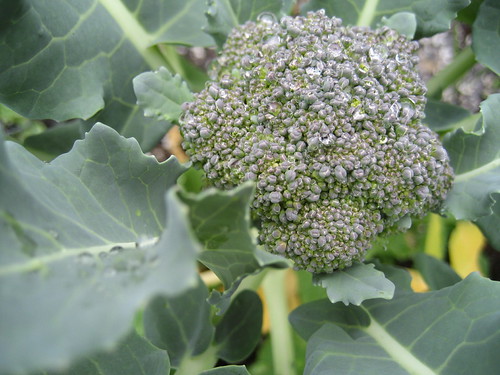
    broccoli, originally uploaded by pilgrimgirl.

    Picture: a closeup of a head of broccoli growing in my garden.

    This ‘flower’ turned out to be pretty tasty. I ate it for lunch on Saturday :) My goal, once the school pressure lets down a bit, is to eat one meal/day from the garden this summer. And I think I just might pull it off. :)

    One of you, on your response to the pilgrimgirl survey, suggested that I should write about school more often. Hmmm….probably not going to happen. At least not anytime soon. Blogging is my escape from school. From the pressure that is building as my Qualifying Exams are looming. A respite from the many hours each day that I am reading, taking notes, writing mock responses to possible exam questions.

    My other escapes from studying? The gym and the garden. Lifting weights does a lot to relieve the pressure. Sometimes I actually imagine myself pushing all the stress out through my arms as I’m bench pressing. It’s lovely to get that ‘release.’ The garden, well, that probably doesn’t need explaining. A few minutes with the sun shining on my face, getting dirt under my nails, running my hands through the lavender, well that’s a feeling so tangibly relaxing that it seems almost sinful.

    How do you relax when life builds up on your shoulders?

    I would really be interested in ideas you have for relaxing before bed. I find myself rehashing all I’ve studied the minute my head hits the pillow. Sleep is far distant and elusive. But at the same time I know sleep is what I most need during this stressful time…I also know that this stress is not an isolated thing, that academia is a path that will continue to be pressure-filled, as there will be deadlines, job talks, conferences, and all manner of difficulties that I need to get used to. I’m hoping that I can continue to build a storehouse of stress-relieving skills that will serve me now and on into the future….

  • an end…and a beginning

    So today I finished the required coursework for my Ph.D. That means that from here on out I may sit in on a few classes, but that’s entirely at my discretion.

    So, what now? My Qualifying Exam (a rather grueling oral exam) will be on April 20th.

    Then the dissertation work commences…

    Yeah! :)

  • my morning


    I’m always searching for the perfect morning routine–one that allows me to get much accomplished while still beginning the day with peace. This morning was a very good one. I awoke at 6:15 feeling rested (thanks to turning out the lights at 11pm rather than at midnite), took a lovely warm shower, had ample of time to get myself dressed and groomed, got GameBoy to school on time, came home and checked email, then went to the garden and watered my seedlings (the peas are looking great!) and meditated there in the sunshine for about 15 min. Came home and had about 2 hours of very focused study and then headed to campus for two back-to-back meetings with colleagues (and even had a few spare minutes to meet John at the ArtBar coffeeshop in-between). After the meetings I walked home from campus (instead of taking the shuttle) to get in a bit of exercise. All-in-all it was super-productive and invigorating start to the day, which I hope to emulate in a similar fashion each day this week.

    On Tuesdays and Thursday I teach from 8-9:30am so the day gets off to an early start, but it never seems as productive as when I start my day with my own agenda. I think I need to work on a routine that will help me to get busy as soon as class is over!

    I’m curious, what rituals/routines help you to get a good start each morning?

  • feminism 101

    So I’m taking a Women’s Studies class this quarter, which I really need. For too long I’ve been skirting around the edge of Feminist Theory, without ever diving in.

    So today I read my first article, “Toward a Woman-Centered University,” by Adrienne Rich in 1973. I’ll share a few portions of the article that resonated with me, though I wish I could share all as I find it highly relevant to my daily life as a mother-academic. This article builds on Virginia Woolf’s notion of “A Room of Her Own” and “Three Guineas” to propose a model for a woman-friendly college. I would add that the changes that Rich proposes would be more human-friendly and parent-friendly (not just for women, IMO).

    It is difficult to imagine, unless one has lived it, the personal division, endless improvising, and creative and intellectual holding back that for most women accompany the attempt to combine the emotional and physical demands of parenthood and the challenges of work.

    As I write this I am sitting in the midst of laundry that needs folding, dishes that need washing, and 2 kids who are working on a rock-polishing project. While I love my life and I am thrilled by the creative tensions that occur in the process of ‘improvising’ my life, it is so not easy and sometimes I wonder if I am wasting my academic pursuits because I can’t devote full-time attention to them.

    Later in her article she quotes Susan Sontag (another favorite author of mine):
    The first responsibility of a ‘liberated’ woman is to lead the fullest, freest, and most imaginative life she can. The second responsibility is her solidarity with other women. She may live and work and make love with men. But she has no right to represent her situation as simpler, or less suspect, or less full of compromises than it really is. Her good relations with men must not be bought at the price of betraying her sisters.

    Wow, there is a lot of meat in the quotation. I love the challenge that Sontag proposes–of living life as fully and imaginatively as possible. Yes, I have taken up that gauntlet. I’m not sure, though, that I have been completely honest about the challenges and compromises that I face in my academic path. Perhaps this is because I don’t discuss my academic path much at all on my blog? Perhaps it is just too raw? Perhaps my experience doesn’t involve such grand compromises because earlier women have paved the path for me to follow? I’ll continue to ruminate on these questions as I approach my later readings.

  • On the intellectual stimulation of children

    When GameBoy was born, I was just finishing up my bachelor’s degree. It was a hard schedule–trying to study in the very little bit of free time that I had as a I cared for my young son. On top of that, I was sleep deprived. One day I was stretched out reading a novel for my English class on the bed with GB napping at my side. Within a few moments I feel asleep, too. When I awoke, I discovered that he had devoured the corner the corner of my book and had eaten half of the first two pages, too. My book was a gummy mess. At the time I thought it was pretty funny (though I did worry about the healthiness of wood pulp in his diet) and after that incident I was more careful from then on to keep my books out of his way. Now, whenever I run across Pamela I get a thrill of remembering that crazy-busy and joyful time in my life.

    So an acquaintance was asking me about my kids, wondering if they ever complained about having been raised in the collegiate environment rather than a traditional middle-class lifestyle. I explained to her that GameBoy has been attending classes with me since he was in utero, as has CatGirl. They know no other way of life, though I think they have moments of imagining the way that “the Jones’” live. I have occasionally queried my kids about this. Would they rather live in a stand-alone house and have a Mom who wasn’t perpetually preoccupied with classes, research, and teaching? They say no, that they love our lifestyle. While I appreciate their affirmation, I do wonder how, later in life, they will react to their unique upbringing. Will they rebel by rejecting academic pursuits? Will they feel that they lost out on some essential childhood experience? Will they feel that they were too quickly thrust into the adult world of intellectuality?

    It seems that everyone grows up with some sort of regret about their childhood. For example, have you ever heard anyone say that their formative years were just perfect? I suspect that we are all a bit envious of others’ experiences and we wonder if the grass wasn’t just a bit greener in someone else’s backyard. But, for now, as I see the amazing humans that my kids are becoming, I think I’ve done okay by them. They continue to digest the written word with ease (though through their brains rather than through their intestines nowadays), they have a passion for learning and a genuine curiosity about the world. They are gentle, kind, and nurturing. They have compassion for the needs of others. They share love and resources unselfishly. They can both be a bit shy, but they are rarely intimidated by adults; engaging deep conversations with people more than five times their age. It seems to me that my kids are empirical evidence that a lifestyle like ours “works,” and is laudable.

  • on blogging and balance


    from my recent Xblog post:
    “I was at lunch with a friend last week and she asked me what I’d been writing lately, and did I have any recent publications? Rather sheepishly, I told her that I’d been investing most of my creative energy into writing for blogs. And I haven’t had much left over time for writing stories, poetry, or academic articles.”