Category: LDS

  • fast and slow

    Tomorrow I’ll be joining in with many friends to fast for peace–with an emphasis on the current difficulties between our nation’s leaders and those of Iran.

    Fasting is a common Mormon practice–many devout members fast for 24 hours on the first Sunday of every month. The practice of fasting is believed to bring one closer to the Spirit. I haven’t fasted in quite awhile, mostly because I usually get very ill when I do so (when I go without water for any length of time I often get a bladder infection, a headache, and horrible phantom pains–pains that are as intense as labor). So this time I’ll drink water and abstain from food and see how it goes. :)

    I’m looking forward to the focus, to the opportunity to slow down a bit and be more mindful. :)

  • A Poem: Seeing Stones

    “Every man who lived on the earth,” Joseph said to them, “was entitled to a seer stone, and should have one, but they are kept from them in consequence of their wickedness, and most of those who do find one make evil use of it.” (Brigham Young’s journal, as quoted in Latter-day Millennial Star, 26:118,119)


    It was the nights when Dad would have kidney stones that he would call me in
    To sit at his bedside to pray.
    I was the family healer, set apart in my partriarchal blessing when I was twelve
    To have the power to be healed and to heal others on their behalf

    I would sit and hold Dad’s hand and ask God
    and he would breathe deep and say
    Thanks Jan, the pain, it’s better now

    But how when it got so bad and the doctors didn’t know why because the stones, they couldn’t see them
    I fasted and prayed my healing prayer
    And the answer
    A time to die
    And then the MRI, it showed cancer. Pancreatic. Uncurable.

    ***

    Dad’s college buddy, Dave, he called today.
    I’d run in to him at Sunstone, recognized him from the funeral
    Asked him for stories about Dad
    Dave said Dad was curious about seer stones. That a girl brought her family’s stone to their Institute class.
    Dave put it in his black felt hat and they had tried to see.

    I asked Dave about Dad’s testimony. Did he always believe?
    He told me of Dad’s mission to the Western States. Dad was dark and could pass for native
    Went to a kiva ceremony and had a manifestation–a Navajo blanket the veil, drawn back and the heavens opened.
    That after that he wondered but never wavered.

    I am angry now that I didn’t know this Dad.
    He never told me the dream stories that Dave tells now.
    Premonitions, knowing, seeing.

    ***

    When I was young Dad stopped at all of the rock shops along the summer route to Utah. I liked the rose crystals, bright pyrite, peacock ores.
    Dad looked, too, but I don’t know what caught his eye.

    Dave says the seer stones give a psychological closeness to the Spirit, remove earthly barriers
    I see myself, a rock-gatherer
    They roll on the floor of my car, mark the bagua of my home, circle the herbs in my garden.
    I see myself, a healer

    Without
    the power to be healed
    Pondering my Father’s stones
    Lacking vision

    ~Jana, 6/2005

    In a revelation from god, Joseph Smith reveals how those who attain glory in the afterlife will receive a seer stone of their own: Then the white stone mentioned in Revelation 2:17, will become a Urim and Thummim to each individual who receives one, whereby things pertaining to a higher order of kingdoms will be made known. And a white stone is given to each of those who come into the celestial kingdom, whereon is a new name written, which no man knoweth save he that receiveth it. The new name is the key word. (Doctrine and Covenants 130:10-11)

  • seeking: radical mormon feminists

    I’m looking for a handful of radical Mormon feminists to work on a project with me. If you’re interested, reply in the comments section of this post or drop me a line at phddilly atyahoo dot com.

  • feminism 101, Part II

    You can find Part I here.

    From “The Combahee River Collective“, with my changes in italics to make this more relevant to Mormon women:

    We reject pedestals, queenhood, and walking ten paces behind. To be recognized as human, levelly human, is enough.

    We believe that sexual politics under patriarchy is as pervasive in Mormon women’s lives as are the politics of class and religion. We also often find it difficult to separate religion from class and sex oppression because in our lives they are most often experienced simultaneously. We know that there is such a thing as religio-sexual oppression which is neither solely religious nor solely sexual, e.g. the history of polygamy and continued practice of insititutional polygyny by Mormon men….

    In the practice of our politics we do not believe that the end always justifies the means. Many reactionary and destructive acts have been done in the name of achieving “correct” political goals. As feminists we do not want to mess over people in the name of politics. We believe in collective process and a nonhierarchical distribution of power with our own group and in our vision of a revolutionary society…we know that we have a very definite revolutionary task to perform and we are ready for the lifetime of work and struggle before us.

    Okay, so this is a ‘proclamation’ that I could stand behind. What about you?

  • another post about sex…

    My friend Chris Bigelow and some of his buddies published an LDS humor column, “The Sugar Beet” (like The Onion for Mormons) for several years and have combined the best of their work into The Mormon Tabernacle Enquirer.

    I’ve reprinted a bit of one of their funnier articles here, some positions from the Mormon Kama Sutra:

    Retention and Reactivation
    The Stripling Warrior
    Urim and Thummim
    The PPI
    Hold to the Rod
    The Secret Combination
    Come, Thou Font of Every Blessing
    Hie to Kolob
    The Rameumptom

    To this list I would add:
    The Bishop’s Daughter
    The RM

    So I’ve been trying to come up with some similarly funny positions using Quaker terminology and I haven’t come up with much–perhaps I don’t know the lingo well enough yet. Perhaps ya’ll can chime in with some of your own ideas?

  • like a fire is burning

    The Spirit of God like a fire is burning!
    The latter-day glory begins to come forth;
    The visions and blessings of old are returning,
    And angels are coming to visit the earth.

    At my first Quaker Meeting, I felt a bit awkward, as I feel with anything new. John had explained a bit about Quaker silent worship to me. Just sit and meditate. Every once in awhile someone will feel prompted to speak. Like in Testimony Meeting. I wasn’t quite prepared for the simplicity of the room where we would sit and worship. Like a Relief Society room with no flowered curtains, no pulpit or table, no pictures on the walls. Just chairs in a circle in a large plain room, about half of them occupied with a wide variety of people. Many were older, almost all wore pants, nearly everyone wore sandals on their feet (certainly a far cry from the fanciness of my Orange County ward).

    As I seated myself and settled into silence, I tried to quiet my mind and think godly thoughts. As I did so, with insistence the temple ceremony came to mind. I found myself walking through each step of the washing and anointing. I smiled as I imagined my self looking into the eyes of the temple workers who were administering the ordinances. I moved on through the endowment and soon found myself seated in the celestial room. Warmth and light filled my chest as I reflected on the many hours that I’d spent praying and basking in the Spirit within that special space.

    When I was endowed, about a month before my marriage, I was wholeheartedly enthusiastic about the temple. John and I attended at least half a dozen times before our actual marriage ceremony. Then we arranged to stay in a temple apartment for the last part of our honeymoon–so we could go through several sessions per day. Then, throughout that first year of our marriage we attended nearly every week. We would arise at 4:30 each Saturday morning so we could make the 40 mile drive to LA without traffic and we could watch the sunrise from a sealing room in the temple, and we could share a cup of custard and a slice of blueberry pie for breakfast after a session or two.

    So why was I reliving all of this in my mind at the Quaker Meeting? I didn’t know at the time and I learned not to fight it. Nearly every time I attended silent worship, I had the same experience. I came to expect it, even though my attendance was spotty, the temple experience was predictable. And like the warm-fuzzy feelings that I’d had in the temple, I would leave Meeting with a giddiness, an ebullience that rather frightened me. I mean, I liked the feelings, but I was scared to question too deeply why it felt so good. I also kept myself rather aloof from the Quaker community. I was friendly with the Quakers that I met, but I was not at all interested in investing in a new faith community. I was too absorbed with grappling with Mormonism and navigating my marriage (by this time, John had been an atheist for many years, and I had long given up hope of changing his mind about spiritual matters).

    I now believe I understand why the temple figured so importantly in my early silent worship. Up to that point in my life, if I sought direct communion with God, I sought him in the temple (or before I was endowed, I would spend time meditating in the garden just outside the temple). Even on a subconscious level I needed the temple ritual (even virtually) to bring me close to the divine.

    Now I can slip much more easily into prayer as I sit in worship with Friends. On occasion I still return to the temple in my mind, but that is becoming more rare. Recently I read these words from George Fox (the founder of The Society of Friends) about the temple:

    The Lord showed me, so that I did see clearly, that he did not dwell in these temples which men had commanded and set up, but in people’s hearts . . . his people were his temple, and he dwelt in them.

    [Note: the second picture above is a sneaky photo that John took during our Quaker Meeting]

  • speaking of prayer…


    This week at the class formerly-known-as-Institute, I led a discussion about prayer and fasting. I gained much insight from my class members and I felt spiritually fed in the process. My Friend John-with-an-h attended the class and has written about about his experiences here and here. Another attendee, JourneyGal, shared her thoughts about the class here.

    I’ve also addressed prayer in my ExBlog post this week, which some of you might enjoy.

  • revoked

    For those who want a laugh, check out this snarky post about John getting his “Guy Card” revoked.

  • and no other…


    NC kiss
    Originally uploaded by pilgrimgirl.

    Another post in the series about my relationship with John. You can find earlier entries here, here, and here.

    When I began to realize that it didn’t seem that God had taken my intention to sacrifice my life literally (meaning, that I hadn’t yet contracted any terminal illnesses, despite my previous willingness to suffer such if it would help John return to the fold), I became uber-Mormon–even more orthodox than before.

    I made it a priority to attend the temple frequently. I would go with a ‘prayer in my heart,’ hoping to get some insight into how I could re-convert John. One memorable occasion, I drove down to the San Diego temple by myself on a weekday while the kids were in school. I knew I would have just enough time to make the drive down, perform a session, and then drive back before they were dismissed. As I drove I was alone with my thoughts and I agonized, pouring out my heart to God. Wanting so much for the heavens to open and a revelation to ensue. Specifically, a revelation that would change my husband’s heart.

    As the temple session concluded and I prepared to pass through the veil into the celestial room, my heart was particularly heavy. This was the part of the ceremony that ritually enacted my own death and entry into heaven. The man who would lead me through the veil that symbolically separated the two areas of the temple was a stand-in for my husband, and this only reinforced my sadness that I was at the temple alone. Generally, this person would be an elderly grandfather-type of man. I wouldn’t see his face until the very last part of the ceremony when he would take hold of my hand from a parting in the opaque curtains. However, this particular time I was caught off guard by the face that greeted me as I stepped beyond the veil. It was a young-ish man, tall, with sandy blond hair and a rugged-looking face. I did a double-take as he drew me through the curtains. This guy was pretty hot.

    Our interaction lasted only a moment, not even long enough for me to scan his hand for a wedding ring. I found myself standing alone in the celestial room, only a small cluster of temple workers conversing quietly in a far corner. I sat down on a chair and proceeded to begin my typical plea/prayer about John. But as I did so, the thought of the man who led me through the veil kept returning. My mind went down a new track. Maybe I was wrong for worrying so much about John and his righteousness. Perhaps God had other plans for me? Perhaps I would be given a new husband, a ‘worthy priesthood holder’ to be my husband for the eternities? Perhaps my tie to John was only an earthly one, and I no longer needed to fret about the consequences of John’s beliefs and choices?

    This seemed a more productive paradigm. I only needed to worry about my own choices and not John’s. What I needed to do was to make sure that _I_ was celestial material. Whether John followed or not was up to him. Yes, this was God’s plan after all—-that each of us had our agency to choose right from wrong. And I would choose right and receive the eternal rewards for doing so. In one part of my mind I was dreaming about the man that God would hook me up with later. Did he know of my fondness for men who were tall, dark, and Asian?

    So I returned from the temple with a new resolve: to be a more righteous, more worthy Mormon. With renewed energy I poured my efforts into building the kingdom. Not long afterward I accepted a church calling with greater responsibilities, which frequently kept me from home as I had numerous meetings and activities to attend. I began attending Institute classes regularly again and renewed my interest in daily scripture study. Not long afterwards, I returned to school at UCI, determined to use my intellectual gifts to support the LDS church. And within a year I also sought a position as an early-morning seminary teacher. I was waking at 4:30 every morning to teach religion classes to Mormon high school students. Every sacrifice seemed worth it, as I knew I was ensuring my own salvation.

    In the meanwhile, though, things were pretty rocky between John and I. Exhausted from assembling lesson plans, daily teaching, a full-time school load, and the normal duties of motherhood, I rarely had time for emotional and/or physical intimacy. I became more and more judgmental of John. I refused to really listen to him, or to give sympathy for his continued struggles. It seemed there was no need to continue to invest in our relationship, anyways. More important, in my mind, was my relationship with God and my endeavor to live my temple covenants.

    So, what happened? When and how did my religious zealousness turn to apathy for Mormonism? That’s a question that’s difficult to answer (and I will expand on the answer to this question in future posts, too). Several events converged at this point in my life. First, with reluctance I stopped teaching seminary after a year–on John’s advice. I conceded when I saw how it affected our family–I was alienated from John and the kids (and I was tired of putting on pantyhose at 5am every morning anyways). Secondly, an expanded understanding of church history made it increasingly difficult for me to teach from church manuals. I could see the ‘whitewashing’ of many of the stories and I grew uncomfortable with the truths that the folklore obscured. Third, as I immersed myself in my graduate studies, I began to feel more an anthropological observer of church ritual and less a believing participant. For example: in an Ensign article about womanhood I saw inscribed gender roles, rather than feeling evidence of divine revelation. I began to question everything. Additionally, the violence on the scriptures that had always troubled me became more visible as I considered the centrality of violence in Christ’s atonement and crucifixion. Both literally and metaphorically, this salvific violence was difficult for me to believe. Finally, I felt a resurgence of love for John. I realized that I didn’t want a marriage of alienation, or dreaming about the spouse who would someday replace my own.

    I thought deeply about the inscription on each of our wedding bands: vous et nul autre, it reads. And I knew that I meant it when I married, and I still meant it. It was “John and no other for me” and I didn’t want it any other way. It seemed that John was the greatest gift in my life, and I could no longer accept a religious paradigm that would separate me from my husband in the afterlife. I embraced a kind of ‘carpe diem’ (and ‘carpe noctem‘) mentality, as I resolved to enjoy each moment with John and our children. I couldn’t imagine a deity who would penalize me for this great love that swelled inside me each time I thought of John.

    And as each day passes and this love grows it is a testimony to me that it is what really matters. That this love is the legacy that I will leave after I die–no matter what happens as John and I step through that veil and beyond.

  • I prayed to know if I should marry John


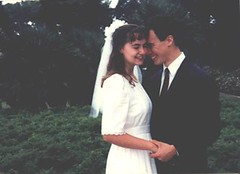
    wedding day, 1992 .

    Another post in the series about my relationship with John. You can find earlier entries here and here.

    When John and I were courting, I prayed to know if he was the right spouse for me. I knew that I loved him like I’d never loved another, I knew that I was super-attracted to him, and I could think of nothing better than the possibility of spending forever with him.

    A part of me really didn’t want to pray about whether or not to marry John. Because I knew if the answer from God was “no”, well, I’d probably go ahead and do it anyways because I was so head over heels in love.

    (Note: I don’t think I’ve ever told this to John, at least I can’t remember if I ever have)

    When I prayed about it I had many warm feelings. I felt sure that God wanted me to be happy and also that he blessed our union. However, there was one caveat to the response: I kept thinking of the choice that John made at age 18 to join the LDS church. He’d willingly disobeyed his parents and was completely disowned from them for his choice. Of course I, as a devout Mormon, felt that John had done right in choosing the church over his family. Yet as I prayed to know if I should marry John I realized that John had already demonstrated a willingness to sacrifice relationships for the sake of his ideals. And that scared me. I thought of John someday leaving the church and I acknowledged this as a very real possibility. Although there was nothing in John’s behavior or in his testimony that led me to think that he would leave the church someday, perhaps even then I was seeing this in our future.

  • revolutions


    My latest post over at ExponentBlog.

  • sparkly-clean


    Take a look at my brief post today over at ExponentBlog.