Category: LDS

  • Whenever I touch a velvet rose


    peace, originally uploaded by pilgrimgirl.

    Picture: a rose with yellow petals, tinged with pink and red at the edges.

    “My Heavenly Father Loves Me” was my all-time favorite Primary song when I was a little girl. One reason I loved it was because each time we sang it Miss Tammy would choose a handful of kids to hold pictures representing the images of the song: a bird, a rain shower, etc. and I would raise my hand high, hoping to be one of the children chosen to for the special job of holding a picture while we sang.

    It seems fitting to me that even now when I contemplate the song of a bird or the breeze rustling through the trees I am overwhelmed with gratitude for the beauty of the world and I feel closer to the divine.

    Whenever I hear, the song of a bird
    Or look at the blue, blue sky
    Whenever I feel the rain on my face
    Or the wind as it rushes by
    Whenever I touch a velvet rose
    Or walk by a lilac tree
    I’m glad that I live in this beautiful world
    Heavenly Father created for me.

  • Another Mo leaves the fold…

    This article ran in the Daily Herald today. It seems to be Richard Dutcher‘s farewell to the LDS church. Dutcher is the dynamic and visionary “father” of Mormon cinema. A part of me is shocked by his leaving the church. Another part of me isn’t at all surprised:

    Mormon doctrines are powerful and beautiful and have given great meaning to my life for more than 30 years. I’m sure they will always continue to inform not only my future work as a filmmaker, but also my private spiritual journey. But it does not appear that it will be my honor to make some of these films that the LDS community so desperately needs.

    As many of you know, I am no longer a practicing member of the church. The private answers to the questions I have asked in my prayers, and in my films, have led me on an unexpected journey, a spiritual path which may ultimately prove incompatible with Mormon orthodoxy. This understanding has brought me some of the most profound surprises and also the deepest sadness of my life. It is very hard for me to say goodbye to something that I love.

    Who knows? Maybe, like Oliver Cowdery (to whom I’ve always felt an uncommon kinship), my travels will someday lead back to Mormonism and to this effort. Such an end would be beautiful and, in a strange way, an answer to my prayers. But I don’t know. One fundamental thing I have learned over the past few years is a genuine humility regarding my spiritual beliefs.

    I know that some of you will not understand my decisions. Please know that I will always be not only a great friend to the Mormon community, but also one of its strongest defenders.

    My brothers and sisters, I respectfully leave Mormon cinema in your capable — and now seasoned — hands. I hope that someday I will hear a few of your names mentioned in the company of the handful of filmmakers who have dared to explore human spirituality in film: Bergman, Bresson, Tarkovsky, Dreyer, Ozu, etc. One of my greatest hopes, of course (in true competitive spirit), is that one day my name will be at the very top of that list.

    May God bless you in your individual and collective efforts. And may Mormon cinema one day achieve its powerful and beautiful potential. May it be “the praise and glory of the whole earth.”

  • mormon-ness?

    There’s something that’s been bugging me. I’ve been hesitant to blog about it because I want to think I don’t care. But I do.

    So, I’ve written before about whether or not I’m an ‘active’ Mormon. Over time I’m certainly becoming less insistent on calling myself active. I don’t think of myself or label myself in that way anymore, really. Am I active in Mormon studies, in thinking about Mormon issues? Yes. Am I active in the LDS church? No.

    But what really bugs me are these people in the bloggernacle (the Mormon blogosphere) who, whenever I write something, make these comments about how I’m not Mormon anymore. That’s just not true. My name is still on the church rolls, and I still have a Home and a Visiting Teacher.

    I don’t know why it bothers me that they do this. I guess it’s because I’m all about getting to define myself the way that I want to. It’s like this discussion I had with some Friends on Sunday–one is a Hindu Quaker. She was asking me why I can’t be both Mormon and Quaker. I was trying to explain to her how hard that is–that there are all kinds of ways that Mormon-ness is ‘policed.’ Yet the more I thought about it, I realized that if these same people in the Bloggernacle were, say, assigned to home teach an ‘inactive’ or less active Mormon, I doubt they would show up on their doorstep and say, “Hey, you’re not Mormon anymore” or any such thing. So why is it that people will say this to me online? And why do total strangers care so much about my church membership anyways? How is it that they can know how ‘Mormon’ I am without even asking me personally (or w/o speaking to my bishop)?

    The Church counts its membership in terms of how many people are listed in the records. I’m still there. I’m still being counted. And that’s important to me.

    And I’m also on the roster of my Quaker Meeting. And that’s important to me, too.

  • a reading

    For your enjoyment: my short creative nonfiction piece, “Pose”, which blends the experiences of Mormonism, yoga, cancer, and disability with my urgent desire to connect to the divine. This story appeared in the March 2004 issue of Sunstone magazine.

    Listen to Pose.mp3

  • Guest Post: RJohn on “Isostacy”

    Folks, please give a warm welcome to RJohn, for his inaugural guest post here at pilgrimgirl…

    Notes Toward a General Theory of Mormon Isostacy

    From the beginning, a confession: I am not qualified to speak on the question of how to avoid anxiety. I have often felt it. I do not enjoy it (even in Heidegger’s sense that anxiety opens your mind to a truer sense of “being”–I still don’t like it). And I still sometimes feel it, emptying out my chest in panic-filled breathing. This may come as a surprise to some people who know me, and perhaps old news to others. For those who have never had anxiety, you have to understand, there is not always a “cause.” Sometimes it just comes to you, disconnected from whatever is happening, and its sudden appearance is strange and terrifying (and in occasional rare moments, I have even felt this terror as something “beautiful,” as though I were approaching a deep and breathtaking chasm). I say this because I am convinced that my anxieties are not “caused” by my ambiguous relationship with god/church, or “caused” by the stressful exigencies of my chosen career, or even “caused” by the existentialist and post-structuralist theories I have learned to negotiate. They just are.

    And in this sense, I am probably not the person to turn to for advice on finding an emotional balance in life. Most of what I can offer here on “religious isostacy” is a path that is difficult and fraught with dangers. But I do it because I have found that there are many people like me for whom the idea of leaving a religious community seems painful and unnecessary, even though they go on being exposed to unconscionable discourse (in the sense that their “conscience” is damaged in failing to either speak against certain policies or resoundingly renounce one’s attachment to certain ideas).

    But let me try to get at what I mean by “religious isostacy.” The term “isostacy” is one I have borrowed from geology (and I’m not a geologist–yet another reason not to trust you, John! ). It’s definition has to do with seismic equilibrium in the earth’s crust: “a condition in which the forces tending to elevate balance those tending to depress; a state in which pressures from every side are equal.” You’ll find “isos” in other words conveying “balance” or “equilibrium,” such as in an isosceles triangle. If you write “isostacy” and try to spell check it, you get the suggestion “apostasy,” but of course they are not the same words at all, and this is really why I like it. Everyone knows what religious apostasy means. It means leaving the community, physically, but retaining a kind of fetishistic fascination for it (hating it almost as passionately as one might have loved it earlier in life). It means cutting off one’s self in terms of community, devotion ( i.e. not paying tithing or wearing the garment), and feelings, but not in mission. The apostate still wants to be in the church, but demands (or writes manifestos demanding) that the organization change in fundamental ways before s/he will return.

    This is, of course, the path that John and Jana are on now. And it is not one that I condemn (even though I do regret not seeing them around more often). In fact, I can even see the path of apostasy as a courageous act. My point, however, in introducing this idea of religious isostacy is that apostasy need not be the only response to the kinds of feelings and experiences people have in the church when confronted with doctrinal or cultural dissonance. As with many things, I get very suspicious when people tell me that there are only two possible options for things (apostasy or orthodoxy, war or appeasement, etc.)

    So let me try to be more specific about what I mean by religious “isostacy” as opposed to “apostasy.” In Billy Wilder’s 1960 movie “The Apartment” Jack Lemmon is a mid-level corporate manager with a number of quirky looks and sayings. One of his little catch-phrases is “That’s the way it crumbles . . . cookie-wise.” It’s corny, but sort of endearing too. After watching the film, I found myself riffing on the phrase in little ways (“that’s the way it bounces…ball-wise”–keeping these to myself, of course. I’d never be so corny in real life!). One day, as I was thinking about my complex relationship with Mormonism, I said something to myself like “Well, that’s just the way I’m thinking, other-wise”). And it struck me that “thinking otherwise” encapsulated nearly everything going on in my weird head at the moment: my doubts about doctrine, my love for Mormon friends and family, my search for the Truth of Mormon history–all of it in this one phrase. Thinking otherwise and thinking “other”-wise. The former is to begin thinking outside of orthodoxy, to be conscious that there are broader possibilities in the world, to have doubts (for me) about things like golden plates, seer stones, priesthood, and polygamy (that would be “other wives” rather than “otherwise” ha ha). But the latter is to be acutely aware that there are there important “others” in your life, “others” that you did not choose– wise to the “others” in the sense that you can sense how much you need them, how much those relationships make you who you are (and maybe even offer wisdom to some of them when they too begin sensing otherwise). Sometimes these “others” understand and even share your thinking otherwise, and sometimes they do not.

    For Mormon “isostates,” then, I recommend the following:

    1) Acknowledge, freely, at appropriate moments, that you have doubts, and that you believe very little about the finer points of Mormon dogma (and perhaps even that you find certain dogmas unhealthy or dangerous).

    2) Do not feel compelled to shout your version of Truth about the universe from the rooftops (or, if you like, your conviction that there is a lack of Truth about the universe).

    3) Reaffirm your commitment to the Mormon community by doing the sorts of things that connect you to that community (not drinking, paying tithing, going to church, etc).

    4) Remember that many Mormons and non-Mormons will not understand your isostacy. It may even seem crazy to them, so be willing to live with that.

    5) Remember that if you did leave (i.e. move from isostacy to apostasy), it would be tumultuous and difficult, but life would go on. It is possible that you may eventually find something outside of Mormonism that provides you with a greater “seismic equilibrium” (I say this because knowing that you CAN leave and be okay is crucial to knowing that you are choosing to stay, and not being forced to stay).

    6) Get involved in Sunstone, Dialogue, and other communities where you will find other souls in a similar isostatic state (and I could point here to Levi Peterson’s sense of being a “Christian by yearning,” or Wayne Booth’s notion of “hypocrisy upwards”–but there are many).

    Whether or not this will bring anyone relief or happiness, I do not know. But I am convinced that thinking otherwise/other-wise is a possible road, one that I’ve been on for some time now, and it has been good to me.

  • Guest Post: RJohn on "Isostacy"

    Folks, please give a warm welcome to RJohn, for his inaugural guest post here at pilgrimgirl…

    Notes Toward a General Theory of Mormon Isostacy

    From the beginning, a confession: I am not qualified to speak on the question of how to avoid anxiety. I have often felt it. I do not enjoy it (even in Heidegger’s sense that anxiety opens your mind to a truer sense of “being”–I still don’t like it). And I still sometimes feel it, emptying out my chest in panic-filled breathing. This may come as a surprise to some people who know me, and perhaps old news to others. For those who have never had anxiety, you have to understand, there is not always a “cause.” Sometimes it just comes to you, disconnected from whatever is happening, and its sudden appearance is strange and terrifying (and in occasional rare moments, I have even felt this terror as something “beautiful,” as though I were approaching a deep and breathtaking chasm). I say this because I am convinced that my anxieties are not “caused” by my ambiguous relationship with god/church, or “caused” by the stressful exigencies of my chosen career, or even “caused” by the existentialist and post-structuralist theories I have learned to negotiate. They just are.

    And in this sense, I am probably not the person to turn to for advice on finding an emotional balance in life. Most of what I can offer here on “religious isostacy” is a path that is difficult and fraught with dangers. But I do it because I have found that there are many people like me for whom the idea of leaving a religious community seems painful and unnecessary, even though they go on being exposed to unconscionable discourse (in the sense that their “conscience” is damaged in failing to either speak against certain policies or resoundingly renounce one’s attachment to certain ideas).

    But let me try to get at what I mean by “religious isostacy.” The term “isostacy” is one I have borrowed from geology (and I’m not a geologist–yet another reason not to trust you, John! ). It’s definition has to do with seismic equilibrium in the earth’s crust: “a condition in which the forces tending to elevate balance those tending to depress; a state in which pressures from every side are equal.” You’ll find “isos” in other words conveying “balance” or “equilibrium,” such as in an isosceles triangle. If you write “isostacy” and try to spell check it, you get the suggestion “apostasy,” but of course they are not the same words at all, and this is really why I like it. Everyone knows what religious apostasy means. It means leaving the community, physically, but retaining a kind of fetishistic fascination for it (hating it almost as passionately as one might have loved it earlier in life). It means cutting off one’s self in terms of community, devotion ( i.e. not paying tithing or wearing the garment), and feelings, but not in mission. The apostate still wants to be in the church, but demands (or writes manifestos demanding) that the organization change in fundamental ways before s/he will return.

    This is, of course, the path that John and Jana are on now. And it is not one that I condemn (even though I do regret not seeing them around more often). In fact, I can even see the path of apostasy as a courageous act. My point, however, in introducing this idea of religious isostacy is that apostasy need not be the only response to the kinds of feelings and experiences people have in the church when confronted with doctrinal or cultural dissonance. As with many things, I get very suspicious when people tell me that there are only two possible options for things (apostasy or orthodoxy, war or appeasement, etc.)

    So let me try to be more specific about what I mean by religious “isostacy” as opposed to “apostasy.” In Billy Wilder’s 1960 movie “The Apartment” Jack Lemmon is a mid-level corporate manager with a number of quirky looks and sayings. One of his little catch-phrases is “That’s the way it crumbles . . . cookie-wise.” It’s corny, but sort of endearing too. After watching the film, I found myself riffing on the phrase in little ways (“that’s the way it bounces…ball-wise”–keeping these to myself, of course. I’d never be so corny in real life!). One day, as I was thinking about my complex relationship with Mormonism, I said something to myself like “Well, that’s just the way I’m thinking, other-wise”). And it struck me that “thinking otherwise” encapsulated nearly everything going on in my weird head at the moment: my doubts about doctrine, my love for Mormon friends and family, my search for the Truth of Mormon history–all of it in this one phrase. Thinking otherwise and thinking “other”-wise. The former is to begin thinking outside of orthodoxy, to be conscious that there are broader possibilities in the world, to have doubts (for me) about things like golden plates, seer stones, priesthood, and polygamy (that would be “other wives” rather than “otherwise” ha ha). But the latter is to be acutely aware that there are there important “others” in your life, “others” that you did not choose– wise to the “others” in the sense that you can sense how much you need them, how much those relationships make you who you are (and maybe even offer wisdom to some of them when they too begin sensing otherwise). Sometimes these “others” understand and even share your thinking otherwise, and sometimes they do not.

    For Mormon “isostates,” then, I recommend the following:

    1) Acknowledge, freely, at appropriate moments, that you have doubts, and that you believe very little about the finer points of Mormon dogma (and perhaps even that you find certain dogmas unhealthy or dangerous).

    2) Do not feel compelled to shout your version of Truth about the universe from the rooftops (or, if you like, your conviction that there is a lack of Truth about the universe).

    3) Reaffirm your commitment to the Mormon community by doing the sorts of things that connect you to that community (not drinking, paying tithing, going to church, etc).

    4) Remember that many Mormons and non-Mormons will not understand your isostacy. It may even seem crazy to them, so be willing to live with that.

    5) Remember that if you did leave (i.e. move from isostacy to apostasy), it would be tumultuous and difficult, but life would go on. It is possible that you may eventually find something outside of Mormonism that provides you with a greater “seismic equilibrium” (I say this because knowing that you CAN leave and be okay is crucial to knowing that you are choosing to stay, and not being forced to stay).

    6) Get involved in Sunstone, Dialogue, and other communities where you will find other souls in a similar isostatic state (and I could point here to Levi Peterson’s sense of being a “Christian by yearning,” or Wayne Booth’s notion of “hypocrisy upwards”–but there are many).

    Whether or not this will bring anyone relief or happiness, I do not know. But I am convinced that thinking otherwise/other-wise is a possible road, one that I’ve been on for some time now, and it has been good to me.

  • consider the lilies of the field…

    What surprised me most about attending the LDS Church on Sunday? The way the attendees were dressed.

    Let me speak a bit first about the way my Quaker Friends dress for church. The men generally wear khakis, jeans or shorts with t-shirts, polos, or button-downs. Occasionally one will wear a sweater. I don’t recall every seeing a tie, suit, white dress shirt, or dress shoes on a male Friend.

    The women’s clothes are quite similar. Some of the women wear nice jewelry, as in a pair of amber teardrop earrings. A few of the older female friends wear dressy scarves or jackets. I’ve seen the women wear loafers, but I don’t think I’ve ever seen a pair of pumps, wedges, or high heels in Meeting. Clogs, sandals or athletic-style shoes are most common. Many Friends wear the same clothes each Sunday. I usually wear my serviceable long-ish black polyester skirt (this same skirt that I’ve had for 10 years and accompanies me on all of my overseas travel because of its indestructibility) with a t-shirt, sweater, or blouse. Sometimes I wear pants, but not as often as a skirt because we do laundry on Sunday afternoon and I rarely have any clean pants on Sunday morning.

    Allright now, back to LDS. Many of the younger women looked dressed as if they were headed to a club. Slinky, clingy fabrics. Very short skirts. Plunging necklines. All in the latest fashions (at least, I am making that assumption given that I know so little about fashion) With all of the makeup, jewelry, and high-heeled shoes to match. The men, of course, wore the requisite dark suits, white shirts, and ties. With expensive-looking leather dress shoes and belts. I found the men quite intimidating–I haven’t been around ‘suits’ in months (no one in academia dresses like that). I hadn’t realized how overwhelming such clothing can be. It gave me pause as I considered how the LDS might appear quite daunting and over-the-top corporate to newcomers.

    As I reflected on this later, it seemed odd to me that the LDS women were dressed so worldly, so ‘immodestly.’ At Quaker Meeting I’ve never seen a mini-skirt or any cleavage. Yet Quakers have no rules or restrictions about the clothing of their members. And the LDS are counseled to dress modestly, even having this reinforced/policed by the nature of their temple garments.

    Interesting…

  • On “wearing my wings”* or wearing a yoke or attending Sunday School today

    So I went to LDS Sunday School today. For those who are wondering, it wasn’t because I am contemplating a ‘return to the fold.’ (Please don’t be confused here. Really.)

    I’m currently grappling with ideas of where my alliances lie–with respect to friends, to community, and to institutions (like the Church).* After thinking long and hard about this yesterday, I’ve decided that my greatest loyalty of these, by far, is to my friends. Hands down. As I’ve said before, I do have the bestest friends.

    So one of these friends was teaching today. And as he’s someone who’ll be moving on soon, I wanted very much to support him and to savor this opportunity to learn from him and the ways that he views the world. What a pleasant surprise to arrive at the meeting and discover that his lesson was on Matthew 11:28-30. These are, perhaps, the three verses of the Bible that have seen me though more dark nights than any other. They’ve been a balm to my raw wounds, especially those that festered so painfully after my father died. Such beautiful sentiments and promises, therein. Despite my current unbelief in LDS doctrine, these memories are still precious to me.

    Sitting there, it was difficult, at first, to concentrate on the lesson. I’m so used to quiet, to letting Spirit wash over me in that silence of Quaker worship, that the words were disruptive. I had a hard time moving from thought to thought through the lesson. I wanted time to pause, to let it sink in. But of course it doesn’t work that way in LDS practice. So when the words and ideas were moving too quickly I let my gaze rest on my brothers and sisters in the room. I was surprised to see so many familiar faces given the gianormous size of the ward. That was joy. I sent my love to each of them and I hope they felt it. I hope that my presence there didn’t make it difficult for anyone else to feel uplifted. I hope that the example of the love of Christ (for, from, and like Christ–as JW so eloquently articulated in his lesson) is a lingua franca that can overcome any barriers or frustrations that others may feel for me. And I for them.

    *Notes: 1) The wings reference is from this poem. 2) My loyalties to myself, to John, and to my children trump those to friends, but those aren’t what I’ve been fretting about lately…

    “Come unto me, all ye that labor and are heavy laden, and I will give you rest. Take my yoke upon you, and learn of me; for I am meek and lowly in heart; and ye shall find rest unto your souls. For my yoke is easy and my burden is light.”

  • On "wearing my wings"* or wearing a yoke or attending Sunday School today

    So I went to LDS Sunday School today. For those who are wondering, it wasn’t because I am contemplating a ‘return to the fold.’ (Please don’t be confused here. Really.)

    I’m currently grappling with ideas of where my alliances lie–with respect to friends, to community, and to institutions (like the Church).* After thinking long and hard about this yesterday, I’ve decided that my greatest loyalty of these, by far, is to my friends. Hands down. As I’ve said before, I do have the bestest friends.

    So one of these friends was teaching today. And as he’s someone who’ll be moving on soon, I wanted very much to support him and to savor this opportunity to learn from him and the ways that he views the world. What a pleasant surprise to arrive at the meeting and discover that his lesson was on Matthew 11:28-30. These are, perhaps, the three verses of the Bible that have seen me though more dark nights than any other. They’ve been a balm to my raw wounds, especially those that festered so painfully after my father died. Such beautiful sentiments and promises, therein. Despite my current unbelief in LDS doctrine, these memories are still precious to me.

    Sitting there, it was difficult, at first, to concentrate on the lesson. I’m so used to quiet, to letting Spirit wash over me in that silence of Quaker worship, that the words were disruptive. I had a hard time moving from thought to thought through the lesson. I wanted time to pause, to let it sink in. But of course it doesn’t work that way in LDS practice. So when the words and ideas were moving too quickly I let my gaze rest on my brothers and sisters in the room. I was surprised to see so many familiar faces given the gianormous size of the ward. That was joy. I sent my love to each of them and I hope they felt it. I hope that my presence there didn’t make it difficult for anyone else to feel uplifted. I hope that the example of the love of Christ (for, from, and like Christ–as JW so eloquently articulated in his lesson) is a lingua franca that can overcome any barriers or frustrations that others may feel for me. And I for them.

    *Notes: 1) The wings reference is from this poem. 2) My loyalties to myself, to John, and to my children trump those to friends, but those aren’t what I’ve been fretting about lately…

    “Come unto me, all ye that labor and are heavy laden, and I will give you rest. Take my yoke upon you, and learn of me; for I am meek and lowly in heart; and ye shall find rest unto your souls. For my yoke is easy and my burden is light.”

  • The Hardest Part, part I

    For those of you who are new to pilgrimgirl, this is an installment in my ongoing effort to explain why I left the Mormon church about a year ago. You can find related posts here.

    This will be the hardest part of the story to tell. But I think I’m ready now. Why is it so hard, you ask? Maybe because it matters so much. Maybe because it took that long to find the words to tell of the experience.

    So I was sitting in church on a very typical Sunday. We were having a fairly unordinary meeting where the men’s and women’s groups were meeting together for an hour after Sunday School (usually the adults meet separately during this part of church). John wasn’t attending church with me on this particular Sabbath. So I sat by myself in the back of the room, empty chairs on each side of me. I didn’t mind being alone, really. If I sat with friends I was generally too distracted to pay much attention to the meeting. And for whatever reason, this particular Sunday I actually wanted to listen, perhaps because many weighty issues were on my mind. Specifically, I was concerned about John’s apathetic attitude towards church, I was thinking about my son’s upcoming ordination to the priesthood (it would occur on his 12th birthday), and I was musing about my own difficulties with some particular church doctrines.

    The Bishop announced a line-up of 4 or 5 male speakers who would discuss various fundamental gospel topics. A few of them got up to the podium to give their spiels. Near the end of the meeting an older man addressed the issue of the Restoration of the Gospel. He began by discussing Joseph Smith’s Vision of the Father and Jesus Christ and then launched into an extended discussion about the Restoration of the Priesthood. He gave specifics of how this occurred through angelic visitor’s conferring ‘priesthood keys’ on Joseph Smith. Following that, the speaker delineated each of the LDS ordinances that are administered by priesthood holders and emphasized their necessity for salvation.

    During much of this man’s talk I found myself impatient. I felt I’d heard this so many times. There was no fresh insight in his words, no illuminating inspiration. I grew weary of the meeting and was looking frequently at my watch, hoping that the talk would be over soon.

    As he began discussing the necessity of priesthood ordinances, however, my feelings began to turn. I focused intently on what he was saying and as I did so, I felt a heavy black fog settle in around me. It was prickly and cold. And then I felt pressure squeezing against my entire body. I looked around at the other people sitting around me in the meeting. Their faces were impassive.

    I tried to understand this feeling that was now so uncomfortable that I felt nauseous. I fought an almost overwhelming urge to stand up and get up out of the meeting. Not wanting to make a scene by leaving, I turned inward, asking myself What is going on? As I did so, distinct words formed in my mind: I DO NOT BELIEVE THIS.

    To be continued in part II

  • from the archive…


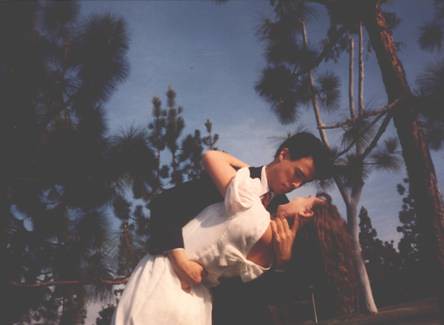
    Park pose, 1990, originally uploaded by pilgrimgirl.

    This photo, taken 17 years ago on a day like today–sunny clear and spring-ish. Me and my about-to-be missionary man in a park near the home where he was renting a room.

    Could we see then, who we are now? No way! Did we even think after two years of separation (during John’s mission to Japan) that we would even end up together? We hoped so, but at that time that was much too far away to anticipate.

    This picture brings back much of that longing I felt when we were first dating–the hoping that John and I were meant to be together, the brightness of the possibilities that lay ahead for us, and the desperate affection I held for him. Even then the world seemed to spin around us while we were safe in each other’s arms. As if time was stopping for us, as the rest of the world moved on.

  • no sheep’s clothing ’round here…

    I’ve had few, if any, regrets about finding a new church home. Quotations like this one from J. Reuben Clark affirm to me that I made the right choice (not, of course, because I look to Clark as my spiritual leader, but because he underscores the fact that by living with integrity (e.g. leaving the fold), rather than continuing to pretend to be Mormon when I don’t believe in the church’s dogma, I am choosing the right):

    “Any titular Church member who does not accept the First Vision but who continues to pose as a Church member, lacks not only moral courage but intellectual integrity and honor if [s]he does not avow h[er]self an apostate and discontinue going about the Church, and among the youth particularly, as a Church[wo]man, teaching not only lack-faith, but faith-destroying doctrines. [S]he is a true wolf in sheep’s clothing.”