Category: amputee

  • because there is no recession for a sick kid…


    I’m sure you’ve all heard of St. Jude’s Hospital, the world-class medical facility that never turns away a child because they can’t pay for healthcare. My biochemist brother David is a researcher at St. Jude’s–his lab has a robot that tests thousands of chemical samples for possible therapeutic properties.

    Recently he called my attention to this video clip of a teen with osteosarcoma (scroll down and click on the link from the Nov 25 show), the same type of bone cancer that I had at age 12. I know it’s a busy season and the economy is awful this year, but if you’re blessed with any surplus to share, St. Jude’s is a worthy cause. Though I wasn’t treated at their facility, they are one of the sponsors of a long-term cancer survivor study that has been invaluable in giving me information about the health issues that I will continue to face because of my high-dose chemotherapy treatments (with their life-altering side-effects).

    Pic above is of me back in 1984 when I was undergoing my cancer treatments.

  • Adaptive exercise: uniped-style

    exercise
    As an amputee I’ve found that finding ways to do cardio exercise is not easy. I’m not able to run or play sports like tennis or basketball. I can bike, but not for very long distances (due to socket discomfort), and any activity where I get very hot is bound to cause my leg to sweat in the socket and start slipping off, which is painful and can result in injury. Most water sports are out because I have a C-leg that can’t get wet–swimming is the exception because I do it sans prosthesis, but I find that it’s not convenient on a daily basis because of the time entailed in getting to the pool, showering, and then getting back into my leg.

    So with this in mind, when I decided I wanted to “get fit” and healthy after I had sufficiently healed from my recent surgery, I had to figure out a way to adapt an appropriate exercise regimen. I wanted to be able to workout at home for convenience’s sake, which added a level of difficulty to finding a good way to exercise. Oh, and also added to the challenge was the fact that I had neither money nor space for any large equipment like a recumbent bicycle or a rowing machine.

    I decided on a two-prong approach to cardio fitness. First, I bought an inexpensive mini-trampoline because I had heard from another amputee that she jumped on a trampoline and that it was a good workout. Second, I remembered from years ago a physical therapist recommended stretching using a fitball so I could strengthen my hips and abs (very important walking muscles for an amputee). I realized that I could “jog” while sitting on a fitball by recreating a jogging hip/arm motion. I don’t wear my prosthesis for either exercise. I have added amazon links to both of these items (above) in case you want to purchase something similar, but you should know that both these items are often available via freecycle and craigslist for free.

    My typical daily cardio workout is now a 5-10 min jump on the trampoline and a jog on the ball for 20-60 min. A word of warning to any amputee attempting to jump on a trampoline: I do so while having the tramp near a wall or doorway so I can easily reach out and stabilize myself if I start to fall over (which happens quite often). My trampoline doesn’t have a stability bar (like the one on the link above does), but I do highly recommend the bar for anyone who is just starting out with this type of exercise. While jumping or jogging I put on headphones with some good tunes and I also hold dumbbells (varying from 3-12 lbs) for a bit of added strength training. When I first began my workouts on the fitball I fell off a lot, and I still do sometimes. Make sure that you are close enough to a wall or chair that you can catch yourself if you start to tip over. And whatever you do, don’t fall over into a bookcase where a large bag of catfood is likely to be dislodged and fall on your head (just saying…). Also, when you first start this type of exercise, just try for 5 min and then work up to longer workouts. It’s deceptively hard work to hold yourself in balance on a ball while jogging and holding dumbbells. You will feel it in your back and abs, trust me. :)

    Since I’ve started my tramp/ball workouts I’ve noticed that I have far greater strength and endurance for walking. These exercises are not only good for my heart, but they seem to target the same muscles that I need for stability in ambulation. I’ve also lost fat and a few pounds along the way. As a result, I feel better, look better, and I have a lot of fun with my morning workouts.

    In addition to cardio exercise, I also do dumbbell weight training exercises and about 20 min of yoga stretching daily. In future posts I will discuss how I’ve adapted both weight training and yoga to suit my unique body.

    Much of my motivation in writing this post is to suggest various ways that those with bodies like mine might also get ideas about how to achieve cardio fitness. But I’m also writing this because of my many years of frustration at trying to exercise like bipeds and feeling painful and discouraged. Yes, most cardio work depends on being able to bounce, jump, and run confidently on two legs and that’s great for those people who can do that. But for those of us who can’t, it’s quite difficult to figure out how to get our bodies moving in ways that will be safe, fun, and effective. My methods aren’t based on any specific advice from a physician, trainer, or a physical therapist, even though I’ve asked plenty of them for ideas over the years. Instead, I’ve figured this out on my own, as someone who is well aware of my own abilities and limitations. I finally hit a point where I realized that no one else could really tell me how I could best get exercise–I was just going to have to figure it out myself, as I am sure many of you have. Thus, I would really like to hear from those of my readers who have also developed your own adaptive fitness techniques–what do you do and how do you do it?

    Caveat: I’m no physical therapist, I am only saying here what’s worked for me in the hopes that it might be helpful to others who are looking for adaptive exercise techniques. Do run these ideas past your doctor or therapist before you try them, ok?

    Pic above was taken by John while I was jogging on my fitball.

  • pilgrim classic: without a foot to stand on

    Originally posted 11/30/2006:

    Can I just say that I really dislike quotes like this one:
    “I complained because I had no shoes until I saw a man who had no feet.”

    Ahem, but what is that saying about men (and women) with no feet??? That they exist as morality lessons for all those shoeless joes out there? Or as objects of pity for all those folks whose closets are so full of shoes that they don’t have enough space to keep them in???

  • phantoms

    Blogfriends:
    The drawing will be delayed for one day (good for you, you get one extra day to leave a comment!).

    I am having some terrible phantom pains this afternoon (it happens one or twice per year). I’ll feel better after hibernating for a few hours.

    Happy Friday everyone! :)

  • not logical

    I’d say that probably 3 or 4 times per year I get some type of parking citation for parking in a disabled parking stall–even with my properly displayed placard. It happened again this morning, only this time I was parked in the stall adjacent to the disabled parking stall because the stall was already taken by another car. Due to construction, there are only two disabled stalls for the entire Humanities area of UCI which has four mid-rise buildings of offices and dozens of classrooms. I got to campus at 8:55am and both spots were already taken. [I should note that there are 5 disabled stalls on the FAR end of this parking lot that are not close to ANY buildings (they are adjacent to an access road and a park). These stalls are so far away that they aren’t even visible from the pathway leading to the Humanities buildings. In the past when I’ve complained about the number of disabled stalls–suggesting that it may not be legal to have so few spaces, those out-of-the-way spaces have been pointed out to me. I don’t consider them accessible and I would suppose that no one else does either given that they are always empty.]

    So I wrote a friendly email to the UCI Parking Office explaining the situation and asking that they stripe more stalls during the construction given that we are all struggling to use two stalls and many of us really _need_ the extra footprint of the larger stall to safely enter/exit our vehicles.

    The only response I received was a terse email saying that I would have to go through the regular citation appeal process if I want to ‘contest’ my citation from this morning.

    So I ask, is it logical that because I was mistakenly cited this morning that I have to go through the time and trouble to appeal this parking ticket? I mean, of course we all make mistakes and I try to have a good sense of humor about these types of inconveniences, but I’m just not feeling particularly patient today.
    /whine

  • harrowing adventures

    First, it must be said: There’s no place like home. I’ve smothered all the peoples here with hugs and kisses. And the kitties, too.

    To the harrow:
    ~Within 48 hours of my arrival in Colorado, my leg infection returned (but, hey, before it got out of control I at least got to hang out at the Hot Springs with my hot sistas, so I feel I can’t complain too too much). I got acquainted with the fine healthcare system at Swedish Medical Center and can say that if one is in need of urgent care in Denver, that is surely the place to head. Yes, I’m doing better now–started yet another round of antibiotics and spent some time with my friend vicodin.

    ~Coming home I had my most traumatic experience with airport security yet. I politely explained to the guard before I walked thru the metal detector that I didn’t need to remove my shoes because of my disability and I would have to be hand-searched because of my prosthetic leg. However he decided that I was being a “belligerent passenger” and called out the red alert. I ended up removing my shoes while being surrounded by several security personnel and then penned in a plexiglass enclosure.

    Moments later, as the head of security was profusely apologizing me for all that had happened–I still in my socks and walking on a slick linoleum floor, slipped and fell in front of a huge crowd of onlookers. I was just mortified–at the horror of being corralled by security, at being held and treated like a criminal simply for trying to explain my needs to one over-reactive employee, and then slipping. And just feeling so vulnerable everytime a TSA employee takes advantage of me (it’s not the first time).

    And, why, oh why do I not feel one whit safer in the skies with these numbnuts policing our airlines?

  • pilgrim classic: I, robot

    Originally posted on 3/1/2007:

    Sometimes I make jokes about being a “bionic woman” or a “cyborg.” Having a prosthetic leg with a computer-controlled knee joint lends itself to such comparisons. Truth be told, the first thing I’d reach for if there was a house fire in the middle of the night and we needed to exit quickly, wouldn’t be the family photo albums. I’d reach for my robotic leg. It would make sense, given that the leg cost as much as a luxury car. And, of course, because it’s essential for my mobility.

    I’ve been robotic for about three years. When I first heard that my insurance would pay for a computerized knee joint, I was thrilled to adopt the technology. I knew that it meant more stability, fewer falls, and a more natural gait. My prosthetist duly warned me not to get it wet, to charge the battery every night for at least three hours, and to notify him at the first sign of any malfunction.

    My kids were thrilled with my leg and its robotic possibilities. We wondered what might happen if an evil genius reprogrammed my leg and forced me to rob banks or steal diamonds? We giggled long and hard about that scenario. The first time my battery started running low, I was standing in a grocery checkout line with my son and daughter. We heard the telltale beeps and I felt the vibrating sensation like a cellphone ringer, notifying me that I had 10 minutes to get my leg plugged in or I’d lose power altogether. We raced home and made it just in time. The adventure was more thrilling than a car chase scene in a spy movie.

    Some days, however, I feel guilty about owning a leg that cost more than fifty thousand dollars. I think of my limbless sisters and brothers in other circumstances and I realize that dozens—if not hundreds—of low-tech limbs could be purchased for the price of my computerized leg. And I contemplate the thousands of new amputees returning home from Iraq, and those people throughout the world who live in daily fear of loss of life and limb.

    Last year my leg malfunctioned while I was traveling in Asia, perhaps a result of using a faulty power adapter for charging my leg. Though there was no way to get the computer repaired during my trip, I was able to continue my travels with my knee stiff–walking as if wearing a cast. Despite the impairment, I carried on with typical tourist activities: scaling the Great Wall, strolling through the markets, touring gardens, and do forth. Nearly every place we visited there were beggars, many of them amputees. I knew I needed to avoid giving handouts or I would be besieged by dozens of people asking for the same. So I kept my hands in my pockets and looked into their eyes and felt heartsick and smug. Contemplating the price that bought my mobility. Feeling my own betrayal.

  • ballet, sans limbs

    I love ballet, but this piece is a bit too overly-sentimental for me. Still, it’s interesting to see how the leg amputee uses his crutch and his body to move around the stage. What do you think?

  • pilgrimclassic: Casting Faith

    This post originally appeared on Nov 19, 2006:

    On Thursday during my casting appointment there was a group of four people involved in the process—two prosthetists and two interns—each taking a different role in wrapping my residual limb in a flexible fiberglass shell, then shaping that shell into a form that will both conform to my anatomy and will also best contain the tissue, muscle and bone as I walk. This is an intimate process, as the socket of my prosthetic leg interfaces with the major bones of the pelvic girdle—holding in the ischium and pressing against the ramus.

    It is an odd feeling to have two male prosthetists shaping the casting material between my legs and around my hip. Realizing that they are interacting with the most personal spaces of my body. Knowing that it is their job and this is a necessary process for getting a good fitting socket. Me, trying to remain a bit aloof and distanced from the process, yet at the same time having such high hopes that they will get a good fit—that the socket will work well and not cause pain and the suppurating sores that I’ve suffered with for the past few years.

    On Thursday evening I experienced a different form of intimacy. I gathered around the kitchen table of a Friend, holding hands with three Quaker women who agreed to serve on my Clearness Committee. We sat in silence, in prayer, until I felt moved to speak, to tell them of the turmoil in my heart in the process of leaving Mormonism. I spoke hesitantly, nervously. Their role was only to ask open-ended questions. Not to judge. Not to guide. After 90 minutes of speaking and silence, they mirrored what I had spoken back to me. They told me what they had heard me say. They discussed how my body language revealed the truths of my heart. Most of all, they shared their concern for the burdens that I am carrying.

    Perhaps ironically, the Clearness Committee experience was far more discomfiting and intimate than the casting for my prosthesis. For I don’t readily share the thoughts of my heart. Yes, I do this daily blogging, but I speak primarily of mundanity here. I’ve only very hesitantly shared the steps of my spiritual journey with anyone. I suspect that most just can’t understand. Within the Mormon community I feel censure and distrust. I have few friends who can empathize with the loss of faith. Who can grieve with me through this process?

    Outside of Mormonism, I am flummoxed by trying to explain what leaving the church means. That it is a complete change of worldview. Is it, perhaps, like having to relearn to walk?

    There is a popular LDS song called “I Walk By Faith” that I sang often during my teen years. I identified with this song as a young Mormon who was developing faith in Christ and as an amputee, because each step involved trusting my prosthesis in hopes that it would support my weight. So now on my spiritual journey away from the LDS Church I am learning what it means to walk by uncertainty, to walk by doubt, to walk into completely unknown territory as my heart leads me onwards. Ironically, this seems the biggest leap of faith thus far.

  • pilgrimclassic: a photo tribute to a well-traveled limb

    Originally published on December 13, 2006:

    Bidding farewell to most of my leg today as I upgrade the socket, cosmesis, stockings, and so forth. A pilgrimgirl first: a photo essay tribute to a well-traveled limb.

    As I put this together I asked myself why I wanted to take pictures of my leg, why this was important to me. And I realized how much I wish I had similar photos of my real leg before it was amputated. To help me remember.

    Update: here is a ‘key’ to the photos for those that are difficult to identify
    1) both feet
    2) my worn-out heel
    3) a tear in the covering at my knee
    4) the valve that seals my suction socket
    5) my big toe w/a shredded nylon over it
    6) looking down the back of the leg starting at the heel

  • pilgrimclassic: I, robot

    Originally posted on 3/1/2007:

    Sometimes I make jokes about being a “bionic woman” or a “cyborg.” Having a prosthetic leg with a computer-controlled knee joint lends itself to such comparisons. Truth be told, the first thing I’d reach for if there was a house fire in the middle of the night and we needed to exit quickly, wouldn’t be the family photo albums. I’d reach for my robotic leg. It would make sense, given that the leg cost as much as a luxury car. And, of course, because it’s essential for my mobility.

    I’ve been robotic for about three years. When I first heard that my insurance would pay for a computerized knee joint, I was thrilled to adopt the technology. I knew that it meant more stability, fewer falls, and a more natural gait. My prosthetist duly warned me not to get it wet, to charge the battery every night for at least three hours, and to notify him at the first sign of any malfunction.

    My kids were thrilled with my leg and its robotic possibilities. We wondered what might happen if an evil genius reprogrammed my leg and forced me to rob banks or steal diamonds? We giggled long and hard about that scenario. The first time my battery started running low, I was standing in a grocery checkout line with my son and daughter. We heard the telltale beeps and I felt the vibrating sensation like a cellphone ringer, notifying me that I had 10 minutes to get my leg plugged in or I’d lose power altogether. We raced home and made it just in time. The adventure was more thrilling than a car chase scene in a spy movie.

    Some days, however, I feel guilty about owning a leg that cost more than fifty thousand dollars. I think of my limbless sisters and brothers in other circumstances and I realize that dozens—if not hundreds—of low-tech limbs could be purchased for the price of my computerized leg. And I contemplate the thousands of new amputees returning home from Iraq, and those people throughout the world who live in daily fear of loss of life and limb.

    Last year my leg malfunctioned while I was traveling in Asia, perhaps a result of using a faulty power adapter for charging my leg. Though there was no way to get the computer repaired during my trip, I was able to continue my travels with my knee stiff–walking as if wearing a cast. Despite the impairment, I carried on with typical tourist activities: scaling the Great Wall, strolling through the markets, touring gardens, and do forth. Nearly every place we visited there were beggars, many of them amputees. I knew I needed to avoid giving handouts or I would be besieged by dozens of people asking for the same. So I kept my hands in my pockets and looked into their eyes and felt heartsick and smug. Contemplating the price that bought my mobility. Feeling my own betrayal.

  • my feet, they’re all wet…


    gettin’ my feet wet, originally uploaded by pilgrimgirl.

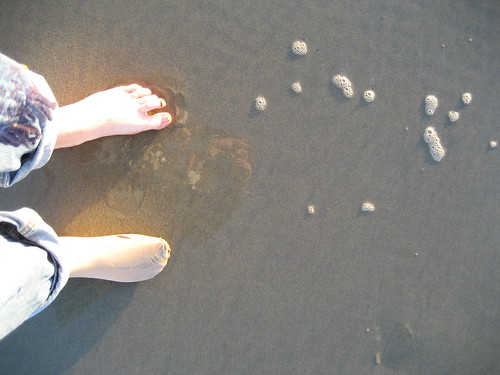
    I can’t get my right foot wholly wet because I don’t want it’s computer-y parts to malfunction. But I can get the prosthetic footshell and nylons a bit soggy, as I’m doing here. Chasing the waves and enjoying the cold sand between my toes.

    When I load photos of my fake foot to flickr (even one as innocuous as this one), I get hundreds of views. There’s a large community of amputee fetishists (called devotees) who are fascinated by such pics. Sometimes I am wary of the attention that such photos garner. Sometimes I just don’t care. Sometimes I am curious about the people who are so interested in me simply because of my missing limb. I suspect that some of my regular readers on this blog may be devotees and I’m okay with that. If you are interested in the whole me (and not just the missing bits) then that seems far less disconcerting than those who simply compile links to images of amputees.

    While I don’t completely understand the fascination that devotees have with amputee women, I can recognize that I have my own odd proclivities. Some folks are just more interesting or attractive to me for whatever reason–it’s a personal aesthetic that seems beyond explanation.

    But a part of me still feels a bit uncomfortable with the fact that a photo of my feet is of more interest than one of my face.