Author: Jana

  • philia

    clouds
    I am drawn to people with passion and vision. That’s much of the reason that I started my podcast–because I wanted to have conversation with people who share my history-lust. Talking to such people causes me to fall in love with my chosen profession (and the whole entire world, for that matter) all over again.

    I was similarly drawn to the passion shown in Wallace J. Nichol’s Oceanophilia post (thanks @hallnjean) about ocean-love and neuroscience. He writes:

    We humans offer up our dreams, our secrets and our treasures to the sea from whence we came…What is it about the ocean that speaks to us on such a fundamental, profound human level? I have always wanted to know, but my chosen profession, science — skeptical, detached, dispassionate science — wouldn’t allow me to go there.

    When I was a graduate student, I tried to weave that big human Love into my dissertation on the relationship between sea turtle ecology and coastal communities. No luck. My advisors steered me to other departments, another career even. “Keep that ’emotional’ stuff out of your science, young man,” they counseled. Emotion wasn’t rational. It wasn’t quantifiable. It wasn’t science…

    We must seize this particular moment in time — when the nascent power of neuroscience is burgeoning and the popular momentum is toward conservation rather than exploitation. We can use science to explore and understand the profound and ancient emotional and sensual connections that lead to deeper relationships with the ocean. I believe that if we do that we have an opportunity for real conservation gains that could do some true and lasting good for the ocean and planet Earth.

    It’s time to drop the old notions of separation between emotion and science. Emotion is science. Let’s convene the top marine scientists, skilled communicators, dedicated conservationists, and leading neurobiologists and cognitive psychologists to ask and answer the most probing and compelling set of questions about the ocean that we can imagine. Let’s explore the mind-ocean connection — oceanophilia.

    His thoughts about oceanophilia echo many other things that are whirling around in my brain this morning. In just a few hours I will abandon all of the tasks on my list and head out for a few hours on my outrigger. To let the ocean tug and push me as she may, while I paddle, paddle, paddle. The connection with the water will stretch and pull me into balance once again.

    And at the same time, I’m thinking a lot about my experience yesterday at THATCampSoCal (a tech-humanities un-conference). A primary theme running through the day was how to forge (and control) one’s online identity in a way that will be an asset in the pursuit for a tenure-track job. The hiring and promotion practices for historians are so capricious. One certainly can’t second-guess all that happens behind the scenes in such interactions. While I want to be thoughtful and careful with my online presence, the thought of having an imaginary search committee governing my actions is so much like the way I used to think about Mormon God–the attempt to “please” someone who was so remote and nebulous and judgmental–it had the hair standing up on the back of my neck.

    Instead, I want to throw myself into my life. Letting my passion and my curiosity drive my choices and my research. I expect that I will make mistakes. I suspect that I will be accused of “not doing it right.” I suspect that I may never get tenure. But I need poetry and art and sunshine (and moonlight). I need waves that pull and bump and threaten me. I need to tell my stories without worry about how they will affect my job security.

    The internet has been my playground for the past decade–just because academia has finally found it, too, I don’t want to lose the immediacy and the thrill of this space.

    And, below, another link I just had to share (if only because of my long-time crush on Bill Nye):

  • Daily Cuppa

    teatime

    This evening a friend dropped by and we shared some tea & scones after dinner. It wasn’t until about after an hour of chatting that I realized that I’ve been so crazy-intensely busy lately that the luxury of having a friend over for a cup of tea simply hasn’t been on my agenda. It’s no wonder, perhaps, that I’ve been waking up in the morning with a tight jaw, after I’ve been dreaming about lists of “To-Do” all night.

    So I’m trying to reincorporate some space for peace and relaxation. Adding meditation. Walks. Sitting time in the garden. It won’t be easy with the schedule that I’ve got over the next few weeks, but I know I need to keep the balance in my life. (poetry, I hear you calling my name….)

    For those of you who have missed my regular postings here, you might want to drop by History Compass or take a listen to one of my recent podcasts.

  • Teh Awesome

    John & Catgirl battling it out in one of UCI’s Lecture Halls. They crack me up!
    PS: Look how tall that Catgirl is getting!

  • birthright

    There are some things that I don’t like about this video–such as the belaboring of the prep before surfing. But there are some things that I love about it. Like that moment where the first wave passes over him and all the sand is washed away…it’s just perfect. And then, seeing him in the water moving so fluidly…I know that feeling so well.

    How can I explain what it means to be in water? To be the only place where gravity doesn’t pull and tug in ways that make movement difficult? In the water, on the water, under the water–I am a fish and my legs (or lack thereof) no longer matter.

    The other thing I like about this video–how it shows the innovative things that Michael does to allow him to surf–such as balancing the end of the board on the fence near the car…So cool.

    BIRTHRIGHT from Sean Mullens on Vimeo.

  • pilgrim classic: Saint or Sinner?

    Republishing this post from 2/19/07:

    [Full disclosure: I kifed this book from John’s pile this morning. And I am ‘stealing’ one of its ideas for this post.]

    Are you good? Are you bad? A host of consequences hangs on the answer. Yet, a brief experiment can easily convince you that the question, so grave in appearance, has little foundation.

    Consider how you spent yesterday. Retrace the main events, how one led to the next, and, as far as possible, reconstruct the thoughts that went with them hour after hour.

    From this reconstruction, consider your attitude. Not objectively. In a partial, exagerated, and tendentious way. Note first the extreme magnanimity of your smallest actions. Be a benevolent judge of your innermost thoughts. Look how devoted you have been, how attentive, altruistic, sympathetic, humane, supportive, charitable, etc

    And then do exactly the reverse. Force yourself to discern, in your acts and thoughts during that day, the obvious signs of perversity, your ability to harm, your taste for destruction, your fundamental wickedness…

    And then, if you have carried this out completely enough, try believing in moral judgements and the searchings of conscience. What have you learned?

    A bit of my experience (note: somewhat sanitized to avoid speaking of particular interactions w/people who might be reading my blog):
    The Saint
    In worship yesterday I felt lightness, love, goodness. A closeness with the spirit. I reached out to newcomers after Meeting. I ate lunch with friends and enjoyed their thoughts and their humor. I ate a divinely-tasty egg salad sandwich. I spent time interacting with my kids and John in the afternoon. I did the family’s laundry rather than spending time on my own tasks. Assembled a favorite salad to share with friends at dinnertime. Was gracious to Friends for their hospitality, etc, etc.

    The Sinner
    Slept in and was grumpy in the morning, as usual. Was testy with John and the kids because I was ready for Meeting before they were. Got to church late, despite having arranged to meet newcomers there beforehand. Resented some disruptions during worship. Had difficulty quieting my mind. Thought mostly of myself and all I want to/need to do. After meeting, left fellowship early to spend time with my friends. Ate egg salad sandwich for lunch w/no remorse about consuming animal protein. After dinner, poked fun of 50s movie and traditional Quakers. Tried to be funnier to impress friends. Thought more about how I was feeling than about others. Didn’t reach out to those I didn’t know well.

    Upshot:
    More than ever I agree with C.S. Lewis that:

    There are no ordinary people. You have never talked to a mere mortal. Nations, cultures, arts, civilizations–these are mortal, and their life is to ours as the life of a gnat. But it is immortals whom we joke with, work with, marry, snub, and exploit–immortal horrors or everlasting splendours.

    It seems to me that we are, all of us, both gods and devils simultaneously. We are selfish and selfless in the same moment. And as such, we should be gentle with judging ourselves, and also with judging others.

  • on passion, evangelism and madness

    riding to the getty

    Yesterday I led another workshop about some of my favorite web-based research tools. My colleagues like to tease me about how zealous I am about such things–my enthusiasm causing me to talk very quickly, show too many glitzy features, and gush. I suspect that my evangelism is charming rather than off-putting (at least, I hope so). I try not to say that using Zotero or GoogleSuite will change the world as we know it, but sometimes I sort of think it will.

    Of late, I’ve come to realize that I need to believe in what I’m doing to be enthusiastic about it. For example, my loss of faith the UC has made it increasingly hard to be tied to that ship, despite all the good that’s come of my years at UCI. And while I’ve spearheaded some small efforts for change at UC, I no longer feel that our high-level administrators have the interests of the humanities at heart (departmental admins, OTOH, rock), so I’m looking forward to moving on. A similar thing happened with the LDS church. I was a super-champion of Mormonism until the foundation gave way (for me), and then it became impossible–even repulsive–to carry on with the organization. I’m not halfway person. Either I love it and believe in it, or I lose interest.

    Having such passion serves me well in many circumstances. When I’m in the front of the classroom I am teaching, believing, and professing with everything I’ve got. Parenting absorbs me completely. My friends know of my wholehearted love affair with my two perfect children (and the amazing man that I made them with)–there is no ambivalence there. Whether I am gardening or traveling or swimming, it is done with body and soul. And there is a thrill with being able to live so fully, so committed. If I say or do something, it’s because I believe in it.

    Life itself seems lunatic. Who knows where madness lies? Perhaps being too practical is madness. To surrender to dreams, this may be madness. To seek treasure where there is only trash is madder still. Too much sanity may be madness. But maddest of all, to see life as it is and not as it should be.”
    (adapted from Dale Wasserman’s screenplay, “The Man of La Mancha”)

    Photo above is of us riding the tram up to the Getty museum when GameBoy was about 6 and CatGirl was 3-ish years old. We love taking our kidlings to museums! I’d forgotten that John and I had matchy-matchy black Dickies messenger bags back then. So cute!

  • living a life different enough to be worth writing about


    china 2005, originally uploaded by pilgrimgirl.

    I’ve been attempting to articulate a particular feeling for several days now, and here Jeffrey Tayler has done it so well.

    If you had 99 lives, what would you do with them? With the one life you have, what will you do that will be different and exciting, worthy of recounting in print? If you’re short on ideas, as I was, let the protagonists of novels and short stories show you how to live; let the great writers, with their imagined plots and characters, introduce you to new paths in real life. I don’t necessarily mean milquetoast paths, easy ways out. So, if you’ve read “A Bend in the River,” let Salim the Indian trader, who came up from the coast to open a shop on the Congo River, show you what you can do when you have nowhere else to go. Let Georges Duroy, the pitiless hero of Maupassant’s “Bel-Ami,” show you what you can do if you arrive penniless in Paris. “The Sheltering Sky” might serve as your guide to Morocco, Jack Kerouac’s “On the Road” to the U.S. The point is that great writers and their works can provide blueprints for changes in our lives. They can teach us about how many possible ways ahead there are, both good and bad. And bad is not as bad as all that. Remember, for a writer, adversity makes good subject material.

    The protagonist of “The Death of Ivan Il’ich” died moaning, in agony, overcome with the realization that he had wasted his days on earth following social conventions. He lacked l’esprit frondeur, and he paid for it. Conventions now are hardly less pervasive than they were in Tolstoy’s day; we’re pressured to start a career, build our résumé, earn a certain amount of money, and so forth. But remember: None of us gets out of here alive. So don’t fear risks. Rebel. Be bold, try hard, and embrace adversity; let both success and failure provide you with unique material for your writing, let them give you a life different enough to be worth writing about.

    Picture from my trip to China a few years ago–a charming round “hobbit door” that I discovered in a garden. What a wonderful adventure that was!

  • orange

    In the last few days I’ve been smelling blossoms on breezes–magnolia blossoms, mostly, but also just a hint of citrus. It’s a little early yet for orange blossoms, but my anticipation is building, nonetheless.

    So this morning I read a thin book of poetry called The Orangery by Gilbert Sorrentino. Each poem in the volume is about orange or oranges. Just what I needed today. It’s full of delicious ironies about the impossibilities of orange (and it doesn’t rhyme, of course).

    An excerpt from “Variations 1”

    Poetry must not be poured into molds
    the man said, fighting an old battle
    filled with wild alarums.

    No one eats oranges
    in anybody’s poems

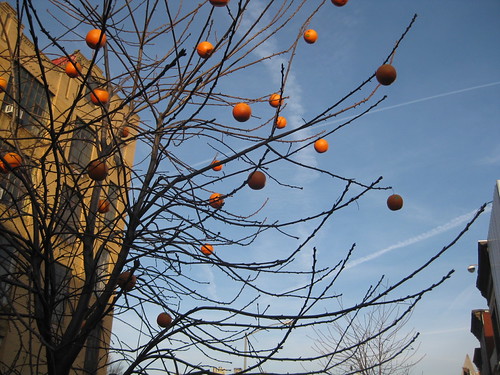
    The image above is from a jaunt to Brooklyn in winter where outside an art gallery there was a bare tree hung with oranges. It delighted me–I am a fan of the ridiculous and unexpected.

  • Busy-ness

    clover
    Friends:

    This week and next I will be unusually busy. I look forward to catching up with you when I return. I will be full of adventures to share–including some details of a trip to the East Coast! :)

    If you are in New Haven or Boston and you want to meetup this weekend, please drop me a line. It will be a whirlwind trip, but I hope to find time for friends!

  • Bridges

    Cross posted at History Compass

    Lido bridge at low tide
    Since I started paddling an outrigger canoe through the Newport harbor, I’ve gone under a lot of bridges. I learned, very quickly, that the current around bridges can be unpredictable–even dangerously so. In my small boat if I hit a bridge it means that I’ll likely end up going for an unintentional swim and the blow from hitting a cement pylon can easily cause irreparable damage to my fragile canoe.

    As I paddled under a low-lying bridge last week and heard the uncanny echo of water and wind through that space, I realized why trolls always live under bridges in folktales. Bridges are important places–necessary crossroads. But they are also liminal places where danger lurks. It might be in the form of a malintentioned someone hiding in the shadows, or it might be a whirl of current that pulls the boat toward a cement piling encrusted with mussel shells. Whatever the possibilities, bridge-crossings demand heightened attention.

    Like the dangers of the bridges that I face as I paddle around segments of the harbor, there seem to be trolls lurking around the bridges of academia, too.

    Right now the trolls that I’m facing are the distractions that pull me away from finishing my dissertation–the largest being the specter of the awful job market, but others include my inner perfectionist that needles me with reminders that the dissertation will never be as good as I wanted it to be.

    Every morning as I plan my day and make my “To Do” list, I realize that some choices I make keep me on a straight and safe course, while others bring me dangerously close to wrecking my boat as I let the current pull me this way and that. And some days I don’t get anywhere–eschewing the list of daily tasks and paddling around in circles rather than making measurable progress toward my end goal.

  • Morbidly romantic


    035:365 Braided Bones., originally uploaded by mind on fire.

    A gift to my lover, upon celebrating 20 years of togetherness (he wrote the poem for me 8 years ago).

    I just wish that I’d thought to black out one of these legs from mid-femur on down. :)