Lately I’ve been writing a bit more on my Chapman blog than here. Here are a few recent posts:
https://blogs.chapman.edu/academics/2016/08/03/the-first-day/
https://blogs.chapman.edu/academics/2016/09/09/using-wordpress-at-chapman/
Lately I’ve been writing a bit more on my Chapman blog than here. Here are a few recent posts:
https://blogs.chapman.edu/academics/2016/08/03/the-first-day/
https://blogs.chapman.edu/academics/2016/09/09/using-wordpress-at-chapman/
This morning I did my regular WordPress maintenance tasks: upgrading to the latest stable release, updating plugins, clearing out spam comments, etc. And as I did so I looked at the tagline on my portfolio site and realized that it needed updating.
It was:
 So now it has a bit more alliteration, and better reflects my current professional identity. Because while I am a historian, I write and think more about teaching than about history.
So it is now:
 There are so many other things I could put there: Paddler, Reader, Gardener, Friend, etc. But for right now, these three words seem the best fit.

I am a teacher, and am happiest when I am grappling with how to share what I know and what I think with others. Thus, I am fortunate that I hold a position where I am teaching nearly everyday–either through technology training or through teaching courses at ChapmanU.
With this new semester, as with each new semester, I am considering how I can improve my teaching skills. And I’ve determined that incorporating a more regular reflective practice will be the best way that I can improve my teaching. I’ve written about this a bit before on my blog, but I am now committing to make this a more explicit focus of my blogginb.
So, to start off, I will invoke one of my greatest mentors and fellow Friend, Parker J Palmer, who asks:
“How can I develop the authority to teach, the capacity to stand my ground in the midst of the complex forces of both the classroom and my own life?”
He clarifies, that by “authority” he means:
In a culture of objectification and technique we often confuse authority with power, but the two are not the same. Power works from the outside in, but authority works from the inside out. We are mistaken when we seek “authority” outside ourselves, in sources ranging from the subtle skills of group process to that less-than-subtle method of social control called grading. This view of teaching turns the teacher into the cop on the comer, trying to keep things moving amicably and by consent, but always having recourse to the coercive power of the law.
External tools of power have occasional utility in teaching, but they are no substitute for authority, the authority that comes from the teacher’s inner life. The clue is in the word itself, which has “author” at its core. Authority is granted to people who are perceived as “authoring” their own words, their own actions, their own lives, rather than playing a scripted role at great remove from their own hearts. When teachers depend on the coercive powers of law or technique, they have no authority at all.
I am painfully aware of the times in my own teaching when I lose touch with my inner teacher, and therefore with my own authority. In those times I try to gain power by barricading myself behind the podium and my status while wielding the threat of grades. But when my teaching is authorized by the teacher within me, I need neither weapons nor armor to teach.
Authority comes as I reclaim my identity and integrity, remembering my selfhood and my sense of vocation. Then teaching can come from the depths of my own truth—and the truth that is within my students has a chance to respond in kind.
His words remind me of something that I have grappled with so many times as I’ve stood in front of a classroom: that feeling of vulnerability and exposure that comes from the unpredictability of human interaction, as well as the actual physical limitations of my own body to enact and enable a teaching experience.
Perhaps I feel this more keenly because of my awareness that my body can be awkward in the physical space of the classroom. On days when I am using crutches it can be nearly impossible to deftly use the podium computer or to meander around the desks of the classroom. Or on some days when I am physically spent and need to sit instead of stand, I feel the challenge of engaging students with my less-than-powerful physical presence. And of course even on days when I am standing confidently there is the sense that my cyborg body is speaking louder than the words that I am sharing with the students.
But then there is the flipside of that, the fact that I am more physically vulnerable can break down the barriers that might be typical between professor and student. If we all gather our chairs in a circle on a day that I need to sit, the students also move away from the spaces of their desks and the trappings of their classroom role. On those days there is no barricade of podium and desk. On those days learning can happen in ways that are quite different from the learning that occurs when I am delivering content from a screen.
Given that I have little control over the days that I can stand in front of my students versus those that I cannot, I try to do the best I can to prepare for whatever might happen when I enter the classroom. A teaching exercise that I used in the past might have to be altered, or a student might need to run the technology if I cannot. If nothing else, it keeps the teaching experience varied, fresh, and open to all kinds of learning possibilities.
So, to return to reflection about my teaching experiences this week, here is a list of a few moments that stand out:
As I think about this list and all that has already happened in this Fall semester thus far, I am feeling pleased about my efforts. As Palmer reminds us,
Good teachers join self, subject, and students in the fabric of life because they teach from an integral and undivided self; they manifest in their own lives, and evoke in their students, a “capacity for connectedness.” They are able to weave a complex web of connections between themselves, their subjects, and their students, so that students can learn to weave a world for themselves…
 In my workshop at Digital Pedagogy today, we discussed how and why someone might want to create a twitter bot. The uses of such bots can vary widely–they can be playful (such as the Billy Joel bot, which tweets out song lyrics) or can expose hidden behavior (such as the Valley Edits bot, which shows edits to wikipedia from Silicon Valley).
I wanted my bot to do something similar to the bot that corrects people who tweet about “illegal immigrants,” offering corrective language. However, I wanted my bot to call attention to everyday words that denigrate the experience of disabled people. So I chose to target my bot on people who tweet the word “lame.” It took about 30 minutes to create the bot, most of which was time spent on signing up for the various services that I would need to create a new Twitter/IFTTT/Buffer accounts. Here’re the step-by-step instructions if you want to do something similar:


 Back when I was a student, I hated the first day of classes (aka Read the Syllabus Day). One semester I rather snarkily informed each of my professors how much I’d paid for their class that day, and that I didn’t feel as though I was getting my money’s worth when the day consisted of having the prof read the syllabus to me (especially because I had already rather-thoroughly perused the syllabus myself beforehand).
So this article about alternative First Day of Class activities struck a chord with me.
What I intend to do this year, which I am hoping will go over well, is to have students learn from my previous years’ students on the first day of class. At the end of last semester, I had each student write a letter “To a Future Student” in the class, and I will pass these out and have the students read them and discuss them as a class, which I will then use to launch into a discussion about class norms, expectations, and policies. I’ll then use that to lead into a brief overview of the class which will cover many of the items in the syllabus.
(Note: this post also appeared on the Chapman University Blogs network)
Last week we did a fairly strenuous canoe paddle, more than 60km, in a remote northern area of British Columbia. The paddling wasn’t so daunting (3-4 hours per day of solid work), but it was the portages from lake to lake, the lightning storms, and the persistent pelting rain that quickly dampened my sleeping bag and all of my clothing that took their toll.
Now that it’s over, however, so much of that difficulty is forgotten. And instead what remains are the gorgeous images imprinted into my memory and onto the roll of film that we shot as we traveled. Such as this one, taken on the home stretch to Bowron Lake:
 (Note: the horizon is slightly crooked due to the boat leaning a bit to the right side that morning)
As I was writing in my journal when the journey was completed, the first thing I put on my list of lessons learned was:
I like to do hard things
And it’s true. The stretch of an ambitious endeavor makes me happy. Doing the mundane, the repetitive, the easily achieved task…boring. I thrive when presented with a challenge, which is why the trip to British Columbia was so much more appealing than a resort stay or some other leisure activity.
While on this trip, these two books, Tracks and Paddling My Own Canoe accompanied me everywhere:
I just finished reading Tracks today, which is a book about a woman who walked across the Australian desert with four camels in the 1970s. At the close of the text, this quotation jumped out at me, as a better expression of my thoughts about hard things, than I expressed myself in my journal (emphasis my own):
As I look back on the trip now, as I try to sort out fact from fiction, try to remember how I felt at that particular time, or during that particular incident, try to relive those memories that have been buried so deep, and distorted so ruthlessly, there is one clear fact that emerges from the quagmire. The trip was easy. It was no more dangerous than crossing the street, or driving to the beach, or eating peanuts. The two important things that I did learn were that you as powerful and as strong as you allow yourself to be, and that the most difficult part of any endeavor is taking the first step, making the first decision.
This is another post in the series about MyYearinIT.
Not too long ago I found myself in a “Strategic IT” meeting we were discussing where we each sit on the curve of change. The discussion leader drew something a bit like this on his whiteboard and asked us each to come up and put a mark where we would be in the curve of adopting to technological changes.
He then asked: Were we on the leading edge? Or did we follow the crowd?
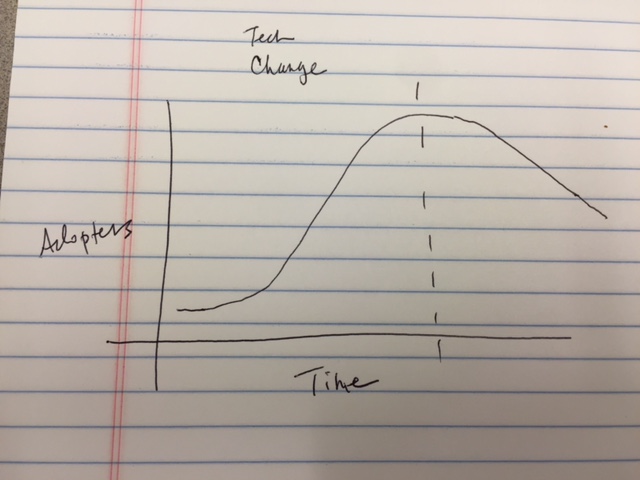
Various colleagues got up and put a mark somewhere on the curve, most of them right around the big bump (those who tended to jump on the bandwagon with everyone else) and a few afterwards (those folks said that they usually waited to whether a technology was likely to last before they adopted it). I was one of the last people to go up to the sign and leave my mark.
This is where I put myself (note: I was the only person to draw a picture, but I’m dorky like that):
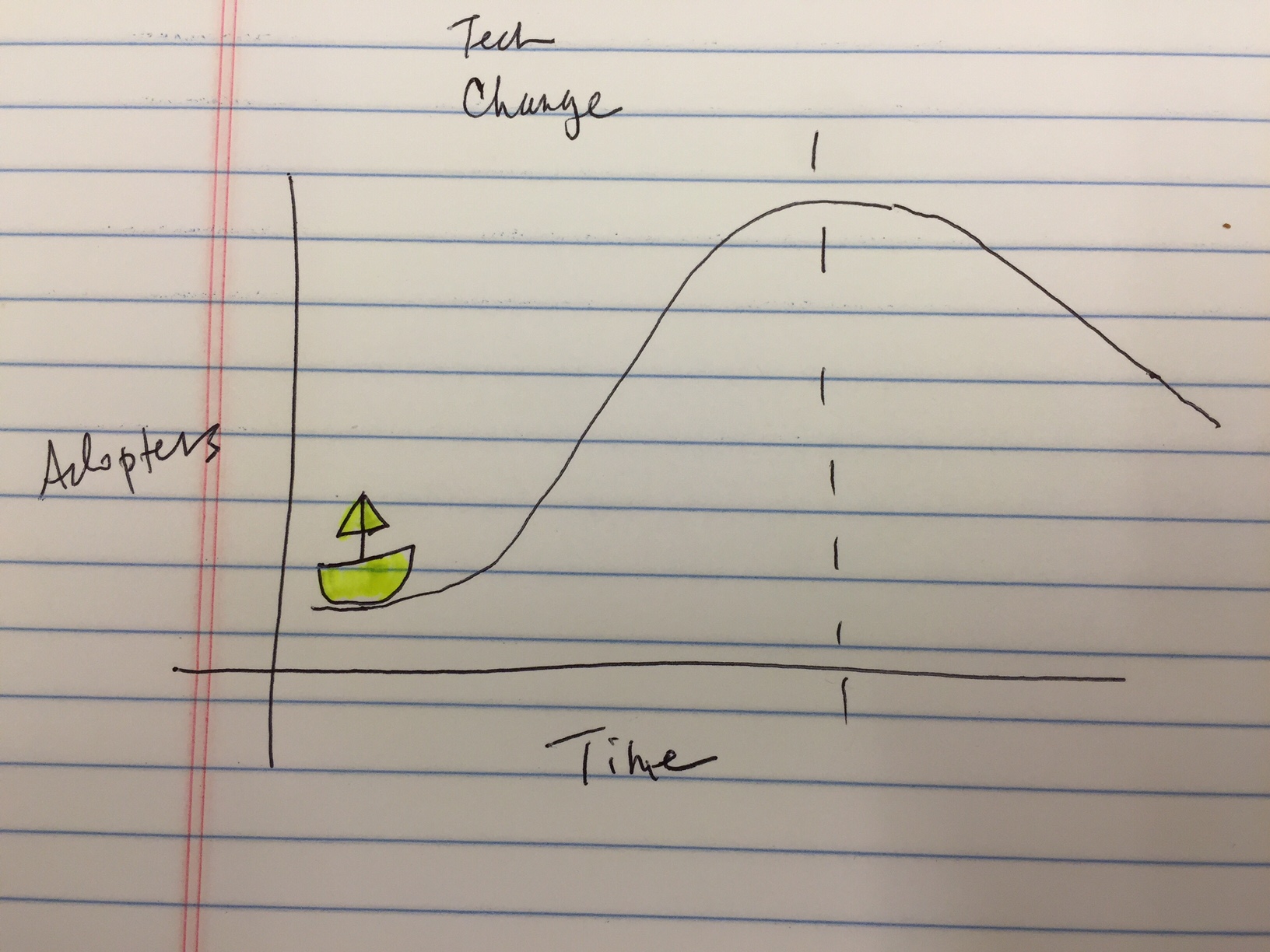 I then told the group a story that’s become a touchstone for me…
When I first began canoeing on the ocean, it was pretty scary to be surrounded by wide open water. The swell could be a low rolling bump that gave a gentle nudge to the boat or the entire ocean could be flat as a pancake, where you had to dig in your paddle to do all the work. But of course there was also the possibility of really big swell. And the first time I encountered that, it was unforgettable. (more…)
This is another post in the series about MyYearinIT.
Because of my IT management role, I recently had the opportunity to complete a leadership profile, and this was my result:
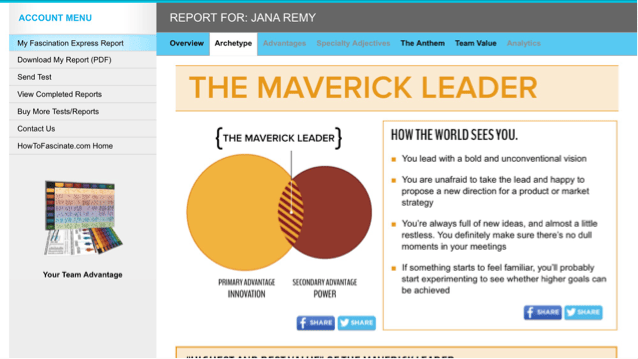 This “Maverick Leader” description seemed fairly spot-on for me, especially the part that says “You’re always full of new ideas, and almost a little restless” and “If something starts to feel familiar, you’ll probably start experimenting to see whether higher goals can be achieved.”
Yep, that’s pretty much me in a nutshell.
Somewhat related, on a friend’s recommendation I just picked up a copy of Cal Newport’s So Good They Can’t Ignore You, which is not a book that I would have selected for myself. It’s a bit too “business-y” for my usual taste, but I actually found it a fairly satisfying read. One thing he mentions that particularly resonates with me, is this:
If you just show up and work hard, you’ll soon hit a performance plateau beyond which you fail to get any better.
That’s one reason why I am constantly stretching myself with new goals. I dislike that space of mastery where there’s nothing new or different on the horizon, where there’s no stretch and pull. I don’t even mind trying something new and failing at it, because for me there’s so much pleasure in the attempt.
One other point that Newport makes that I’m somewhat convinced about now, is that telling someone to “follow their passion” is likely to lead to failure, and it’s far better to gain skills than to chase a dream.
This NGram analysis traces the rise of “passion” literature, to show how the idea has percolated into popular culture since the publication of “What Color is Your Parachute” and other similar self-help books (certainly this message has become a popular one in the last decade!):
Reading this book has caused me to reflect on my professional journey. A lot of those steps have been ones born of passion. But even more have been pragmatic choices that led to job security and financial health, and I have learned to love those steps while I’ve pursued them with the same vigor as the very “passionate” ones.
Because I do like me some book-ish poetry…
Untitled
by Elizabeth Bishop
Close close all night
the lovers keep.
They turn together
in their sleep,
close as two pages
in a book
that read each other
in the dark.
Each knows all
the other knows,
learned by heart
from head to toes.

I sometimes make small bargains with myself to keep focused on the things that are important to me (and to reign in my time-wasters). One such bargain is that I often set is that I won’t peer into Facebook until I’ve finished reading my current book. So I’m up to that again, and have promised myself to finish Christina Lamb’s Farewell Kabul, which I picked up in the airport last week. It’s a pretty dense read, but is fascinating. I am learning so much.
 (photo is of my new Little Free Library, where I can pass along all of the awesome books that I read, to others!)
From Mary Oliver:
“We all have a hungry heart, and one of the things we hunger for is happiness. So as much as I possibly could, I stayed where I was happy.”
This reminds me of something that my ex said to me as we were splitting up. He said that he wasn’t too worried about me, because I was happy no matter what happened. While there’s some truth to that, and I think it comes from having a lot of really awful things that have happened over the years (so awful, so out of my control), that I generally choose not to wallow in misery but to make the best of my circumstances. But that’s somewhat different than being happy–that’s just survival.
Being happy, in my mind, is a daily act of choosing joy:
It’s the parking-lot-Chewbacca-mask Mom who can laugh at herself and at the simple joys of her life (without worrying about how she looks to millions of strangers).
It’s jumping into Walden Pond and taking a long swim even though that’ll mean that your hair is a mess for the rest of the day.
It’s pulling over to take a photo of a field of poppies even when you’re running late for your train.
It’s drinking straight out of the milk bottle because every other cup in the kitchen is dirty.
It’s getting sand in your shoes because of a spontaneous ramble at the beach.
It’s getting up at 2am to stare at the full moon.
It’s building wooden things with simple tools.
It’s a cozy chair and a novel.
It’s supporting the people you love as they embark on their own journeys.
It’s a text message with silly emojis.
It’s starting the day with a walk in the garden, noting how things have changed since yesterday and imagining how they will be different tomorrow.
It strikes me, as I read this list, that many of the ‘happinesses’ that come to my mind right now are solitary ones. In years past there were so many more that came from caregiving for my children and from time with my community. While those are still important to me, I spend most of my work-work time with people everyday, that the small acts of happy-solitude feel like a necessary counterweight to teaching/leading/collaborating.
(poppies, taken by me in Italy five years ago)
I’m heading into the home stretch of my year in IT, and am enjoying a bit of extra attention from my colleagues as a result:

