Author: Jana

  • a perfect start

    a perfect start

    Yesterday I made this pumpkin bread recipe from Smitten Kitchen and it was every bit as magical as Deb said it would be: crunchy sweet top (who knew that this was what pumpkin bread needed to be really special), thick dense cakey center, not at all too sweet.

    It made the perfect addition to my breakfast this morning!

  • My love affair with letters (and the end of the semester…)

    My love affair with letters (and the end of the semester…)

    I am more than a little bit obsessed with letters. Ever since I was a young girl I have been a prolific writer of letters, often spending hours every Sunday writing to friends and family members, loving the practice of telling the stories of my life and sending little thoughts out through the post. In fact, I used to keep a large stash of little things that I collected from magazines and newspapers, just to have fun little things to include in the letters that I was writing.  One of my greatest treasures is the address book that I kept for years, where I would record all of the places where my correspondents lived. Even though I no longer add to that book, I still keep it because of the waves of memories that it holds as I look at where each of my friends moved over the years.

    And my love of letters even overlaps with my love of books.  Three of my all-time favorites are Angle of Repose (which includes letters as part of the narrative), Pamela (an entirely epistolary novel) and Letters from Africa (the real-life letters of Karen Blixen to her beloved Denys Finch-Hatton). This is also why I am so very delighted by the current novel that I’m reading, Hello to the Cannibals, which also has letter writing at the core of the narrative.

    I also use letters in my teaching, not just as source material for my students to examine, but for themselves to use the act of letter-writing as the basis for a reflective practice. One of my favorite assignments is at the end of the term, when I have my Digital Humanities students write letters to future students in the class, telling them what they can expect of the course.  Here are some fun excerpts from those letters:

    This class will take all types. Those who are tech-savvy, and those who still carry around those bricks people affectionately refer to as “Nokias.” Those who know how to code, and those who can barely form a proper sentence. And that’s okay. The hope is by the end of the class, you’ll find something, no matter how small, you can attach to and find what interests you in this honestly intimidating field. Once you find that thing, run with it and run far. You’ll have the freedom to really make this class work for you, if you want it to…I also thought I wouldn’t be using any of these tools after the semester ended. After all, they looked really cool, but how could I integrate them into my own studies? In this case, desperation is both the mother and father of invention. As work in my other classes became more involving and complicated, I realized I could unravel some of that complexity with some of the practices I learned from this class. Even if there isn’t a specific tool that you find particularly helpful, the concepts of critical thought, deconstruction, and distant reading will be universally helpful to you.


    What I am taking away from this class more than anything is a new way of looking at , and questioning, our digital world. Why do our screens have to be rectangular? What does that do to our thinking? Why do our presentations needs to be composed of slides? What does that do to our thinking? Why do we only watch one video at a time? What does that do our thinking? Are these the only ways? These are questions I wasn’t asking before, but I am now.


    And finally, there’s this letter that a student wrote using animated GIFs and is well worth clicking through and seeing on her wordpress site: http://wordpress.chapman.edu/juliaross/2017/12/09/good-luck-to-you-boo/

  • Using Google Drive in my courses and some surprises about how it spawned collaboration

    Using Google Drive in my courses and some surprises about how it spawned collaboration

    This post originally appeared on the Chapman Academics Blog.


    For quite some time I’ve used GoogleDrive to store my course materials. For me it is the easiest way to manage the many documents that I create during a semester, and the iterations of those documents as I update them each time I teach a class. To share these documents with my students I add them as hyperlinked content on Blackboard.

    However, this semester I had two unanticipated experiences from using GoogleDocs, which seemed worth sharing with others who are using this tool in the classroom.

    1. I created a folder in GoogleDrive for each of my students to store content related to their end-of-semester research projects. For example, I created a document called “Sources” in that folder where the students were required to upload the online links (or images of book covers) for their research sources, prior to completing their writing. By having their sources all in GDocs, I was able to peruse and comment on each one, to either validate it as an appropriate source or to suggest alternatives when the source did not match the students’ research question or the parameters of the assignment. I was surprised, however, as I was navigating through these GDocs, to find that many of the students were logged into the Docs at the same time that I was leaving my comments. This allowed us to virtually “chat” through the comment stream about their sources, and was a surprisingly informal and helpful way to offer suggestions and corrections for the students. In the future I intend to experiment with holding virtual office hours via GoogleDocs, which seems an excellent way to be available for conversation with my students during times that they might not be on campus or I might not be near my office phone.
    2. I discovered about halfway through the semester that in one of my classes where I created and linked to the stored syllabus in GoogleDocs, that they students were “chatting” on the syllabus page during class about the course material that I was presenting in class. At first I was taken aback and uncomfortable with knowing this–were they not paying attention in class and instead chatting with each other virtually, becoming something like a class snapchat account? But then I realized that it was pretty ingenious of them to use this tool that I’d given them in a way that I’d not expected. In fact, one class session where I was at a conference and had scheduled a guest speaker for the class, I jumped into the syllabus document and chatted with the students while they were in class and I was at my conference hotel. I loved that I got to “check in” with them in the moment, virtually. Their candid responses to the speaker were also helpful to me–they said that they were learning a lot from him! This assuaged any guilt that I had for not being present that day and allowed me to feel better about what was occurring in my classroom.

    These experiences have cemented my interest in using GDocs in the classroom. In both intended and unintended ways, they are excellent tools for student collaboration of all kinds.

  • a new look for janaremy

    a new look for janaremy

    Perhaps some of you have already noticed that I’ve been doing a bit of rearranging around here. As of a month ago, my site looked like the image above.

    I loved this look for my site that I’ve had for the past seven years. The colors and simplicity of the design were so me. However under the hood the site was a pretty big mess–the design wasn’t responsive, the subpage links kept breaking, and the content was really hard to update due to the customization of WordPress necessary to support the visual layout. So I realized that it was time for it to go and to adopt a new look.

    So I fussed around about it for awhile and came up with something super-simple, that resembles some of the former look of the “pilgrimsteps” blog from way back when.

    Today:
    screenshot from landing page for this website

    Way Back When:

    screenshot of an old blogpost


    And from Way Way Back When:
    screenshot from 2010

    And From the Stone Ages of Blogland:

    a screenshot from enivri.com (in 2002)


    Some things never change, such as my love for light backgrounds, san-serif fonts, and images. But some things have changed so very very much in the past fifteen years.  More than I can even begin to document. Fortunately I have a blog archive stretching back over all that time that I can peruse and marvel at all the roads I’ve traveled since then.

  • a better gardener

    a better gardener

    Wild roses are fairest, and nature a better gardener than art.

    ~Louisa May Alcott

    And a link to an image showing my last visit to Louisa.

  • A Room of My Own

    A Room of My Own

    Virginia was right.

    A woman must have money and a room of her own if she is to write…

    After a few years of Stijn and I trying to co-habit in a shared office space, I realized a few weeks ago that it wasn’t working for me, that I needed my own space to write, one that had my own books, office supplies, piles of papers, houseplants, etcetera.

    I was nervous to tell him that I wanted to keep a separate space. I felt like, somehow, it was a signal that there was something amiss with our relationship. I waffled for a while about broaching the subject. And when I finally did, I was nervous that he would resist or feel betrayed. He didn’t. He was nonchalant, asked a few clarifying questions about shared resources, and wished me well.

    For many years I have worked and written from wherever I could plug-in my laptop, and I have done just fine. I wrote papers, authored blogposts, crafted technical documentation, and replied to emails all from wherever and whenever. It has worked and I have made do. But now it feels like such a luxury to be able to claim a room and to make it my own. And already I can feel the difference. Writing is easier than it has been in a very long time.

    Intellectual freedom depends upon material things. Poetry depends upon intellectual freedom. And women have always been poor, not for two hundred years merely, but from the beginning of time. Women have had less intellectual freedom than the sons of Athenian slaves. Women, then, have not had a dog’s chance of writing poetry. that is why I have laid so much stress on money and a room of one’s own.

  • An update from the Archive

    An update from the Archive

    For those of you who followed along on the FBLive videos that we created in the Archive last summer, you will know that we left you hanging as to the outcome of the developing relationship between Florence and Wally. Specifically, you knew that they had plans to marry soon but also that Wally would “ship out” soon too, and we didn’t tell you which would happen first.

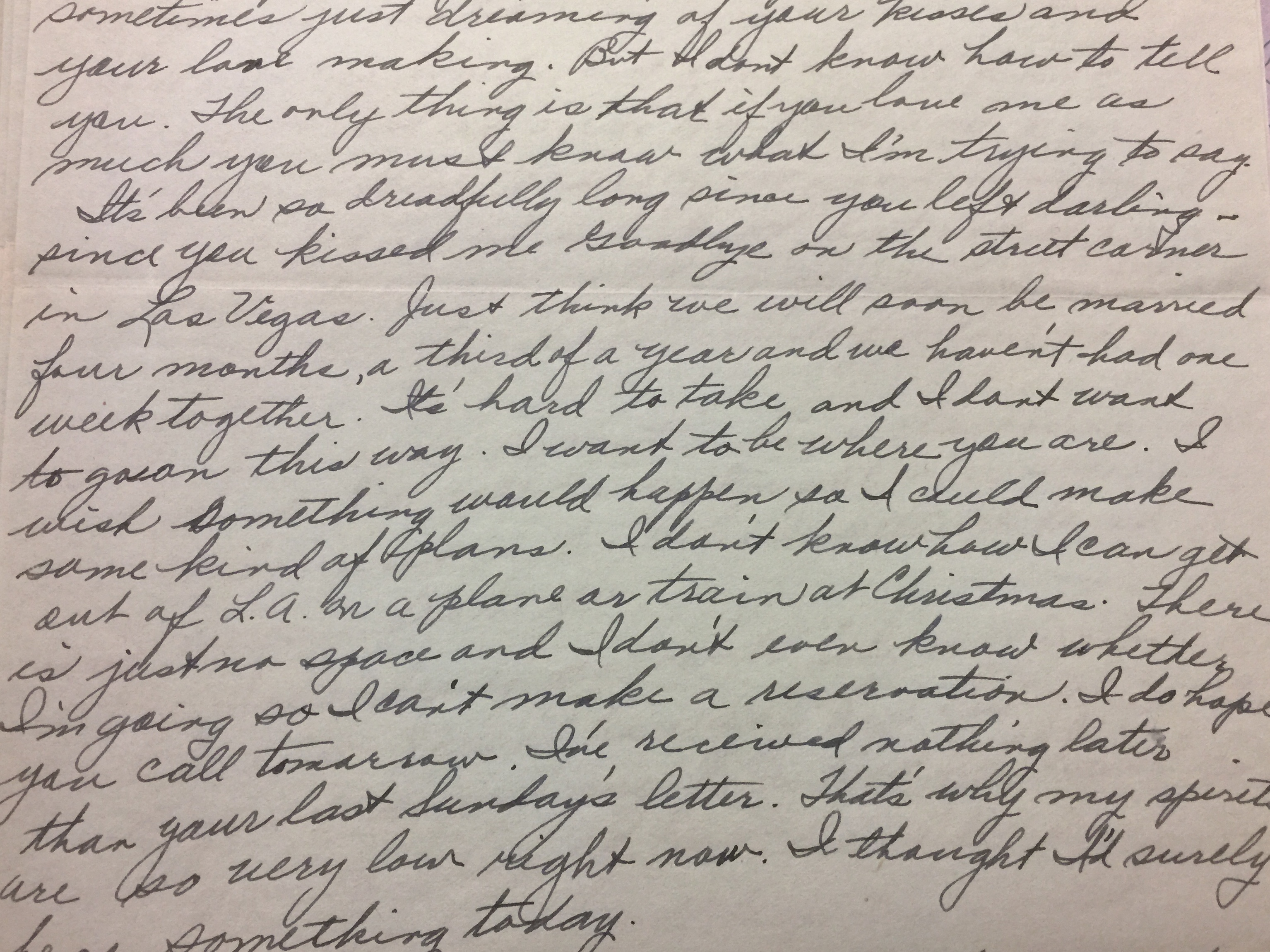
    Therefore, today I’m here to tease you with a bit more information.  It can be found in this snippet from one of Florence’s letters:

    letter from Florence Keeler
    My transcription of the relevant parts:

    It’s been so dreadfully long since you left darling — since you kissed me Goodbye on the street corner in Las Vegas. Just think we will soon be married for four months, a third of a year, and we haven’t had one week together. It’s hard to take and I don’t want to go on this way. I want to be where you are. I wish something would happen so I could make some kind of plans. I don’t know how I can get out of LA on a plane or train at Christmas. There is just no space and I don’t even know whether I’m going so I can’t make a reservation. I do hope you call tomorrow. I’ve received nothing later than your last Sunday’s letter. That’s why my spirits are so very low right now…

    Poor Florence, she hasn’t heard anything from Wally lately, she had to say goodbye to her brand new husband on a street corner as he shipped out for parts unknown-to-her, and she is struggling to make her holiday plans. I felt so awful for her as I read this letter, perhaps even more so because it’s that same time of year that I’m also scheming about all of my own Christmas plans!

    So I’ll let you in on a secret to break a bit of the suspense. She gets her wish and Wally does come home for Christmas. And this time it’s not a furlough or a weekend break. He’s home for good.

  • What I learned from launching a social media campaign about the War Letters Archive

    What I learned from launching a social media campaign about the War Letters Archive

    An earlier version of this post appeared HERE.

    At the beginning of last summer I began a social media experiment, to bring people into the Center for American War Letters Archive with me (and my collaborator Doug) virtually, via FB Live, to share some of our findings from WWII letters. I had no idea what to expect from this experiment, whether it would flounder or fly. Doug and I committed to trying this experiment for 12 weeks, but it ended up running for nineteen.  Here are some reasons why:

    1. For the fun of it. Hands down, this was my favorite part of my work week, to have a conversation about the War Letters. That it was a regularly scheduled commitment, with viewers, means that it happened no matter what other chaos is occurring in my/our work week.
    2. For the reach of it. Facebook tells me that our social media engagement with these sessions is in the hundreds. It would be very difficult for us to bring even a dozen people into the archive physically, so having this kind of reach is deeply satisfying. It has been surprising to see that many of the people in my FB circles who have engaged with these sessions are not scholars or historians, but they find the War Letters meaningful for other reasons.
    3. For the productive conversations. Often it wasn’t until Doug and I started talking about some letters that the insights about the letters start happening. Between the two of us we were able to make connections that we wouldn’t be able to alone. Those times that we’ve been able to add visitors to the sessions have added even deeper insights for us.
    4. For the scholarship. Diving into these Letters has aided so many other War Letters projects that we’ve been engaged with. It has helped us to author grants, to attract donors, and to garner the attention of students who want to join in the effort. (And on a related note, here is an article about our work with some fun “behind the scenes” images)

    You can watch each of the episodes we created last summer on our Facebook Page, Voices from the Archive.

    So now, we’re in the midst of planning several writing projects related to our work in the archive.  If you’d like to keep updated on how that’s going, please “Like” us on Facebook and follow along.

  • we haven’t time

    we haven’t time

    Nobody sees a flower really; it is so small. We haven’t time, and to see takes time – like to have a friend takes time.
    ~Georgia O’Keefe

    Nearly every year I resolve to be a better friend.  However, nearly every year I look back and feel that I’ve failed at doing that.

    One recent “small” success in that area was when I was traveling last month and managed to visit many friends in many places that I hadn’t seen in awhile, such as Susan, Melinda, Melanie, Sarah, Alison, Vickie, and Courtney.  We hugged, laughed, ate, schemed and talked. It felt so good and indulgent. It was so worth taking the time.

  • the post-post divorce Christmas celebration

    the post-post divorce Christmas celebration

    In 2011 I wrote a post about composing a post-divorce Christmas card. It has been one of the most-googled posts on my blog, which I suppose is because there are lots of people out there who have to figure out the right way to talk about divorce in their annual holiday card. It’s not really a happy topic like discussing the kids’ cello and flute concerts, or the vacation to Yellowstone.

    Now as I look back on that post and remember that time of my life, when so much of what was happening was beyond my ability to spin into a positive newsy message for far-flung friends, I’m glad that I kept sending out messages most years, even when they were just a photo postcard with no explanation of why there was a different person at my side in front of the Xmas tree.astro veggie xmas tree

    And that’s on my mind tonight because I just finally got word that my son will be able to come home for the holidays–he got the days off of work that he’d requested–Joy! That means both kids and Stijn and I will get to celebrate for the first time in our own home. That feels so huge and important, after years of putting up the tree in a different place nearly every year.

    So I’m anticipating a lot of fun around our house once the kids arrive. I think I’m going to resuscitate the Astro-Veggie Christmas Tree tradition and also do gingerbread houses. It feels so important to bring back so many of the activities that used to be a part of our annual celebrations. And of course make a few new ones, too.

  • room for randomness

    room for randomness

    Lately I’ve had multiple days where I have had back-to-back meetings for 5 or 6 hours, sometimes even more. Moreover my schedule this semester includes a 4.5-hour teaching block on Thursday evenings, which can be both the most draining and the most enlivening hours of my week.

    So it’s Monday now and I am looking over my calendar and ensuring that I have a few “holes” of time where I can put my head down and work, rather than be leading a committee or teaching a class or a workshop. Because I fear that if I am simply running from meeting to meeting to class to training, then I’m likely missing the time I need to have a conversation with a colleague or to solve large problems. I am likely to simply be in list-making mode rather than in a space of productivity.

    Thus, this quote from Jim Barnes (via Creative Mornings) resonated with me. Because it’s actually work to ensure that I have the free spot in my calendar, but I know that it’s an investment that is well worth the effort.

  • Solving Mysteries in the Archive

    Solving Mysteries in the Archive

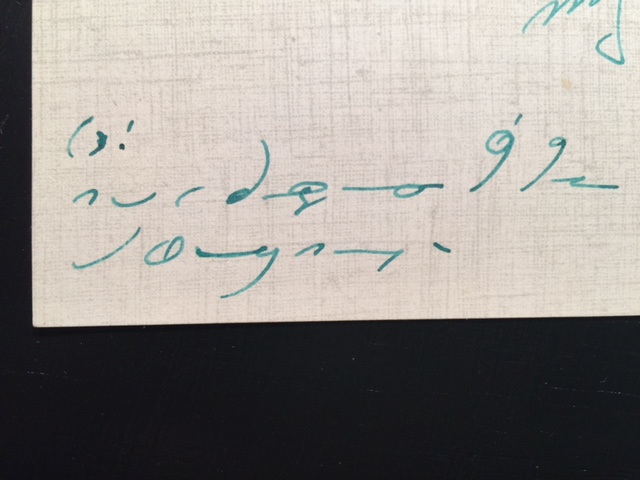
    A few months ago while reading letters held in the CAWL Archive, my colleague Doug came across this shorthand notation written at the end of a letter:

    three lines of shorthand writing
    written in the postscript of a letter from Florence Mesner to Walter Keeler

    I was sure there ought to be a way to decipher the message, and I figured that the “crowd” would be my best bet, specifically finding women who had done office work during the 20th century, and as a result had learned to write shorthand. I first sent it to my Mom, who could only make out the second line. She wrote:

    I can only read a little bit of it. The second line says “and I love you ______. I could only guess what the first line might mean. It’s been a long time since I had to read it. Also, it is easier to read one’s own than someone else’s.

    I then shared it with the members of a listerv that I’m on, which includes some women of an older generation than mine. That worked! From my friend Loralie I learned that it says:

    Pops
    You are the very nicest man I’ve ever known

    and I love you so much.

    That’s hardly newsworthy stuff. Florence floridly expressed her love to Walter in her letters, in longhand. However I believe this moment written in shorthand is something a bit special because she admits to him that he’s the “nicest man” she has ever known. And because we know that Florence has been married and has had several previous serious romantic relationships, this shorthand moment seems to be the moment that tipped the scale in Walter’s favor–where he became the “very nicest” out of all of the others.

    And if nothing else, it was a mystery that begged an answer–what did that mysterious bit of text mean? And now we know!