Category: world

  • this one’s for you


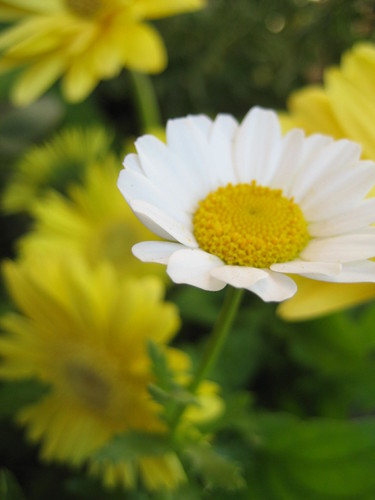
    daisy yellows, originally uploaded by pilgrimgirl.

    I look at this petite little daisy and I see the strength of one. In a sea of people we sometimes wonder if one person can ‘make a difference’, or if we really even matter at all. But I think we do, each of us!

    I’ve been thinking a lot about SL’s post , which was a riff on an earlier post of mine. I think we both struggle with wanting to know what our place is in changing this world.

    For me, lately, I have come to understand that I should be simple-minded in my efforts. I may not come up with a world-wide program for combating disease. I may not be a Paul Farmer or a Dorothy Day. But I can take pictures of flowers, and grow vegetables, and give a kind word. I can aim to have a welcoming home, where all can join in the simple pleasures of a good meal. I often play piano concertos on my record player and eat fine chocolate and hold a purring kitty on my lap. It’s all good.

    In speaking of the women’s suffrage movement, Alice Paul wrote:

    “I always feel the movement is a sort of mosaic. Each of us puts in one little stone, and then you get a great mosaic at the end.”

    My efforts are my own little stone and I like thinking that they are a part of something bigger and grander than myself. Like one blossom in a meadow-full of flowers. :)

  • Dark Days

    Yesterday I watched Dark Days as I was doing housework and eating lunch.* Wow. It’s about a group of homeless folks who made their homes in an abandoned subway tunnel under the streets of Manhattan. They had running water, electricity and well-built homes made of scavenged materials. There were drugs, rats, and some interpersonal tensions. But the ingenuity and perseverance of these folks is quite admirable. My favorite parts were watching them cook: making cornbread and meatballs and all manner of ‘normal’ foods in their tiny kitchens. Amazing. And somewhat reminiscent of the frontier era. Oh, and the cinematography was quite unique as everything was shot in the dark underground using ‘night vision’ cameras.

    Here’s the trailer for your enjoyment (note: the music in the movie itself is a bit more subtle):

    *Hat tip to John for netflixing this gem.

  • Mother’s Day Proclamation for Peace

    The celebration of Mother’s Day originated with poet Julia Ward Howe, as a movement for women to fight the devastation of war and to show the way towards peace. Today’s sentimental-flowers-&-Hallmark-card bedecked event hardly measures up to the fiery rhetoric of the day’s founding mother…

    Julia Ward Howe’s Mother’s Day Proclamation – 1870

    Arise then…women of this day!
    Arise, all women who have hearts!
    Whether your baptism be of water or of tears!
    Say firmly:
    “We will not have questions answered by irrelevant agencies,
    Our husbands will not come to us, reeking with carnage,
    For caresses and applause.
    Our sons shall not be taken from us to unlearn
    All that we have been able to teach them of charity, mercy and patience.
    We, the women of one country,
    Will be too tender of those of another country
    To allow our sons to be trained to injure theirs.”

    From the bosom of a devastated Earth a voice goes up with
    Our own. It says: “Disarm! Disarm!
    The sword of murder is not the balance of justice.”
    Blood does not wipe out dishonor,
    Nor violence indicate possession.
    As men have often forsaken the plough and the anvil
    At the summons of war,
    Let women now leave all that may be left of home
    For a great and earnest day of counsel.
    Let them meet first, as women, to bewail and commemorate the dead.
    Let them solemnly take counsel with each other as to the means
    Whereby the great human family can live in peace…
    Each bearing after his own time the sacred impress, not of Caesar,
    But of God –
    In the name of womanhood and humanity, I earnestly ask
    That a general congress of women without limit of nationality,
    May be appointed and held at someplace deemed most convenient
    And the earliest period consistent with its objects,
    To promote the alliance of the different nationalities,
    The amicable settlement of international questions,
    The great and general interests of peace.

  • outdoor carpets?

    Feeling proud of my own “edible estate”…

  • Satan is behind illegal immigration

    Yah, so for all of you who are worried about the increasing social conflicts that result from immigration, well now you know who to blame: It’s all Satan’s fault.

    So glad to have that one all cleared up. Whew. No need to worry about our brothers and sisters who attempt to infiltrate our borders, as they are all just pawns of the devil’s plan.

  • it’s the bomb…

    The chilling beauty of these ‘mushroom cloud’ images might be an appropriate accompaniment to John’s Wednesday challenge. As I saw the homes leveled by the winds and thought of the untold devastation of Hiroshima, Nagasaki, and the Nevada tests, I found myself in awe of the power of humanity at the same time I was horrified that such weapons were ever developed, much less used on humans (enemy or otherwise).

    I have often wondered if Utah’s nuclear legacy is a reason for my own bout of osteosarcoma. It may have more to do with my father’s research in petrochemicals during the time of my conception. Or it may be an entirely random ailment. In any case, I have bone-deep empathy for those whose bodies were and are maimed in acts of war or other violence.

  • granny goes to war

    Are you all following Jane Stillwater’s blog? Ragin’ granny who eats peanut butter sandwiches for a year so she can afford a plane ticket to Baghdad. And she arrived a few days ago and she’s embedded with some troops and now is eating like a queen. She’s also making friends with many of the soldiers, listening to their stories. From yesterday’s post:

    These men are my boys. Hurt them and you have to go through me. Hear that, George Bush? These men aren’t just action figure toys for you to play with. These are real, living human beings. Sincere. Serious about doing their jobs — and doing them well. They deserve better than the blunders of GWB. They deserve respect. They’ve got mine.

    It reminds me of the conversation I had with a friend at Meeting today. I think this might be the Friend who used to be the head of the CDC. If not, at least he’s someone who has some connections. He asked me about my prosthetic leg, he told me about overseeing Walter Reed Medical Center in the post WWII years and how crappily veterans are being treated in this current war. We commiserated at the pointlessness of it all. The bodies being maimed in a war we shouldn’t be fighting, at the instigation of a president who shouldn’t have been elected. The horror….

  • In any honest cause


    The best line from this article about Quakers’ role in the abolition of slavery: “In any honest cause there is no agitator like a Quaker.”

    Full article with pictures.

    Keeping it Under their Hats
    By Stephen Tomkins

    Quakers started the British campaign against the slave trade and invented modern campaigning, championing the petition and the consumer boycott, and mastering the use of images and logos. Not that they like to shout about it.

    It is perhaps the defining image of the battle to end the slave trade. Not a picture of a shackled slave, or some gruesome punishment, but a cross-section of a ship. It is a ship packed so full that the mind boggles at the sheer logistics of inhumanity.

    The use of the engraving of the Liverpool slave ship, the Brookes, is the perfect example of how Quaker mastery of PR kick-started the movement that toppled the slave trade.

    “In any honest cause there is no agitator like a Quaker,” said the abolitionist George Stephen. But today their contribution has largely been forgotten.

    Anyone in full possession of the facts would agree, it is time for that to be put right; few, if any, deserve greater credit for the defeat of slavery and the slave trade than them.

    The campaign to abolish the slave trade was an overwhelmingly religious affair. The importance of evangelical Anglicans, like William Wilberforce and John Newton, is well known.

    But Quakers were the pioneers of the movement, its brains, and much of the soul too. The more you delve into the story, the more you find Quakers under every shadow.

    The Quaker Anthony Benezet published a formative attack on the slave trade in 1772, 17 years before Wilberforce’s first abolition motion. Long before Wilberforce first spoke on the issue, the Quakers had formed a campaigning group, petitioned Parliament and distributed tens of thousands of free tracts.

    When the first Anglicans got involved – the philanthropist Granville Sharp, the rector James Ramsay and the passionate young ordinand Thomas Clarkson – it was the Quakers who published their literature and brought them together.

    Thus the Abolition Committee was formed, the engine of the movement. It consisted of 12 men, nine of them Quakers. The evidence and testimonies that Clarkson dug up for them all round the country were essential to the cause, but equally essential was the PR genius of the Quakers.

    They had a century of experience campaigning for their own rights, and channelled this expertise into defending the rights of slaves. As Adam Hochschild has argued in Bury the Chains, the movement forged most of the tools used by campaigners today. They pioneered the mass petition and the consumer boycott, targeting Caribbean sugar.

    The committee invented the campaign slogan and logo, commissioning Wedgwood to produce a design of a slave in chains with the words “Am I not a man and a brother?”. They got the poet William Cowper to write them a civil rights ballad. And in the greatest PR coup of the movement, the committee’s publication of the Brookes diagram, which showed 482 slaves lying shoulder to shoulder, made “an instantaneous impression of horror on all who saw it” according to Clarkson.

    The national network of Quaker meeting houses proved vital to mobilising the public and spreading information. Some of the most radical anti-slavery voices were Quakers – such as Elizabeth Heyrick, who argued, exceptionally, that when the slaves were freed it was they and not their owners who should be compensated.

    The Quakers were natural enemies of slavery, with their fundamental belief in equality in a hierarchical society where that was still highly controversial. They believed above all else that every person is made in the image of God and carries the divine light, so it is blasphemous to elevate one above another.

    They refused to raise their hats to their social betters or to call them “my lord”, “my lady” or even “you”, insisting on the familiar “thou”. Their egalitarianism was still quite scandalous in the 18th Century, but it made slavery uniquely abhorrent to the Quakers.

    The problem was that they were a dangerous sect of fanatics, according to the received wisdom, so no-one listened to a word they said. They were excluded from public office.

    This is why they needed to work with Anglicans like Wilberforce, who brought both respectability and political power to the movement. It is also why their involvement was not especially celebrated at the time, and why it was easily forgotten afterwards.

    The modern Quakers do not plan any major national commemoration of their role in ending the trade, preferring for the most part low-key local services. Their efforts will instead be focused on current campaigns, including their efforts to end the use of child soldiers.

    They are not the only unsung heroes of abolition. James Ramsay, for example, had a huge impact, being the first Anglican clergyman to publish revelations of plantation life, and became a martyr to the movement when constant attacks from colonists destroyed his health.

    But there can be few people who have done so much in such a good cause as the Quakers, and been so little recognised.
  • another yellow ribbon

    Friends:
    This is pretty irreverent comedy. You might find some of the language offensive. Or you might laugh. :)

  • blogher

    Wow. My IWD post, “Is it because of all that armpit hair?” is featured on this blogher article about youtube feminism. Cool!

    More and more, I feel that feminism is returning. I know the term itself has baggage, and that there are numerous women who feel that the movement is too fractured with vying groups for it to have any focus or effect. But I’m hopeful that it can and that it will.

    As I predicted/prophesied at the Sunstone Symposium last summer, I believe that the Internet will be the biggest influence on the world of LDS feminism. By the same token, I believe the ‘Net will have huge impact on feminism at large–enough to initiate a new wave of activism and social change. When I see groups like Mojo Moms, Coalition of Women for Peace, Moms Rising, Women for Women, and similar organizations that are building a strong presence via the web, I am filled with hope.

    Yes, I know that there are problems with attempting to organize feminists. There are factions along lines of identity politics and issues with essentializing gender. But I think there are things that we can agree on, and we can move forward with the movement by finding common ground.

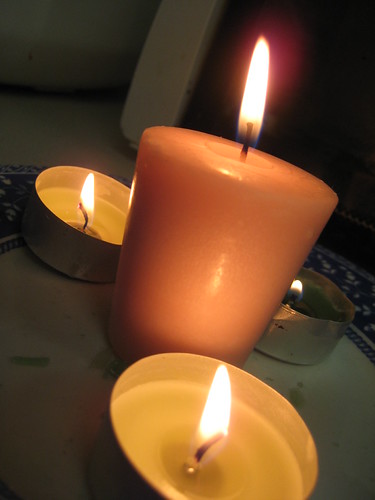
  • lights for peace


    lights for peace, originally uploaded by pilgrimgirl.

  • veggie-tarian

    I felt that a reply to Elise’s recent comment warranted a whole post. She asked:

    Would you be willing to share a little more about your own vegetarian lifestyle? Are you 100% strict on not eating any animal products, or do you eat a little bit of meat here and there?

    My reply:
    I’m not a strict vegetarian right now. I occasionally eat meat or meat-based products (e.g. chicken broth) on conditions of necessity or hospitality. For example, if a friend cooks me dinner and doesn’t know of my vegetarianism, then I will often taste some of their meat-based food (though I rarely eat much of meaty stuff and I generally refuse beef altogether).

    Having said that, I must confess that I do occasionally eat seafood. I cook salmon about twice/month (wild caught Alaskan or Canadian) because it is a family favorite. I also indulge in sushi a few times per year.

    I try, with some success thanks to Trader Joes, to source our dairy products from organic farms. I feel that organic dairy tastes better and is a better choice than traditional dairy practices. I wish I had the time and energy to give up animal products altogether. I did for a few months and my body felt wonderful. But it was an awful lot of work and I think my kids would be unhappy if I encouraged them to eat that way all the time.

    Elise and others, I heartily recommend Francis Lappe’s Diet for a Small Planet if you want to learn more about the environmental costs of meat production. This book is a bit old, but still a good read on the topic and you can generally find used copies of it for just a few dollars.