Category: Quaker

  • because of my weakness…

    The acknowledgment of our weakness
    is the first step in repairing our loss.
    ~Thomas Kempis

    While I was at the Sunstone Symposium in August, sitting in a session about women and the Mormon church, I had to fight the urge to flee the room.

    In sitting there I realized that the rationales, the angst, and the pain of gender inequity–those were the things that I’d been so relieved to leave behind when I stopped attending LDS church. Being confronted with them again was repulsive and pulled me back to that dark place where I’d been a few years ago: a sort of dark cave where I felt stranded. Where I couldn’t see how god could bless an institution that was so biased, so short-sighted. And at the same time afraid of the pain that would come to me and to my extended family should I choose to walk away.

    As these thoughts ran through my mind I felt a pendulum of emotion shifting to and fro inside of me and I was on the verge of tears. And then I realized something about myself…I’m just not one of the “strong ones” who can continue on in the LDS church while being fully aware all of its flaws. My soul and my spirit just aren’t up for the task. I am too weak. Too fragile. I need a spiritual home where I am buoyed and supported and affirmed. The dissonance of being Mormon was literally ripping my spirit into pieces. I felt no hope there.

    For me, the move to practicing as a Quaker is not just transferring my allegiance to a new religious institution. It’s about adopting a spiritual practice and community based on the yearnings of my heart and not based on my pedigree and my upbringing. It’s a choice for comfort and peace. It’s laying down the struggle of trying to fit into the LDS mold–the continued abrasiveness of being a square peg that can’t adapt to the expectations and orthodoxies of Mormonism. It’s about recognizing my own weakness and accepting it.

    The Mormon founder, Joseph Smith, compared his spiritual journey to that of a rough stone rolling down a mountain. He saw each of his experiences as chipping away at himself, smoothing away his raw edges. Me, I’m not up for a similar trajectory, or perhaps my body has just had enough trauma. I’m seeking an angle of repose.

    Let me quote from a favorite author who has walked a similar path:

    Spirituality is solitary…At times, it is lonely, often informed by pain. On other occasions, it is the body submerged in a phosphorescent tide, every movement sparking a trail of illumination. Afterwards, we sit on the shore in moonlight. No candles are necessary. Spirituality exists when we are present, buoyed up by the waters of attention. We learn the courage of faith. It is peace that is earned. We can take solace in the heat of doubt knowing this is the pulse of poetry.
    ~Terry Tempest Williams, Leap (2000)
  • quakin’ (with the Quakers)

    Yesterday during Meeting there was an earthquake.

    It being SoCal, that wasn’t so unusual. But it was my first earthquake with the Friends. We were sitting in our simple circle of chairs, in silence, when the building began to shake. There were a few pops and creaks. Though no one spoke, I could feel a tension in the room, as if each person was fully aware and ready to move if necessary. (note: we meet in an old building in the historic district of downtown Santa Ana. I do not feel very secure about the structural integrity of the building)

    My first thoughts were of the children in the adjacent room. My body was poised to spring out of my seat and go to them if and when the quaking became more intense.

    But it turned out to be just a small quake, not even enough to jostle our chairs. After the windows ceased rattling the peace returned to the Meetingroom. I realized that my breathing had become much more forced, even panicked. I sat back in my chair and calmed myself and returned to meditation.

    At the end of the Meeting, when the silence was broken, a few Friends commented on the quake. One noted, quite simply, that if the shaking had been any worse, we probably should have moved to the side of the room opposite from the windows.

  • You call that a religion?

    Recently I sat down with a dozen or so of my LDS friends and spoke with them about my desire to affiliate with Quakerism. I talked about my deconversion from Mormonism and the joys I feel when worshiping with Friends. As I spoke about Quaker beliefs, practices, and values, one of my friends questioned whether The Religious Society of Friends could really be labeled a ‘religion’ because it doesn’t have any concrete beliefs about the afterlife.

    I found this post from Friend Heather to be a nice response to the question of whether Quakerism is a religion. I particularly like these paragraphs:

    I don’t worry too much about whether others call what we do a religion. What does the name matter? If we earnestly try to turn our hearts to God, to sit together in waiting worship, and to follow the promptings of the Light revealed to us, then it doesn’t matter what we’re called.

    I thought of the many other times and places where I feel the sense of worship: around trees, in meditation, at concerts, in acts of service, walking, dancing, in the presence of the ocean, listening to a child, making love with my husband, experiencing sudden natural beauty, doing mundane chores, knitting, sharing a cup of tea with a friend. I am reminded that it’s all sacred, that God is everywhere, and that all I need to do is open my heart and be where I am, right now.

    What do you think? Do names matter? I suspect that most LDS would say that they do. Mormons hold the belief that the name of their church was divinely revealed and that each word in its name has significance. I’m not sure that Quakers give such importance to such words. I do know that they call themselves a ‘religious society’ rather than a ‘religion’ to distance themselves from the hierarchical trappings of most religions (and certainly those contemporary to the founding of Quakerism).

    I’ve discussed before how labels matter to me because they are about creating self-identity. But I’m not sure if it’s important to me whether Quakerism is a ‘religion’ per se. It just feels right to me and for me. And perhaps that’s all that matters?

  • some pretty flowers


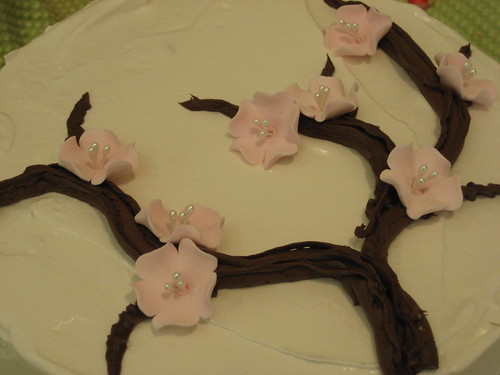
    wedding cake, originally uploaded by pilgrimgirl.

    Picture: a closeup of a round wedding cake decorated with frosting branches and sugary pink blossoms.

    This was the cake at a Quaker Wedding that we attended on Saturday. Friends marry somewhat differently than other denominations. There is no preacher or other authority figure to lead the service. Rather, the wedding party and guests gather in silence, then the couple rise and speak their vows to each other. There is a suggested form for these vows that fairly similar to that of other denominations. However, from what I understand, the couple is welcome to modify these words to suit their desires.

    After the vows, the silence continues but it is punctuated by those in the congregation who feel moved by the Spirit to speak. Yesterday some Friends gave marriage advice, some expressed their love for the bride & groom, and one Friend sang the refrain from “You Light Up My Life.” When the Meeting ended, the couple signed their marriage certificate to seal their vows. Then everyone in attendance signed the certificate as the witnesses to the marriage (it’s a fairly large piece of paper–more like a poster–to accommodate everyone’s signature).

    For those who are interested…attire at this event ranged from very casual to somewhat formal. Some women wore sundresses and some men wore slacks with dress shirts, though the bulk of the group was dressed more casually. The bride wore a simple ivory-colored lacy sleeveless dress and a long strand of pearls. The groom wore a suit.

    Photo by CatGirl

  • In any honest cause


    The best line from this article about Quakers’ role in the abolition of slavery: “In any honest cause there is no agitator like a Quaker.”

    Full article with pictures.

    Keeping it Under their Hats
    By Stephen Tomkins

    Quakers started the British campaign against the slave trade and invented modern campaigning, championing the petition and the consumer boycott, and mastering the use of images and logos. Not that they like to shout about it.

    It is perhaps the defining image of the battle to end the slave trade. Not a picture of a shackled slave, or some gruesome punishment, but a cross-section of a ship. It is a ship packed so full that the mind boggles at the sheer logistics of inhumanity.

    The use of the engraving of the Liverpool slave ship, the Brookes, is the perfect example of how Quaker mastery of PR kick-started the movement that toppled the slave trade.

    “In any honest cause there is no agitator like a Quaker,” said the abolitionist George Stephen. But today their contribution has largely been forgotten.

    Anyone in full possession of the facts would agree, it is time for that to be put right; few, if any, deserve greater credit for the defeat of slavery and the slave trade than them.

    The campaign to abolish the slave trade was an overwhelmingly religious affair. The importance of evangelical Anglicans, like William Wilberforce and John Newton, is well known.

    But Quakers were the pioneers of the movement, its brains, and much of the soul too. The more you delve into the story, the more you find Quakers under every shadow.

    The Quaker Anthony Benezet published a formative attack on the slave trade in 1772, 17 years before Wilberforce’s first abolition motion. Long before Wilberforce first spoke on the issue, the Quakers had formed a campaigning group, petitioned Parliament and distributed tens of thousands of free tracts.

    When the first Anglicans got involved – the philanthropist Granville Sharp, the rector James Ramsay and the passionate young ordinand Thomas Clarkson – it was the Quakers who published their literature and brought them together.

    Thus the Abolition Committee was formed, the engine of the movement. It consisted of 12 men, nine of them Quakers. The evidence and testimonies that Clarkson dug up for them all round the country were essential to the cause, but equally essential was the PR genius of the Quakers.

    They had a century of experience campaigning for their own rights, and channelled this expertise into defending the rights of slaves. As Adam Hochschild has argued in Bury the Chains, the movement forged most of the tools used by campaigners today. They pioneered the mass petition and the consumer boycott, targeting Caribbean sugar.

    The committee invented the campaign slogan and logo, commissioning Wedgwood to produce a design of a slave in chains with the words “Am I not a man and a brother?”. They got the poet William Cowper to write them a civil rights ballad. And in the greatest PR coup of the movement, the committee’s publication of the Brookes diagram, which showed 482 slaves lying shoulder to shoulder, made “an instantaneous impression of horror on all who saw it” according to Clarkson.

    The national network of Quaker meeting houses proved vital to mobilising the public and spreading information. Some of the most radical anti-slavery voices were Quakers – such as Elizabeth Heyrick, who argued, exceptionally, that when the slaves were freed it was they and not their owners who should be compensated.

    The Quakers were natural enemies of slavery, with their fundamental belief in equality in a hierarchical society where that was still highly controversial. They believed above all else that every person is made in the image of God and carries the divine light, so it is blasphemous to elevate one above another.

    They refused to raise their hats to their social betters or to call them “my lord”, “my lady” or even “you”, insisting on the familiar “thou”. Their egalitarianism was still quite scandalous in the 18th Century, but it made slavery uniquely abhorrent to the Quakers.

    The problem was that they were a dangerous sect of fanatics, according to the received wisdom, so no-one listened to a word they said. They were excluded from public office.

    This is why they needed to work with Anglicans like Wilberforce, who brought both respectability and political power to the movement. It is also why their involvement was not especially celebrated at the time, and why it was easily forgotten afterwards.

    The modern Quakers do not plan any major national commemoration of their role in ending the trade, preferring for the most part low-key local services. Their efforts will instead be focused on current campaigns, including their efforts to end the use of child soldiers.

    They are not the only unsung heroes of abolition. James Ramsay, for example, had a huge impact, being the first Anglican clergyman to publish revelations of plantation life, and became a martyr to the movement when constant attacks from colonists destroyed his health.

    But there can be few people who have done so much in such a good cause as the Quakers, and been so little recognised.

  • mormon-ness?

    There’s something that’s been bugging me. I’ve been hesitant to blog about it because I want to think I don’t care. But I do.

    So, I’ve written before about whether or not I’m an ‘active’ Mormon. Over time I’m certainly becoming less insistent on calling myself active. I don’t think of myself or label myself in that way anymore, really. Am I active in Mormon studies, in thinking about Mormon issues? Yes. Am I active in the LDS church? No.

    But what really bugs me are these people in the bloggernacle (the Mormon blogosphere) who, whenever I write something, make these comments about how I’m not Mormon anymore. That’s just not true. My name is still on the church rolls, and I still have a Home and a Visiting Teacher.

    I don’t know why it bothers me that they do this. I guess it’s because I’m all about getting to define myself the way that I want to. It’s like this discussion I had with some Friends on Sunday–one is a Hindu Quaker. She was asking me why I can’t be both Mormon and Quaker. I was trying to explain to her how hard that is–that there are all kinds of ways that Mormon-ness is ‘policed.’ Yet the more I thought about it, I realized that if these same people in the Bloggernacle were, say, assigned to home teach an ‘inactive’ or less active Mormon, I doubt they would show up on their doorstep and say, “Hey, you’re not Mormon anymore” or any such thing. So why is it that people will say this to me online? And why do total strangers care so much about my church membership anyways? How is it that they can know how ‘Mormon’ I am without even asking me personally (or w/o speaking to my bishop)?

    The Church counts its membership in terms of how many people are listed in the records. I’m still there. I’m still being counted. And that’s important to me.

    And I’m also on the roster of my Quaker Meeting. And that’s important to me, too.

  • consider the lilies of the field…

    What surprised me most about attending the LDS Church on Sunday? The way the attendees were dressed.

    Let me speak a bit first about the way my Quaker Friends dress for church. The men generally wear khakis, jeans or shorts with t-shirts, polos, or button-downs. Occasionally one will wear a sweater. I don’t recall every seeing a tie, suit, white dress shirt, or dress shoes on a male Friend.

    The women’s clothes are quite similar. Some of the women wear nice jewelry, as in a pair of amber teardrop earrings. A few of the older female friends wear dressy scarves or jackets. I’ve seen the women wear loafers, but I don’t think I’ve ever seen a pair of pumps, wedges, or high heels in Meeting. Clogs, sandals or athletic-style shoes are most common. Many Friends wear the same clothes each Sunday. I usually wear my serviceable long-ish black polyester skirt (this same skirt that I’ve had for 10 years and accompanies me on all of my overseas travel because of its indestructibility) with a t-shirt, sweater, or blouse. Sometimes I wear pants, but not as often as a skirt because we do laundry on Sunday afternoon and I rarely have any clean pants on Sunday morning.

    Allright now, back to LDS. Many of the younger women looked dressed as if they were headed to a club. Slinky, clingy fabrics. Very short skirts. Plunging necklines. All in the latest fashions (at least, I am making that assumption given that I know so little about fashion) With all of the makeup, jewelry, and high-heeled shoes to match. The men, of course, wore the requisite dark suits, white shirts, and ties. With expensive-looking leather dress shoes and belts. I found the men quite intimidating–I haven’t been around ‘suits’ in months (no one in academia dresses like that). I hadn’t realized how overwhelming such clothing can be. It gave me pause as I considered how the LDS might appear quite daunting and over-the-top corporate to newcomers.

    As I reflected on this later, it seemed odd to me that the LDS women were dressed so worldly, so ‘immodestly.’ At Quaker Meeting I’ve never seen a mini-skirt or any cleavage. Yet Quakers have no rules or restrictions about the clothing of their members. And the LDS are counseled to dress modestly, even having this reinforced/policed by the nature of their temple garments.

    Interesting…

  • Some Friend-ly Sabbath links


    —An excerpt from some thoughts on Quaker silence:

    By and large Quakers tend to be busy people, and you rarely find them wondering how to occupy their time. They would, however, be the first to recognize how essential it is for them to have periods of disinvolvement, even from the activities which express their continuing concern to care for people …. In our disinvolvement two elements will be present. First is a kind of detachment that while standing back, accepts all experience in the hope of transcending it- seeing beyond it creatively. Secondly a cessation from all mental activity so that the body and mind are as still and quiet as possible.

    —A Quaker Pioneer: Ann Preston, early woman doctor

    —A method for silent worship.

    —Ways of Worship from JohnW’s grandma. An excerpt:

    I think of myself like the tree planted by the “rivers of water” in Psalm 1, sucking up God’s gift of life and being restored.

    —A Quaker Home Blessing: (Someday this may be framed and hanging in my front doorway)

    LET the guest sojourning here know that in this home our life is simple. What we cannot afford we do not offer, but what good cheer we can give…we give gladly.

    We make no strife for appearance sake.

    Know also, friend, that we live a life of labour, therefore, if at times we separate ourselves from thee, do ye occupy thyself accordingly to thine heart’s desire.

    We will not defer to thee in opinion or ask thee to defer to us. What thou thinketh ye shall say, if ye wish, without giving offense. What we think, we also say, believing that truth hath many aspects, and that love is large enough to encompass them all.

    So, while ye tarry here with us we would have thee enjoy the blessing of a home, health, love and freedom, and we pray that mayst find the final blessing of life. PEACE

  • another post about sex…

    My friend Chris Bigelow and some of his buddies published an LDS humor column, “The Sugar Beet” (like The Onion for Mormons) for several years and have combined the best of their work into The Mormon Tabernacle Enquirer.

    I’ve reprinted a bit of one of their funnier articles here, some positions from the Mormon Kama Sutra:

    Retention and Reactivation
    The Stripling Warrior
    Urim and Thummim
    The PPI
    Hold to the Rod
    The Secret Combination
    Come, Thou Font of Every Blessing
    Hie to Kolob
    The Rameumptom

    To this list I would add:
    The Bishop’s Daughter
    The RM

    So I’ve been trying to come up with some similarly funny positions using Quaker terminology and I haven’t come up with much–perhaps I don’t know the lingo well enough yet. Perhaps ya’ll can chime in with some of your own ideas?

  • like a fire is burning

    The Spirit of God like a fire is burning!
    The latter-day glory begins to come forth;
    The visions and blessings of old are returning,
    And angels are coming to visit the earth.

    At my first Quaker Meeting, I felt a bit awkward, as I feel with anything new. John had explained a bit about Quaker silent worship to me. Just sit and meditate. Every once in awhile someone will feel prompted to speak. Like in Testimony Meeting. I wasn’t quite prepared for the simplicity of the room where we would sit and worship. Like a Relief Society room with no flowered curtains, no pulpit or table, no pictures on the walls. Just chairs in a circle in a large plain room, about half of them occupied with a wide variety of people. Many were older, almost all wore pants, nearly everyone wore sandals on their feet (certainly a far cry from the fanciness of my Orange County ward).

    As I seated myself and settled into silence, I tried to quiet my mind and think godly thoughts. As I did so, with insistence the temple ceremony came to mind. I found myself walking through each step of the washing and anointing. I smiled as I imagined my self looking into the eyes of the temple workers who were administering the ordinances. I moved on through the endowment and soon found myself seated in the celestial room. Warmth and light filled my chest as I reflected on the many hours that I’d spent praying and basking in the Spirit within that special space.

    When I was endowed, about a month before my marriage, I was wholeheartedly enthusiastic about the temple. John and I attended at least half a dozen times before our actual marriage ceremony. Then we arranged to stay in a temple apartment for the last part of our honeymoon–so we could go through several sessions per day. Then, throughout that first year of our marriage we attended nearly every week. We would arise at 4:30 each Saturday morning so we could make the 40 mile drive to LA without traffic and we could watch the sunrise from a sealing room in the temple, and we could share a cup of custard and a slice of blueberry pie for breakfast after a session or two.

    So why was I reliving all of this in my mind at the Quaker Meeting? I didn’t know at the time and I learned not to fight it. Nearly every time I attended silent worship, I had the same experience. I came to expect it, even though my attendance was spotty, the temple experience was predictable. And like the warm-fuzzy feelings that I’d had in the temple, I would leave Meeting with a giddiness, an ebullience that rather frightened me. I mean, I liked the feelings, but I was scared to question too deeply why it felt so good. I also kept myself rather aloof from the Quaker community. I was friendly with the Quakers that I met, but I was not at all interested in investing in a new faith community. I was too absorbed with grappling with Mormonism and navigating my marriage (by this time, John had been an atheist for many years, and I had long given up hope of changing his mind about spiritual matters).

    I now believe I understand why the temple figured so importantly in my early silent worship. Up to that point in my life, if I sought direct communion with God, I sought him in the temple (or before I was endowed, I would spend time meditating in the garden just outside the temple). Even on a subconscious level I needed the temple ritual (even virtually) to bring me close to the divine.

    Now I can slip much more easily into prayer as I sit in worship with Friends. On occasion I still return to the temple in my mind, but that is becoming more rare. Recently I read these words from George Fox (the founder of The Society of Friends) about the temple:

    The Lord showed me, so that I did see clearly, that he did not dwell in these temples which men had commanded and set up, but in people’s hearts . . . his people were his temple, and he dwelt in them.

    [Note: the second picture above is a sneaky photo that John took during our Quaker Meeting]

  • honesty

    Sure there are moments when it’s best not to be too honest–when doing so would offer undue criticism that would hurt another person.

    Yet it seems that in telling one’s own experiences honesty is an admirable thing. Over the past few years, as I’ve written much about my experiences as an amputee, as a cancer survivor, and as a Mormon woman, I’ve tried to be unflinchingly candid and honest. I want to tell my stories truthfully and sincerely. Because truth staves off fear.

    However, I was talking with some friends recently who challenged my need for honesty. They asked me why I had informed my LDS leaders that I was no longer planning to attend church. Why hadn’t I just drifted into inactivity or gone my own way without need to ‘inform’ people of my choices? It’s a good question, one that I’ve been muddling over.

    And, honestly, I have had many moments over the past few weeks when I should have just lied a little to make it easier. Told a few falsehoods to smooth over the difficulties, or just kept my mouth shut and pretended that everything was okay.

    So it’s when I have a night like last night, that I wish I’d never been honest. That I wish I was a liar. That I wish I’d just said nothing and pretended that I was complicit.

    And I wonder where my honesty has gotten me???

  • "They are all Come-Outers"


    An interesting rumination by famous prison-reformer and Quaker Elizabeth Fry, who suggests that “The Mennonite, Dunkard, Shaker, Oneida Communist, Mormon and Quaker are all one people, varying only according to environment.”