Category: books

  • novelty

    lisanthus on the windowsill

    Last year in October I dyed some sections of my hair neon purple.  There was no particular reason for me to have purple hair, it just seemed like something worth trying.  I was curious if it wold affect the way people interacted with me and/or the way I felt about myself.  As far as I can tell, it didn’t really have much of an impact other than being novel.

    Much of my life lately seems to hinge on that novelty factor.  There’s such a rush from trying new things, or experimenting with new ways of doing things.

    One thing, however, that I thought would always be a constant in my life, is my love for books.  But ever since I started reading e-books, my love for actual books with paper pages has waned.  I like being able to browse through a text quickly via keyword searching.  I like being able to jump from TOC to chapter with the click of a link.  And having all of my devices synced to that exact page in the novel that I’m reading…has stimulated my love of reading all over again.  Instead of needing to carry a book with me to fill in the gaps of my day, I can simply turn on the kindle app on my phone, and be back where I stopped reading the night before.

    What about you, are you reading ebooks?  If so, how are you liking them?  Are they changing your reading habits?

  • reflection

    reflection

    As part of organizing my new office at Chapman University, I’m moving most of my academic books from the shelves in my living room over to campus.  Every time I pull a history book off the shelf it brings back memories of the specific graduate school seminar where we studied that work.  So in packing the bags of books I’m also re-living much of my graduate school experience.  There are so many memories held in those pages!  Most of all, it is sitting around the seminar table in the basement of Murray Krieger Hall and grappling with the ways we imagine the past and the best practices for doing our own writing about it.  I remember failures.  And moments where I really “got” an idea as brilliantly as a lightbulb turning on inside my head.

    My journey through graduate school has not been easy–balancing my family’s needs with my own need to write and study has meant major sleep derivation, and sometimes half-baked scholarship.  In those seven years since I started graduate school I’ve battled a life-threatening illness, I’ve left my Mormon community behind, and I’ve become a person that would be hardly-imaginable to my 32 year-old self.  When I signed up to get a PhD I didn’t know exactly what to expect, but it certainly wasn’t all that!

    So many of those thoughts where swirling around in my mind when I came across a dusty copy of The History of Tooele County.  It was a gift from Mike Davis, the historian-writer who strongly urged me to attend graduate school and was an ardent supporter of my creative nonfiction writing.  I’d written about my Utah family and their problematic relationship to the land that’s poisoned by the Kennecott mines that loom so close nearby.  Mike talked with me about the Iosepa cemetery, which is one of my all-favorite burial grounds (a close second to the Pleasant Green cemetery).  He understood the tensions I felt between my bone-deep allegiance to the place of my family and to the utopian promise of the “West,” while also validating why I felt so betrayed by the Mormon naivete that “all is well” in Zion. One day we walked along the beach in San Diego as we talked about all of this, and he asked me how I could continue to believe in the Mormon church, knowing all I did about its failings.  I looked at my kids who were running in the waves alongside us and thought of Davis’ own wife who was about ready to give birth to twins.

    “I love them so much,” I said, pointing to my kids. “How could I ever live with the constant overwhelming fear of losing them if I didn’t believe in eternal families?  I can’t not believe that they will always be with me.”

    He replied to me on an equally deep level, expressing his love for his children, and his fears for their futures.

    There was something about walking along the rocks and sand and waves that cemented that interaction in my mind long after it was over, and all of that returned as I held the old book in my hands yesterday.  It’s been a few years since I chatted with Mike and since then I’ve faced down a lot of fear.  I no longer feel the same sense of needing to believe in Mormon cosmology to assuage my concerns about losing my children, even though I do constantly worry about their safety.

    It brings to mind some favorite lines from a Mary Oliver poem, “Little Summer Poem Touching the Subject of Faith”:

    And therefore, let the immeasurable come.
    Let the unknowable touch the buckle of my spine,
    Let the wind turn in the trees,
    and the mystery hidden in dirt

    swing through the air.
    How could I look at anything in this world
    and tremble, and grip my hands over my heart?
    What should I fear?

    One morning
    in the leafy green ocean
    the honeycomb of the corn’s beautiful body
    is sure to be there.

  • Mary Monday: lessons, shells, and solitude


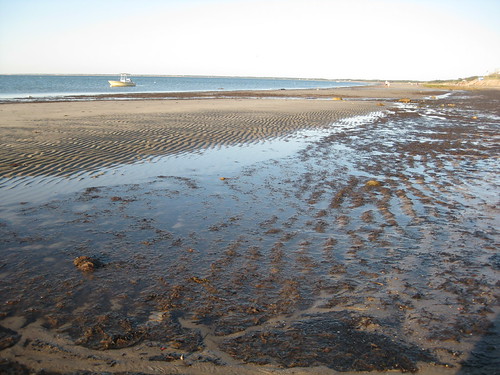
    Cape Cod-tide on its way out, originally uploaded by pilgrimgirl.

    My visit to Cape Cod was two months ago, but I feel like I’m just now actually processing the lessons that I learned while I was there. I was so raw, still, from John’s excommunication. For a very long time I’d been feeling this urgency to have some time just for me, and I had those few days to sort out some of the concerns that weighed rather heavily. I needed the time to be on my own, to wander, and to face the sea wind.

    It’s not often that we get a chance to be apart from the world for awhile, in such a beautiful place. Cape Cod will always be dear to me now, as the landscape that held me when I was aching, that taught me to feel strong in the midst of fear and change.

    Today’s passage isn’t from Mary Oliver, but from another woman who knew the gifts from the sea, Anne Morrow Lindbergh. Her insights gained during her time on the “island” are resonating with me today as I think back to my time on Cape Cod.

    She writes:

    “Moon shell, who named you? Some intuitive woman I like to think. I shall give you another name–Island shell. I cannot live forever on my island. But I can take you back to my desk in Connecticut [or in Irvine]. You will sit there and fasten your single eye upon me. You will make me think, with your smooth circles winding inward to the tiny core, of the island I lived on for a few weeks. You will say to me “solitude.” You will remind me that I must try to be alone for part of each year, even a week or a few days, and for part of each day, even for an hour or a few minutes in order to keep my core, my center, my island-quality. You will remind me that unless I keep the island-quality intact somewhere within me, I will have little to give my husband, my children, my friends, or the world at large. You will remind me that woman must be still as the axis of a wheel in the midst of her activities, that she must be the pioneer in achieving this stillness, not only for her own salvation, but for the salvation of family life, of society, perhaps even of our civilization.”

    The need for solitude and stillness is not just essential for women and mothers, but for everyone so they can find center. Where do you go when you need to be alone for awhile?

  • the view


    Picture above is the sun setting over the Rocky Mountains, as seen from the 38th floor of a Denver hotel.

    Part of my “trip reading” during the Western History Association Conference is The Best American Essays 2009. I realized that I just had to buy it when I saw that Mary Oliver was this year’s editor.

    A favorite quote from her Introduction that applies to blogwriting as well as more traditional forms of the essay:

    We speak a good deal these days of the loss of community, and many of us feel that we have lost therefore something very precious. Essays can move us back into this not-quite-lost realm. Tackling a hundred subjects, in a hundred different styles, they are like letters from a stranger that you cannot bear to throw away. They haunt you; they strengthen you.

    Perhaps I’ve been so busy contemplating the world of the ‘not-quite lost’ that I’ve had my head in the clouds for most of this last week. Somewhat literally, of course, as I’ve been staying in high-rise hotels for the duration of the conference, but also in that twice I’ve found myself lost and wandering around Denver city streets. How I can still get lost even with the aid of googlemaps is beyond me. But maybe there are only so many weighty thoughts that can occupy my brain at any given time….

  • Interview: Gary Presley, author of _Seven Wheelchairs_


    Today PilgrimSteps offers my interview of Gary Presley, author of the recently-published Seven Wheelchairs: A Life beyond Polio.

    From Kirkus Reviews: “The painful story of what it’s like to become crippled as an adolescent and forever dependent on others.Now in his 60s, Presley got a booster shot of the Salk attenuated polio virus vaccine in 1959 at age 17. Designed to enhance immunity, the virus instead produced major paralysis, which required the boy’s removal to an iron lung and then to a series of rocking beds and mechanical devices to force air into his lungs…Now some 50 years and seven wheelchairs later, Presley recounts his evolution from the deep anger, self-pity, frustration, passivity and hostility of those first decades of bitterness and depression to his emergence as an adult. It didn’t help that he spent those early years as a “crip” on a Missouri farm with a stoical, stiff-upper-lip dad (his mom was loving and devoted). Nor did it help that about the time both parents were dying, he fell ill with post-polio syndrome. That he recovered, could work, fall in love, marry and convert to Roman Catholicism are part of the trajectory toward a happy ending. But not quite…But he has become a fighter, raging against the pity and stigma experienced by people with disabilities, as though they are less than human…for readers who remember the era of infantile paralysis and newsreels of children in iron lungs, Presley’s descriptions of exactly how they work, as well as the daily care that paralysis demands, are a revelation.One of the more honest and informative disease memoirs.”

    1) What led you to write a book about your experience with disability?

    As I grew older, I began to realize “Hey, I’ve used a wheelchair for four decades. I thought that … well, rather interesting, but I had never written much about the “disabled experience.” Then, on a lark, I wrote an essay titled “A Pot to Pee in,” which was really an assembly of random thoughts about the bad ol’ days when people who used wheelchairs could rarely find an accessible restroom. Friends on a writing critique list said “This is good stuff. Write a memoir.” The first fifty thousand words came easily — all the dramatic stuff that makes TV shows like “ER” popular — and then it took a bit longer to get to the philosophical points.

    2) Has it been difficult for you to discuss your experiences with disability when this is generally a ‘taboo’ subject in American culture? Why or why not?

    Disability is a fear-filled subject, I think, rather than one that’s entirely taboo. People want to talk about disability only in the sense of the “Overcoming Hero” story. To think — to discuss, to write — about disability in the context of daily life reminds people that the Universe sometimes sneaks up and bites people in the fanny. In the memoir, I refer to myself as a “burnt out case” (an allusion to Graham Greene’s novel), which in the context of your question means I don’t much care about the emotional aspects of “The Life Disabled” any longer. To me disability is reality. Why disguise or avoid what cannot be changed?

    3) Do you think the main audience of your book is people with disabilities, or those without disabilities? Why?

    I think my book is written for those who want to read about people in all their unique manifestations. I’m fascinated by history, and by the place people play in history, and how the individual fits into (or is excluded by) society. People can read it and learn we (meaning even gimps like me) are all mortal creatures — driven by intellect, emotions, and some sort of immeasurable spiritual factor.

    4) What is your advice for aspiring writers who may also want to write a memoir about their experiences with disability?

    Don’t begin unless you’re wiling to learn more about the person you may really be … I cannot say that I knew Gary Presley entirely until I finished Seven Wheelchairs and then began to contemplate what I wrote. I pray I’m not deluded, but I think I like myself a little better now.

    As to the practicalities of the writing process …
    –Write every day.
    –Join a critique group, preferably an online one where people will be more apt to tell you the truth about your work.
    –Take criticism without becoming defensive.
    –Regard criticism as opinion.
    –That means stay true to your voice and your message.
    –Grammar and syntax are important but not as important as the story and the truth it contains.
    –Tell the truth even when it hurts, especially if it is painful for you to tell it.
    –Remember the truth is sometimes subjective, which means each person perceives events and people differently.
    –Believe in your truth.
    –Prepare to be rejected, multiple times.
    –Persevere in the face of those rejections.

    5) Can you share a short passage from your book so we can get a feel for your writing style?

    Here’s a bit describing one of my first encounters in the rehab center:

    In fact, no one ever asked me, “What would you like to do with your life? Or how do you plan on earning a living?”
    I wish they had. And I wish I had known the question needed to be asked.

    This was 1960, and the subtext of every interaction between patient and staff was to teach the patient how to cope with the effects of a disability, and it ended there – You’re crippled. You’re going to be crippled the remainder of your life. This is how to put on a shirt. This is how to pee in a urinal while sitting in a wheelchair. Here, when you’re finished, you can make a leather wallet to keep busy until it’s time for your favorite television show.

    No one expressed any idea that it might be preferable – or even possible – to integrate people with disabilities into society. No one said, “Some sort of disability, some sort of disadvantage, visible or invisible, is part of the human condition. Live fully with yours as you see it. Be assured others do as well with their own perceived disability, visible or not.”

    The lesson I needed then could have been stated bluntly. You are a cripple. You will never walk again. You will be dependent on the care of others. Cry and complain for a while if you like. That’s normal. Then find something useful to do with your life.

    If you would like an autographed bookplate to place inside your copy of Seven Wheelchairs, please contact Gary at garypresleyATgmailDOTcom.

  • either husbands or lovers

    I’m chewing on this quote from Susan Sontag today:

    “Great writers are either husbands or lovers. Some writers supply the solid virtues of a husband: reliability, intelligibility, generosity, decency. There are other writers in whom one prizes the gifts of a lover, gifts of temperament rather than of moral goodness. Notoriously, women tolerate qualities in a lover—moodiness, selfishness, unreliability, brutality—that they would never countenance in a husband, in return for excitement, an infusion of intense feeling. In the same way, readers put up with unintelligibility, obsessiveness, painful truths, lies, bad grammar — if, in compensation, the writer allows them to savor rare emotions and dangerous sensations. And, as in life, so in art both are necessary, husbands and lovers. It’s a great pity when one is forced to choose between them.”

  • bookish


    For those of you who’ve been to our humble home (or who have seen the video–we’ve moved since then but the layout is similar), you’ll know that we’re a very bookish family. Part of that comes from having two parents who are in graduate school, part of it is pure fanatical obsession with the written word.

    As a young girl, my books were like dear friends. I read them over and over again–each one had a special place on my bookshelf. Every year for my birthday and for Christmas my best-loved gifts were the small stack of new novels that I would receive from Mom–often Newbery award winners or classic children’s lit. In recent years, one of my greatest thrills has been to pass on my copies of books like The Island of the Blue Dolphins, A Wrinkle in Time, or From the Mixed-Up Files of Mrs. Basil E. Frankweiler to my own kids (who seem to appreciate the sentiment even if the books are now all falling apart at the spines).

    While I’ve been ill for the last few months, I’ve read some good reading time. Here a few recent favorites:

    ***Book Three in the Twilight series (and will probably borrow the 4th from a friend soon). Does anyone else out there agree with me that Edward is getting particularly creepy and over-protective and Jacob is seeming a far more attractive candidate for Bella’s attention? (please, no spoilers for #4 in the comments, people!) I’ve learned that it’s oddly apropos to be reading about blood-sucking vampires when one is ailing in the hospital. Another good vampire read (not so much romance, but more sophisticated plotline and writing) is Angel Falling Softly.

    ***By far, my favorite recent read is The Book Thief, which was sent by a dear friend. At first I was a bit put off by the unusual story narration, but I persisted and once I was in a few dozen pages, I was swept away. I really thought I’d read plenty about Germany during World War II (my previous favorite being Ursula Hegi’s delicious Stones from the River) and wouldn’t want to read another book on the era. I was so wrong.

    ***A great diversion,Bonk: the Curious Coupling of Science and Sex, wasn’t as funny as I’d expected it to be, but had me enthralled anyways–I was especially fascinated by the author’s own participation in some of the sex studies that she discusses!

    ***For those of you with China on the mind, you might like The Dragon’s Village as much as I did. An autobiographical tale about land reform in revolutionary China, I found it hard to put down–it offered a poignant personal perspective on such an important and complicated historical moment. I wish I’d read it prior to my China trip a few years ago.

    I’d love to know any books that you’d recommend for me to read while I convalesce. I’m open to anything except super-suspenseful mysteries and horror (because I’m still afraid of the ghosties who live under my bed). I love artful writing, but a hard-to-put-down plot-driven novel works for me, too!

    the first few words
    [My kids, dressed as Harry & Hermione, reading the first few pages of the last Harry Potter book at a Midnight Madness book release party]
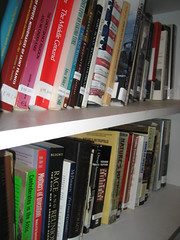
    P.S. See how all those books in the top picture have white stickers on their spine as if they were in a library? A few years ago we cataloged all of our 2,000+ books according to their LOC numbers–because we are crazy like that.

  • on wolves, coyotes and gentle men

    Just finished reading Amy Irvine’s memoir, Trespass. It’s a well-wrought story of a Jack-Mormon woman’s relationship to the land, in the style of Terry Tempest Williams. One of the threads in the story is about her relationship with Herb, a SUWA lawyer that she dubs the “lion man.” Late in the book she shifts his identity from lion to coyote. She writes [note that she’s speaking about a picture of the two of them near Lake Powell]:

    “Herb, as usual, looks invincible. In this particular instance, it is as if the recessive climactic conditions that threaten the region [of Southern Utah]–combined with the stresses in our life–only strengthened his resolve to flourish.
    Now as I stand in the home he has built, it is the photo that helps me grasp that he is not a lion an at all. He is pure Coyote–decadent, passionate, and possessing an inherent tendency to thrive in the worst of times.
    But there’s more. He has his arms around me in a desperate sort of way–as if he’s trying to uphold my burgeoning mass [note: Amy is pregnant]. What strike me now, in thinking about the photo, is how he falls into anything that resembles the work of a savior–that this is how he gets duped into trying to hold the entire world in his hands…It’s not wonder that he feels so at home in Deseret–where God and biology are in perfect agreement that men and Canis latrans should take as much territory as possible. But, for all his sparkles and grins in that one photographic moment, his eyes are dark and resigned. It is the glimmer of resentment. The part that blames me for his hind legs’ getting caught in the snares of convention and duty. This part is his in our troubled equation…
    His response was that of any trapped creature: to chew his paw off and run” (341-342).

    This section of Amy’s book made me think of a poem that I posted way back in the early days of this blog, speaking about John and GameBoy:

    There are Men Too Gentle to Live Among Wolves

    There are men too gentle to live among wolves
    Who prey upon them with IBM eyes
    And sell their hearts and guts for martinis at noon.
    There are men too gentle for a savage world
    Who dream instead of snow and children and Halloween
    And wonder if the leaves will change their color soon.

    There are men too gentle to live among wolves
    Who anoint them for burial with greedy claws
    And murder them for a merchant’s profit and gain.
    There are men too gentle for a corporate world
    Who dream instead of Easter eggs and fragrant grass
    And pause to hear the distant whistle of a train.

    There are men too gentle to live among wolves
    Who devour them with apetite and search
    For other men to prey upon and suck their childhood dry.
    There are men too gentle for an accountant’s world
    Who dream instead of Easter eggs and fragrant grass
    And search for beauty in the mystery of the sky.

    There are men too gentle to live among wolves
    Who toss them like a lost and wounded dove
    Such gentle men are lonely in a merchant’s world
    Unless they have a gentle one to love.
    -James Kavanaugh

    I think this is a tough world for most men. They are taught to repress emotion and/or are encouraged to act tough or even violently, even as they hunger for intimacy. At the same time, in our culture, they are shuttled into the role of breadwinner or provider. The burden of this makes it difficult for them not to play up to the men with the IBM eyes or the wolves of the corporate world. There seems so little space for men to play, to express creativity, to choose a profession that’s a passion rather than a “responsible choice.”

    For many years I’ve been dependent on John to bring home the bacon, to provide health insurance, and to make my life (and our children’s lives) comfortable materially. It’s a huge burden that is not without emotional and physical cost. I am often unsurprised when I hear stories from friends of their husband’s mid-life crises. It’s no wonder that so many men “chew [their] paw off and run” to a place where they can live a fleeting fantasy for awhile.

    Yes I realize that part of being an adult is doing things we don’t enjoy too much. The slogging mundanity of daily household chores, the endless errands that are required to keep a family outfitted and fed, the days of busywork at a job that depletes one’s soul. And I wonder, why does it have to be this way? And how can I remove myself and my beloved from this madness? How can we create a space to live and to thrive even as middle-class corporate America seems destined to suck the life right out of us? Where is the oasis in this desert? Where is the Innisfree where “peace comes dropping slow”?

    Your thoughts?

  • BOOKS!

    Will you be at the LA Times’ Festival of Books this weekend? If so, drop me a line in the comments and we’ll see if we can arrange a meetup!

    :)

  • Book Meme

    From John, a Book Meme:

    The rules:
    1. Pick up the nearest book of 123 pages or more. No cheating!
    2. Find page 123
    3. Find the first 5 sentences
    4. Post the next 3 sentences
    5. Tag 5 people

    My nearest book at hand is James Goodman’s Blackout. This is a wickedly good history book, the kind of history that I want to write someday. But honestly this passage just sucks.

    “I’m almost 70 years old and I have no place to go,” cried a woman standing across the street from the charred remains of her $57 rental.
    “I wish I had died.”

    “I’m no bleeding heart,” said the head of the Legal Aid Society’s criminal-defense staff.

    The teaser from the dustjacket offers a more provocative glimpse into the book’s topic:

    The summer of 1977 seethed.
    Unemployment was up.
    Crime was through the roof.
    Son of Sam was on the loose.
    Things couldn’t get much worse.
    Then the lights went out.
    When they came back on, nothing was quite the same.

    I now tag:
    All of my female readers, including…Brooke, Barbara, Bonny, Alison, Allison, Alise, Alisa, Allyson, Christi, Kirsten, Deborah, Darlene, Amy, Alberta, Bekah, Lorell, Lucy, Sara, Sarah, Susan, Shana, Sandra, Rebecca, Caroline, JaneAnne, Janice, Emily, Maria, Margy, Jessica, Penny, Angela, Emma, Nicole, Tanya, Elise, Elisabeth, Lisa, Reg, C.L., Wen, Holly, Elaine, Cheryl, Kara, Kate, Kay, and so forth (and dang it, if I forgot to name you in my list, let me know and I’ll fix it ASAP)! And if you’ve already played along once, feel free to join in the fun again. :)

    You can answer in the comments or on your own blog… :)

  • my loves


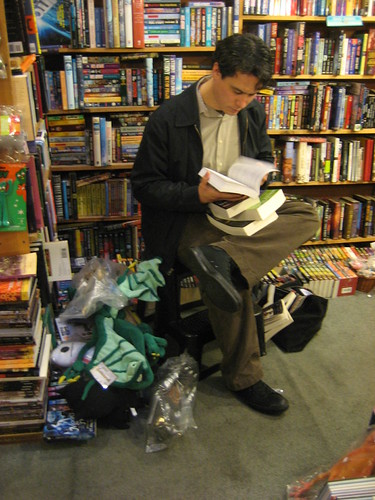
    dark carnival boookstore, originally uploaded by pilgrimgirl.

    John and books, books and John. What more could a girl ask for?
    (note: the kidlings were upstairs at the bookstore, searching for ways to spend their Christmas money…)