Author: Jana
-
holidayz
Had a great “Christmas” this morning, which included the Gift Which Will Never be Rivaled(TM).
As we travel for the next few weeks, I’ll update this blog irregularly, so feel free to follow our pilgrimage via flickr and twittr. :)
Happy Holidays, everyone. Thank you, each of you, for the goodness of this past year and for the many ways you make my life more rich and meaningful.
-
How the UPS man ruined Christmas
Reblogged from 2 years ago…
Setting: evening at our house. The front door is open because it’s stuffy inside the house from cooking dinner. GameBoy and CatGirl are sitting at their desk in the living room working on their homework. Christmas carols are playing on the stereo. Our brightly lit Christmas tree is visible from the front doorway. A guy in a brown uniform is walking up the pathway to our place.
UPS Guy: Ma’am? Your package broke open in the truck, the tape is undone on one side now. Can I bring it on in for you? It’s really big…
Me: Sure, put it right here in front of the bookcase.
UPS Guy: Someone’s sure lucky to be getting a —–.
Me: Shhhhh….(gesturing wildly towards the kids)
A deep intake of breath from one of the kids, a squeal of delight from the other.
UPS Guy: Uh oh.
-
the path of joy
Learning to live in the present moment is part of the path of joy.
~Sarah Ban BreathnachUndoubtedly, I will not live up to every expectation that I’ve set up for myself for this holiday season. Some gifts may be late, some may not please the recipient as much as I’d hoped, some important details might be neglected.
As we settle into the last hours before we leave on our trip and I realize all of the items on the ‘to-do’ list will not be checked off, I am panicking a bit. How to prioritize? What must be done now and what can wait? Have I prepared well? Will we at least be safe and ready for any contingencies that might arise?
And most importantly, can I relax and enjoy myself, without concerns about what might be left undone?
-
still holding on…
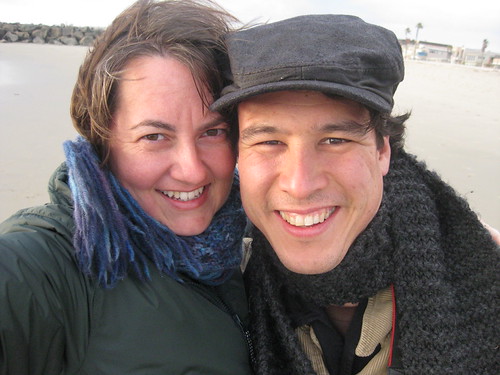
Our first date was just over 19 years ago (December 14, 1989). John and I have grown up with each other, having spent more than half of our lives together now, in many ways seeming more like siblings than lovers…Sometimes I wonder what I saw in him then that told me he would continue to hold my attention even after all these years.
I’ve loved him as I have loved no other. It is he who taught me the true meaning of hope.
I have been overcome by the beauty and richness of our life together, those early mornings setting out, those evenings gleaming with rivers and lakes below us, still holding the last light.
~Anne Morrow Lindbergh -
gift from the sea
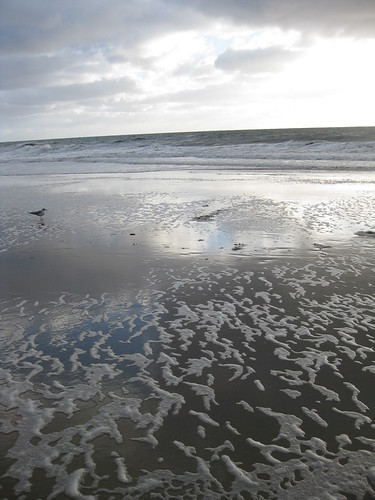
The sea does not reward those who are too anxious, too greedy, or too impatient. One should lie empty, open, choiceless as a beach – waiting for a gift from the sea.
~Anne Morrow LindberghPic above is from our family jaunt out to the beach last weekend at sunset as a storm was rolling in on the far horizon. Yesterday I also enjoyed a ‘gift from the sea’ as I went outrigger canoeing on the Back Bay with a friend. Though my paddling style may have been lacking a bit (it was my first time trying to paddle in that particular manner and I ended up inadvertently dousing my friend more than once when my paddle hit the water at the wrong angle), I loved how smooth and easy it felt to be on the water. A gift, indeed.
-
magical places

Our family visited the Isle of Man about 8 years ago and it was a sublime (despite having various dramas with British Airways–ugh) vacation. One of our favorite spots were the ruins of Peel Castle (pictured above), a space where my ancestors had certainly walked the halls many generations ago. For me, traveling is magical–especially when I can reconnect with the past in a meaningful way, or just let the beauty of a new place wash over me and fill me up with new sensations.I can’t wait to return to the IOM someday, but in the meantime I’m dreaming of trips to new places (specifically, my East coast trip starting next week!) to fill me with their wonder.
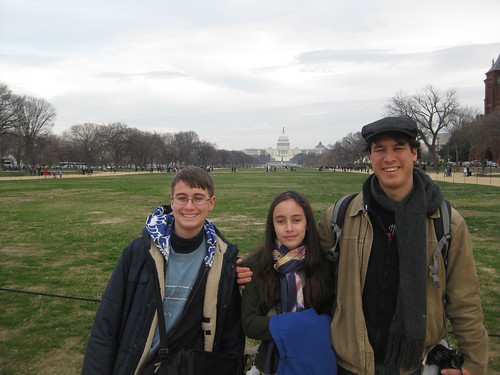
Speaking of traveling…if you’re in NYC or DC and you want to meetup over the holidays, let me know ASAP. Also, if you’ll be at the AHA conference, let’s definitely touch base at some point during the proceedings. :)
-
Interview: Gary Presley, author of _Seven Wheelchairs_

Today PilgrimSteps offers my interview of Gary Presley, author of the recently-published Seven Wheelchairs: A Life beyond Polio.
From Kirkus Reviews: “The painful story of what it’s like to become crippled as an adolescent and forever dependent on others.Now in his 60s, Presley got a booster shot of the Salk attenuated polio virus vaccine in 1959 at age 17. Designed to enhance immunity, the virus instead produced major paralysis, which required the boy’s removal to an iron lung and then to a series of rocking beds and mechanical devices to force air into his lungs…Now some 50 years and seven wheelchairs later, Presley recounts his evolution from the deep anger, self-pity, frustration, passivity and hostility of those first decades of bitterness and depression to his emergence as an adult. It didn’t help that he spent those early years as a “crip” on a Missouri farm with a stoical, stiff-upper-lip dad (his mom was loving and devoted). Nor did it help that about the time both parents were dying, he fell ill with post-polio syndrome. That he recovered, could work, fall in love, marry and convert to Roman Catholicism are part of the trajectory toward a happy ending. But not quite…But he has become a fighter, raging against the pity and stigma experienced by people with disabilities, as though they are less than human…for readers who remember the era of infantile paralysis and newsreels of children in iron lungs, Presley’s descriptions of exactly how they work, as well as the daily care that paralysis demands, are a revelation.One of the more honest and informative disease memoirs.”
1) What led you to write a book about your experience with disability?
As I grew older, I began to realize “Hey, I’ve used a wheelchair for four decades. I thought that … well, rather interesting, but I had never written much about the “disabled experience.” Then, on a lark, I wrote an essay titled “A Pot to Pee in,” which was really an assembly of random thoughts about the bad ol’ days when people who used wheelchairs could rarely find an accessible restroom. Friends on a writing critique list said “This is good stuff. Write a memoir.” The first fifty thousand words came easily — all the dramatic stuff that makes TV shows like “ER” popular — and then it took a bit longer to get to the philosophical points.
2) Has it been difficult for you to discuss your experiences with disability when this is generally a ‘taboo’ subject in American culture? Why or why not?
Disability is a fear-filled subject, I think, rather than one that’s entirely taboo. People want to talk about disability only in the sense of the “Overcoming Hero” story. To think — to discuss, to write — about disability in the context of daily life reminds people that the Universe sometimes sneaks up and bites people in the fanny. In the memoir, I refer to myself as a “burnt out case” (an allusion to Graham Greene’s novel), which in the context of your question means I don’t much care about the emotional aspects of “The Life Disabled” any longer. To me disability is reality. Why disguise or avoid what cannot be changed?
3) Do you think the main audience of your book is people with disabilities, or those without disabilities? Why?
I think my book is written for those who want to read about people in all their unique manifestations. I’m fascinated by history, and by the place people play in history, and how the individual fits into (or is excluded by) society. People can read it and learn we (meaning even gimps like me) are all mortal creatures — driven by intellect, emotions, and some sort of immeasurable spiritual factor.
4) What is your advice for aspiring writers who may also want to write a memoir about their experiences with disability?
Don’t begin unless you’re wiling to learn more about the person you may really be … I cannot say that I knew Gary Presley entirely until I finished Seven Wheelchairs and then began to contemplate what I wrote. I pray I’m not deluded, but I think I like myself a little better now.
As to the practicalities of the writing process …
–Write every day.
–Join a critique group, preferably an online one where people will be more apt to tell you the truth about your work.
–Take criticism without becoming defensive.
–Regard criticism as opinion.
–That means stay true to your voice and your message.
–Grammar and syntax are important but not as important as the story and the truth it contains.
–Tell the truth even when it hurts, especially if it is painful for you to tell it.
–Remember the truth is sometimes subjective, which means each person perceives events and people differently.
–Believe in your truth.
–Prepare to be rejected, multiple times.
–Persevere in the face of those rejections.5) Can you share a short passage from your book so we can get a feel for your writing style?
Here’s a bit describing one of my first encounters in the rehab center:
In fact, no one ever asked me, “What would you like to do with your life? Or how do you plan on earning a living?”
I wish they had. And I wish I had known the question needed to be asked.This was 1960, and the subtext of every interaction between patient and staff was to teach the patient how to cope with the effects of a disability, and it ended there – You’re crippled. You’re going to be crippled the remainder of your life. This is how to put on a shirt. This is how to pee in a urinal while sitting in a wheelchair. Here, when you’re finished, you can make a leather wallet to keep busy until it’s time for your favorite television show.
No one expressed any idea that it might be preferable – or even possible – to integrate people with disabilities into society. No one said, “Some sort of disability, some sort of disadvantage, visible or invisible, is part of the human condition. Live fully with yours as you see it. Be assured others do as well with their own perceived disability, visible or not.”
The lesson I needed then could have been stated bluntly. You are a cripple. You will never walk again. You will be dependent on the care of others. Cry and complain for a while if you like. That’s normal. Then find something useful to do with your life.
If you would like an autographed bookplate to place inside your copy of Seven Wheelchairs, please contact Gary at garypresleyATgmailDOTcom.